





Concealed Carry: Pros & Cons of Shoulder Carry

We take a dive into shoulder carry, looking at the pros and cons of this CCW method. Come read up on what you need to know!

PPT Editor-in-Chief. Professional journalist 15+ years. NRA & BLS instructor. 2000+ articles
We review products independently. When you buy through links on our site, we may earn a commission to help support our testing. Learn more.
We're continuing our walk-through of the different concealed carry methods, and on today's agenda...it's shoulder carry time!
Guaranteed, you've watched at least one movie or TV show with a crusty old detective sporting one of these rigs. (It probably has a 1911 in it too...)

So, we're going to explore shoulder carry, talk about the pros and cons of this style, and also discuss the draw.
By the end, you should have a better grasp of whether this concealed carry method is right for you.
But before we jump in, make sure to check out Brownells' Daily Defense video below for more tips and tricks.
Table of Contents
What Is Shoulder Carry?
Again, you gotta love the gun industry's simplistic naming scheme. Makes things easy!
Shoulder carry refers to a holster worn around the shoulders. These holsters hold the gun (and sometimes spare mags) under the armpit.
You've likely seen this style in old detective or spy movies.

Shoulder carry is not a popular method. But it does provide a means to carry if you absolutely can't make belt line or ankle carry work for you.
Pros of Shoulder Carry
The most apparent advantage to shoulder carry is the ability to access the firearm while seated. Tucked underneath the armpit allows access to the gun if you're in the car or routinely work from a desk.
This method is also convenient because it provides a grab-and-go setup with the holster and mag pouches altogether — no need to purchase additional accessories.

Shoulder carry also works if you live in colder climates where you regularly don jackets or coats. The holster can slip underneath the outer layer and allow you better access than an IWB rig nestled under layers.
Finally, it offers a decent weight-bearing option to allow you to carry larger firearms that, for whatever reason, might not work on the beltline.
Cons of Shoulder Carry
Let's be real; you probably aren't going to adopt this as an everyday carry option.
Why?
Well, you're pretty limited clothing-wise. To keep the gun concealed, you'll have to sport a blazer, coat, jacket, or unbuttoned shirt/vest at all times. T-shirts need not apply.

If you work a job that requires a jacket at all times, this works, but if you're someone who ditches the blazer when you get to a desk or cubicle...well, this method might not be the best.
Additionally, the draw from a shoulder holster can be awkward and slow.
It requires you to reach across your body, and that's not necessarily the most natural motion. Similarly, it's slow to reholster.

Finally, due to this carry method's nature, most ranges and concealed carry classes do not allow live-fire practice from this position. This limits your ability to effectively train at least on a range.
So what can you do?
Either find a facility that will allow you to live fire from this carry mode or invest in a lot of dry fire training at home.
How to Draw From a Shoulder Holster
The gun will be set up in a cross-draw position, meaning you must reach across your body to retrieve the firearm.
When a threat emerges, reach your dominant hand across your body while simultaneously lifting your support arm up and away from the holster. (Think chicken wing!)
From here, release the thumb break on the holster. This allows the gun to be drawn from the holster.

Retrieve the gun and present on target.
It's important to be aware of the muzzle as you draw so you do not sweep yourself (or others) as you come out on target.
To reholster, you'll need to grab the holster with your non-dominant hand and hold it steady to place the gun back inside.
Again, be aware of the muzzle and where it is pointed at all times. Do not accidentally sweep yourself as you place the gun back in the holster.
Also, don't forget to button or velcro the thumb break back into place.
For a detailed look at how to draw from a shoulder holster, check out the Daily Defense demo below!
Tips for Shoulder Carry
At this point, some of my tips are going to feel a little repetitive. That's because most carry methods are going to require similar basic elements for success.
1. Invest in Good Gear
It's imperative to find good, quality holsters to pair with your gun. You likely dropped a few hundred dollars on your gun, so protect that investment with a high-quality rig that will set you up for success.
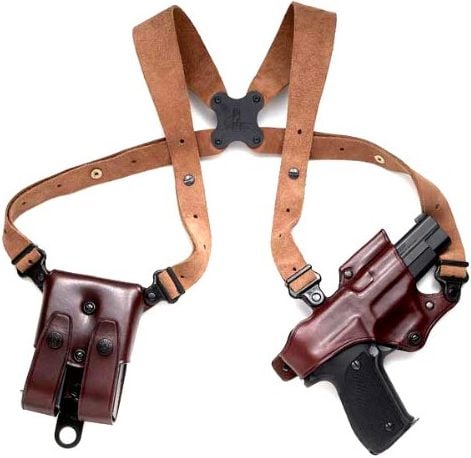
While leather is a popular choice for shoulder holsters, fabric and even Kydex/hybrid ones do exist.

As with anything holster-related, go for one that completely covers the trigger and offers some retention mechanism a la a thumbreak that keeps the gun in place.
You'll also need to decide on whether you want a horizontal, vertical, or angled shoulder holster.
A vertical holster will orient the gun with the muzzle pointed down.

While it can be a slower draw, it does allow you to sport a larger gun.
A horizontal holster, orients the gun horizontally -- meaning the muzzle will point behind you.

These offer a faster draw but, depending on your width, you might be limited to shorter barreled guns.
Finally, an angled holster situates the gun at an angle -- usually a 45 degree upwards position though there are some angled holster that orient the gun at a 35-degree angle downwards.

While this method is also pretty quick to draw from, some might find it difficult to get a good grasp on the gun without compromising safety.

When choosing a holster, make sure to read up on sizing. Not all holsters are created equally. So know your measurements to get the best fit!
2. Gun and Clothing
When working with a shoulder rig, you're going to need to choose your clothes, wisely. As I mentioned, this style relies on a cover garment like jacket or unbuttoned overshirt. But not every cover garment will work.
Personally, I've found that garments that are more fitted/cut closer to the body or made from lighter fabrics, tend to reveal the holster -- more so than looser, less fitted jackets or button-up shirts or those made from heavier fabrics.
You might have to play around with the clothes in your closet to see what prints and what doesn't.

That said, winter coats work really well with shoulder holsters! I have carried more than a few times in a shoulder rig with a heavy Columbia jacket and Glock.
Also, while picking your attire, consider the size of gun you want to conceal.
A larger, full-size gun might work in certain attire but probably won't be your best bet if you're in a slimmer blazer and carrying horizontally.

Again, this is where the good gear concept comes into place. The right gun in the right holster makes all the difference!
3. Practice!
I mentioned earlier that live-fire training might be difficult on a range. Many ranges and classes do not support shoulder carry live-fire drills due to the potential of muzzling fellow range goers.
So, you might be limited in your training. But luckily, you can always dry fire at home!

Put some reps in to work on confidently drawing from a shoulder holster.
Also, make sure to practice in multiple outfits so you know the limitations of each.
Conclusion
Shoulder carry isn't the most popular carry method. Still, it does provide a means to concealed carry if your beltline isn't an option.
Using a cross-draw method and placing the gun under the armpit of the non-dominant side, it only works if you wear a cover garment.

Though it's not how most people choose to EDC, it is an option if nothing else works.
Do you shoulder carry? If so, what’s your holster/gun setup? Let us know in the comments below. If you missed our other CCW articles in this series, no worries. Get spun up on Strong Side Carry, AIWB, Pocket Carry, and Ankle Carry.