
Glock 17 vs Glock 19: Which Glock Is Better?

We test the Glock 19 against its bigger brother, the Glock 17, to see which of these 9mm Glock pistols comes out on top.

Retired LEO. SWAT Commander. POST/NLEFIA/USCCA Instructor. Former FFL. Gun Writer 10+ years
We review products independently. When you buy through links on our site, we may earn a commission to help support our testing. Learn more.
- Quick Look: Glock 17 & 19 Comparison Chart
- Accuracy & Reliability
- Shooting Velocity
- Ergonomics & Handling
- Glock 17 vs Glock 19 Trigger
- Controls Comparison
- Concealed Carry with the Glock 17 vs Glock 19
- History of the Glock 17 & Glock 19
- How We Analyzed the Glock 17 & Glock 19
- The Winner Is...
- Additional Glock Resources
The Glock 17 and Glock 19 are iconic pistols that have been around for almost 40 years, but if you really had to pick, which one should you carry?
We combined a lot of personal experience with a unique range session comparing the two guns to provide you with a definitive answer.
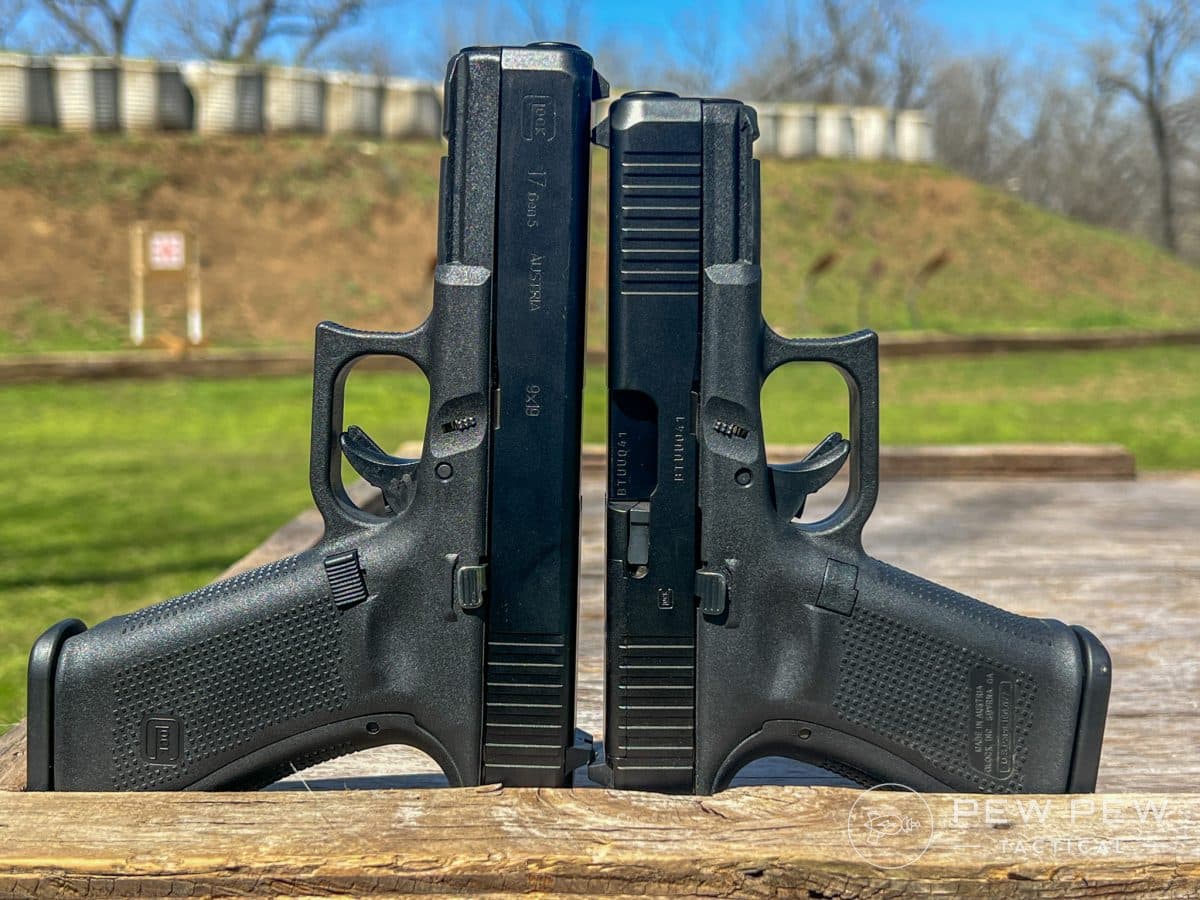
So, let's break down the difference between the G17 and G19 and find the perfect Glock 9mm pistol for you!
Table of Contents
- Quick Look: Glock 17 & 19 Comparison Chart
- Accuracy & Reliability
- Shooting Velocity
- Ergonomics & Handling
- Glock 17 vs Glock 19 Trigger
- Controls Comparison
- Concealed Carry with the Glock 17 vs Glock 19
- History of the Glock 17 & Glock 19
- How We Analyzed the Glock 17 & Glock 19
- The Winner Is...
- Additional Glock Resources
Quick Look: Glock 17 & 19 Comparison Chart
| Glock 17 | Glock 19 | |
|---|---|---|
| Caliber | 9mm | 9mm |
| Action | Semi-auto | Semi-auto |
| Capacity | 17+1 | 15+1 |
| Length | 8.03" | 7.36" |
| Barrel Length | 4.49" | 4.02" |
| Width | 1.0" | 1.0" |
| Height | 5.47" | 5.04" |
| Weight | 24.87 oz. | 23.63 oz. |
| Primary Purpose | Duty/Home Defense | Concealed Carry |
Accuracy & Reliability
I fired 10-shot groups at a paper target from seven yards, using only the iron (plastic) sights to establish accuracy.
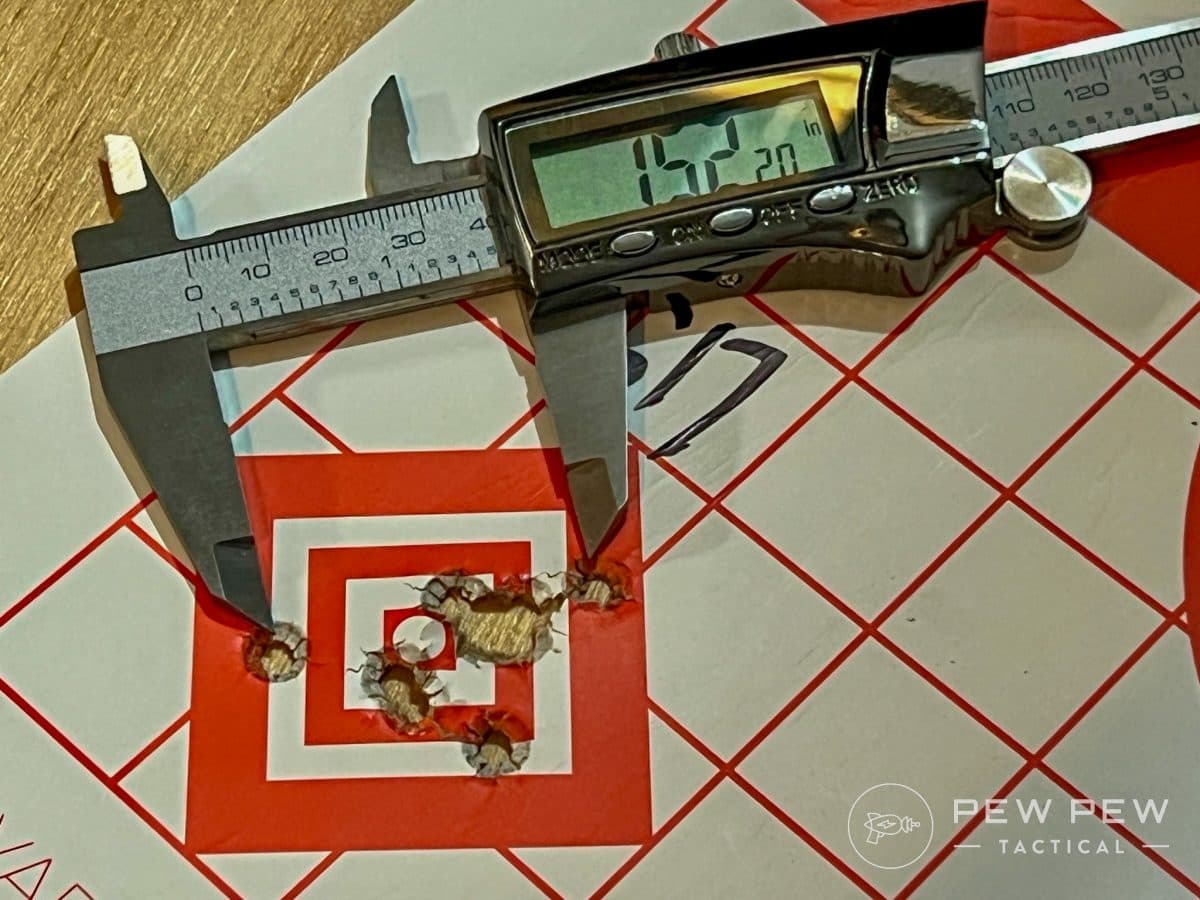
While the G17 has a slightly longer barrel than the G19, this doesn’t make it any more accurate. Taking my time and carefully breaking each shot, I fired ten rounds of AAC 115gr FMJ through each gun.
The results were so close I wasn’t really able to tell with the naked eye so I measured them with calipers. For the G17 all shots were in a group roughly 1.52 inches while the G19 grouped 1.42” inches.
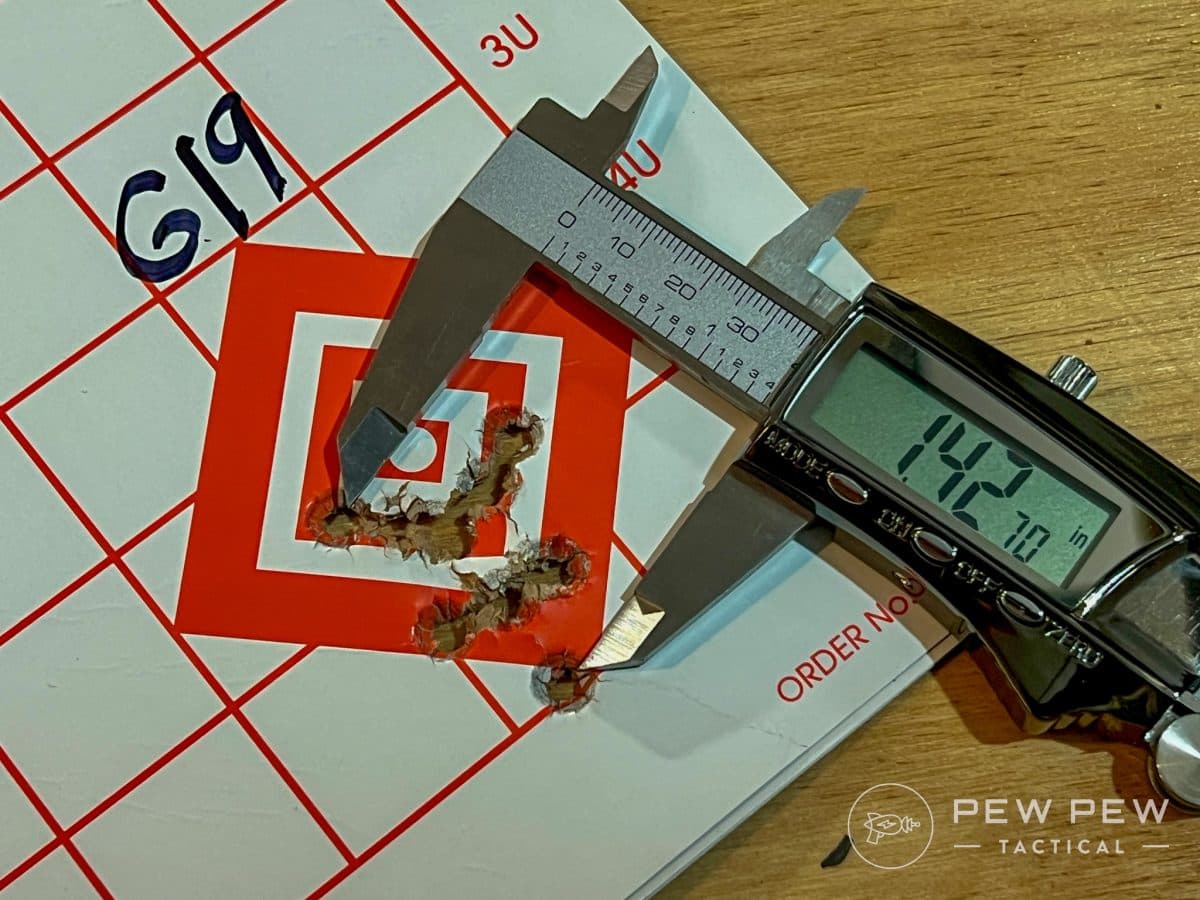
Considering I was the main variable in this equation, I interpreted this result as somewhat of a draw. I could probably shoot this multiple times and share results back and forth between both guns.
Shooting Velocity
One area where a longer barrel actually does make a difference is velocity. The G17 comes with a 4.49-inch barrel, which is 0.47 inches longer than the G19’s 4.02-inch barrel.
I used a Garmin Xero C-1 Pro chronograph to test velocity and fired ten-shot groups of AAC 115gr FMJ to obtain average speeds. With a half-inch barrel length difference, I wasn’t expecting much change.
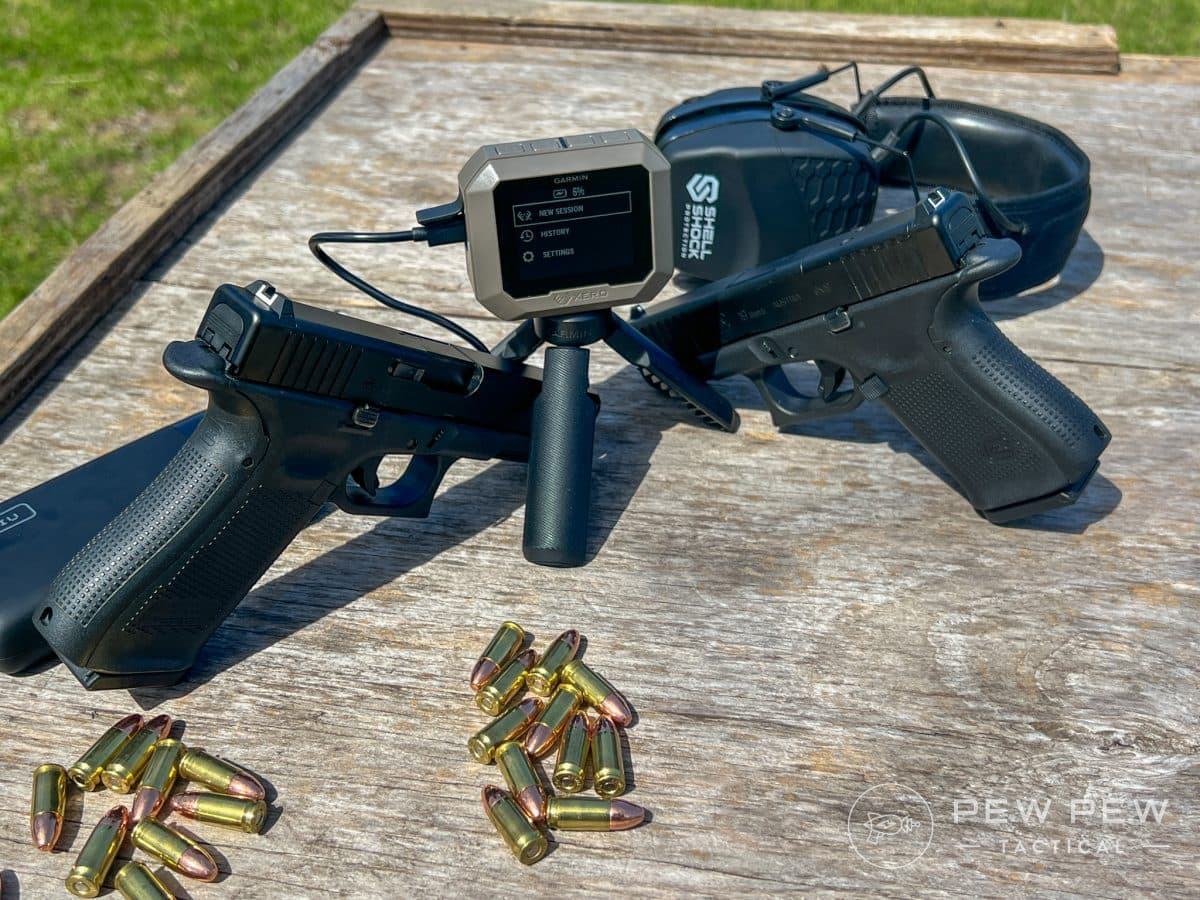
Interestingly, the G17 averaged a speed of 1209.4 FPS compared to the 1133.9 FPS average from the G19. The G17 takes this hands down, but that really isn’t much of a difference.
Ergonomics & Handling
While Glocks are widely known for their reliability, their brick-like shape has often caused people to lament their ergonomics.
While the shape of the slide really doesn’t matter that much, the blockiness of the grip tends to lose some points in ergonomics.

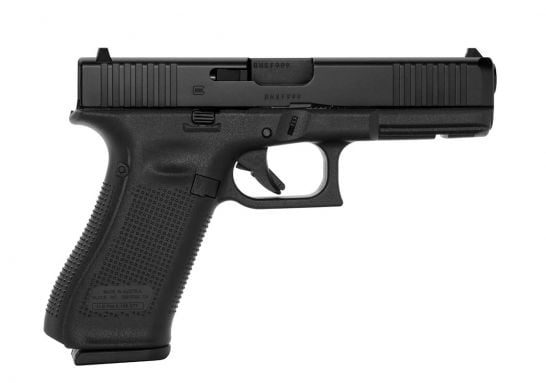
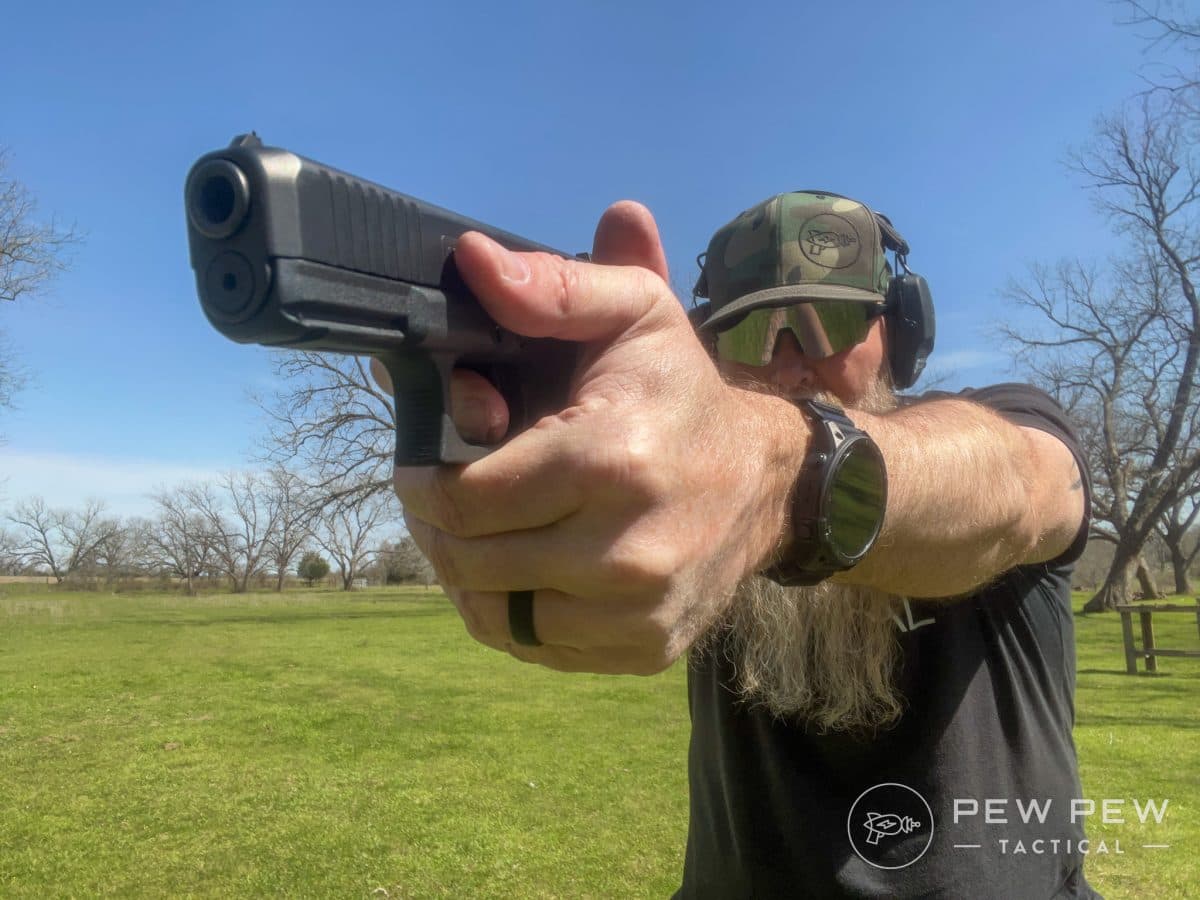
The G17 has a larger overall frame, which allows plenty of room to establish a good grip. In addition, the support hand also has ample room to complete that grip.
In comparison, the G19 has a slightly shorter grip, so the distance between the top of the backstrap and the bottom of the magwell is shorter. While it still fits a wide variety of hand sizes, there is a little less room.
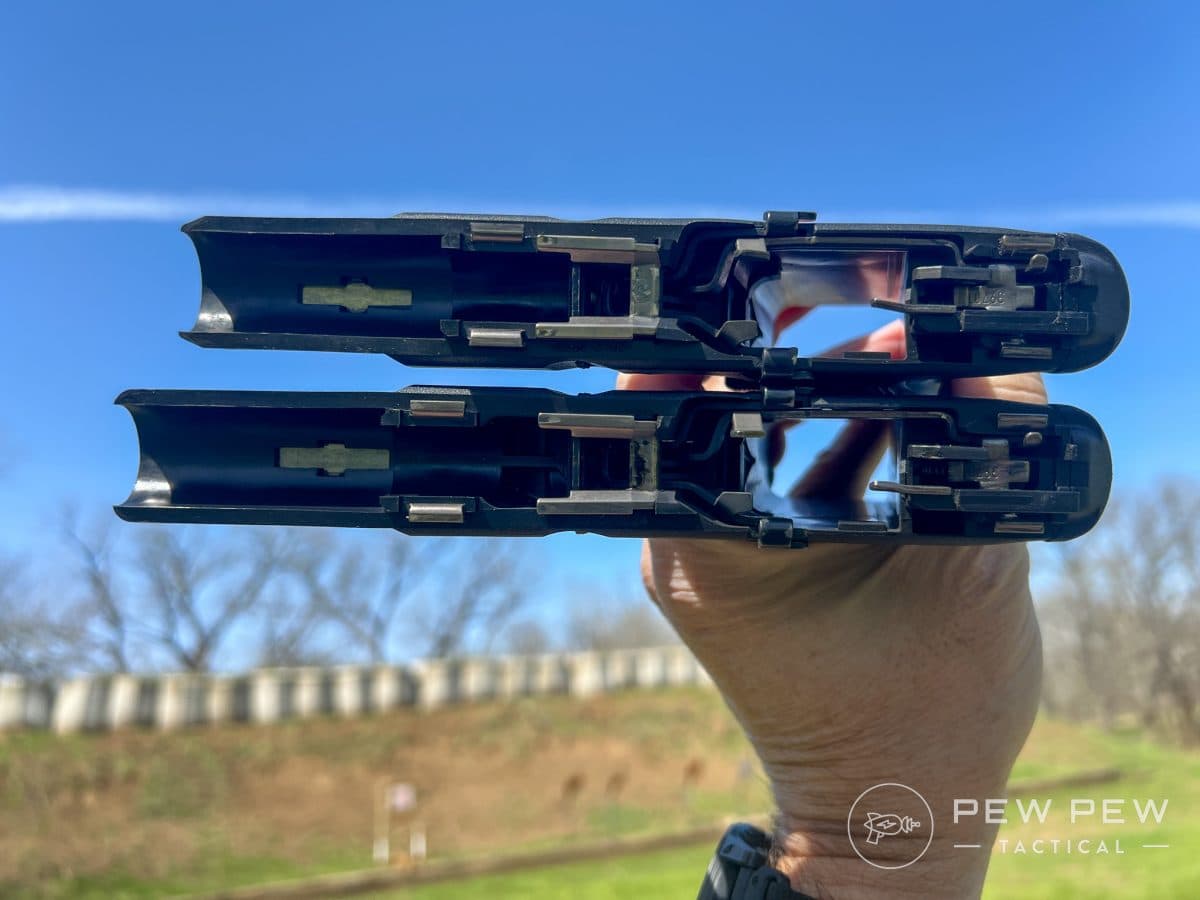
It should be noted that the G17 has a grip that is roughly four inches tall, measuring from where the slide mates to the bottom of the magwell. Conversely, the G19’s measurement is approximately 3.5 inches.
Hand size matters when selecting a G17 or G19 sidearm. Anyone with big mitts should use an extended beavertail to avoid a potentially painful problem.
The shape of Glock’s grip can cause the webbing of the hand to push up over the backstrap. In turn, this allows the back of the slide to strike the hand with each shot — known as slide bite.
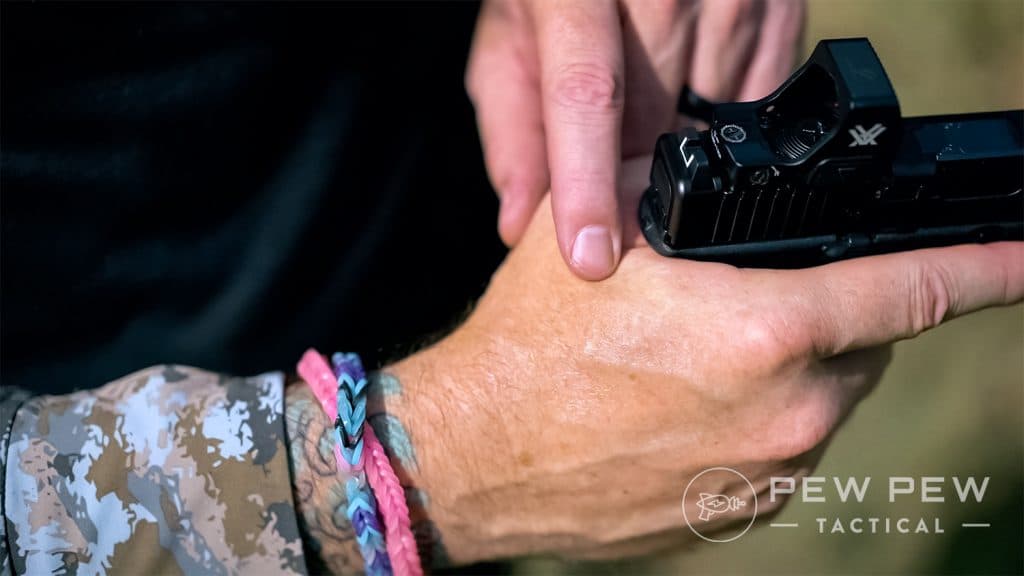
It is a very real issue, though I often hear it discussed as some sort of range myth. I have scars on my right hand from early model Glocks (or Glocks without extended beavertails).
Thankfully, with the fourth generation, Glock introduced several interchangeable backstrap options for various hand sizes. At least two of them included an extended beavertail.

Regardless of hand size, both the G17 and G19 offer serviceable grips, though there are more ergonomic options out there. Either option will work, though the G17 has the advantage of having more room.
Texture on the grips is light, though adequate. A series of raised squares covers all four sides and keeps the Glocks in your hand even when wet.
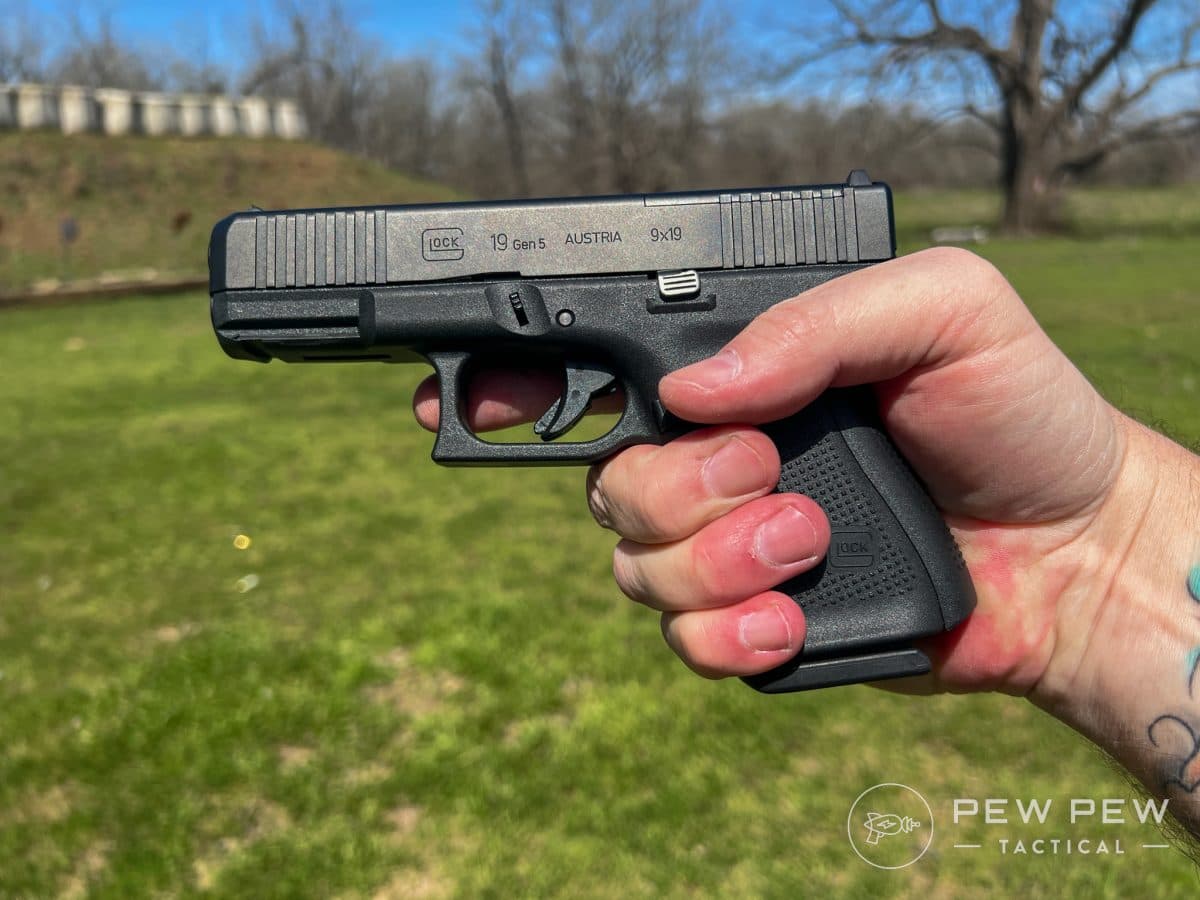
And again, while the overall shape of the grip is blocky, the backstrap is nicely curved and helps lock the gun in with a high grip, as does the undercut on the trigger guard. The curve fits the swell of the palm and is even more substantial with an extended backstrap.
Glock 17 vs Glock 19 Trigger
I’m not going to beat around the bush about Glock triggers; they don’t have a great reputation. That said, the Gen 5 triggers are my favorite -- definitely the best out of the bunch.
(Learn more about the different Glock generations in our guide!)
One of the issues identified with them is a squishy pre-travel up until you hit the wall, followed by a bit more compression before they break. This issue is present in older models, though I feel the Gen 5 has improved.
The actual break is fairly crisp for a striker-fired gun, and the reset is great. I like the audible and tactile nature of the reset on Glocks.

The triggers in the G17 and G19 are the same, so there isn’t much point in comparing these two models in this area. Glock lists their trigger pull weight at 28 Newtons, which converts to 6.29 pounds of force.
Using the Lyman Digital gauge, I measured my test models, and the G19 averaged 5 lbs. 8.4 oz. The G17 averaged 4 lbs. 13 oz. but has a higher round count.
(If you hate the trigger, you can always swap it out for an aftermarket variety. We did some extensive testing on Glock triggers using a Dvorak Trigger Scan unit in our Best Glock Triggers round-up. )

Controls Comparison
Both guns also benefit from an ambidextrous slide stop/release that is a little easier to reach in the Gen5 variants. The last issue to discuss is the magazine release.
Although it’s serviceable, I have to break my master shooting grip to activate the button. I have seen extended mag releases that make this unnecessary, but they sometimes conflict with holsters and can release your mag when you don’t want it.
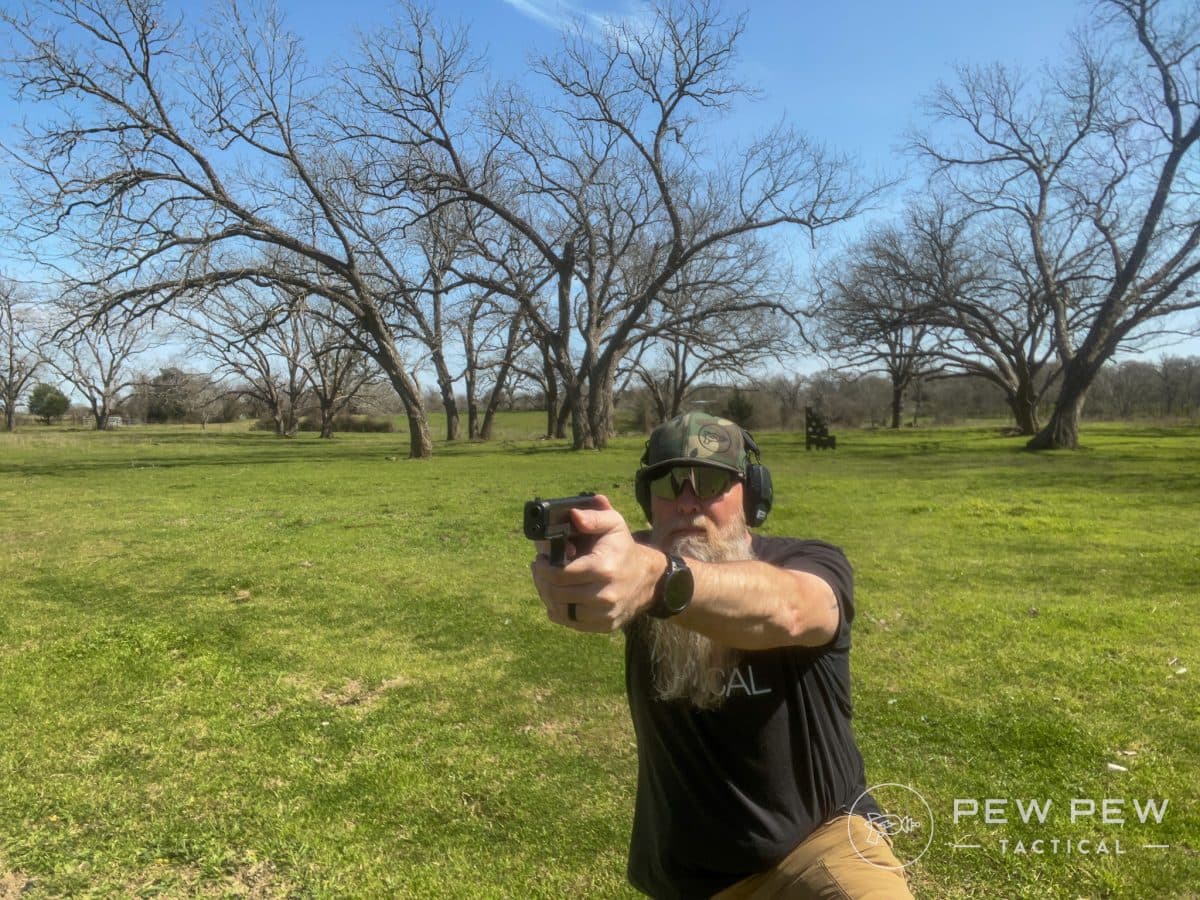
Again, these are the same in both models. Glocks' modularity is a great benefit, particularly to organizations that must field several at a time.
Concealed Carry with the Glock 17 vs Glock 19
Another area I wanted to test was seeing how both guns concealed and how they drew from concealment. To keep things on a relatively even playing field, I mounted a Surefire X300 light to each gun and holstered them.
The holster I used was a PHLster Floodlight. It is designed to index off of the light and isn’t completely reliant on the shape of the gun, so a convenient way to fit both the G17 and G19.
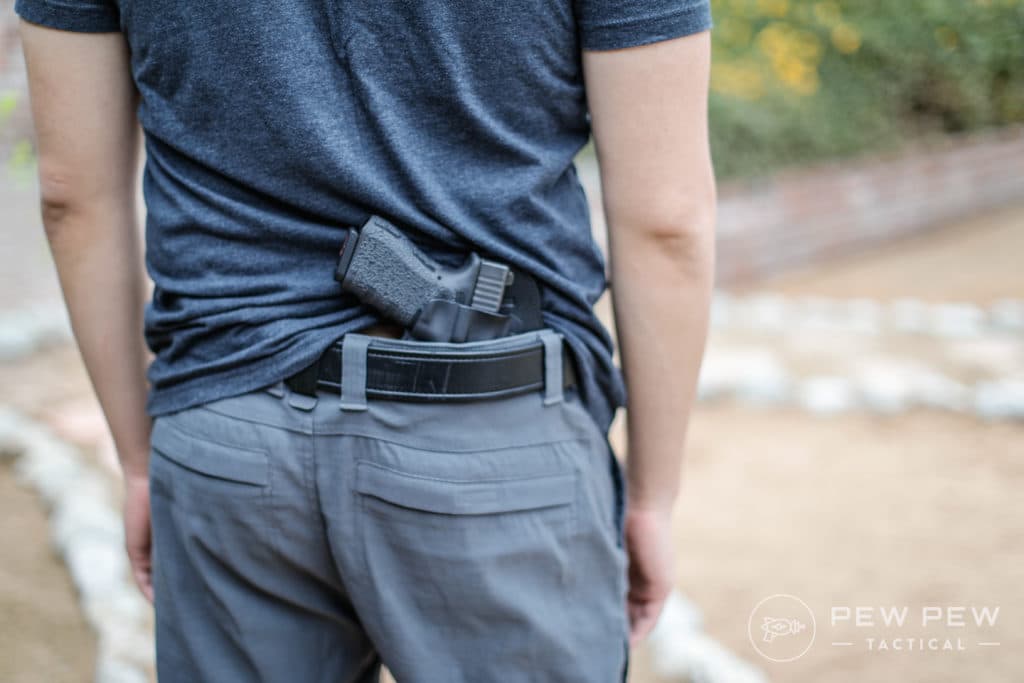
Donning the Floodlight in that AIWB (appendix in waistband) position, I placed the Glock 17 in the holster and draped my t-shirt loosely over it. Against my abdomen, the grip of the G17 felt large and bulky but, surprisingly, didn’t print under my shirt.
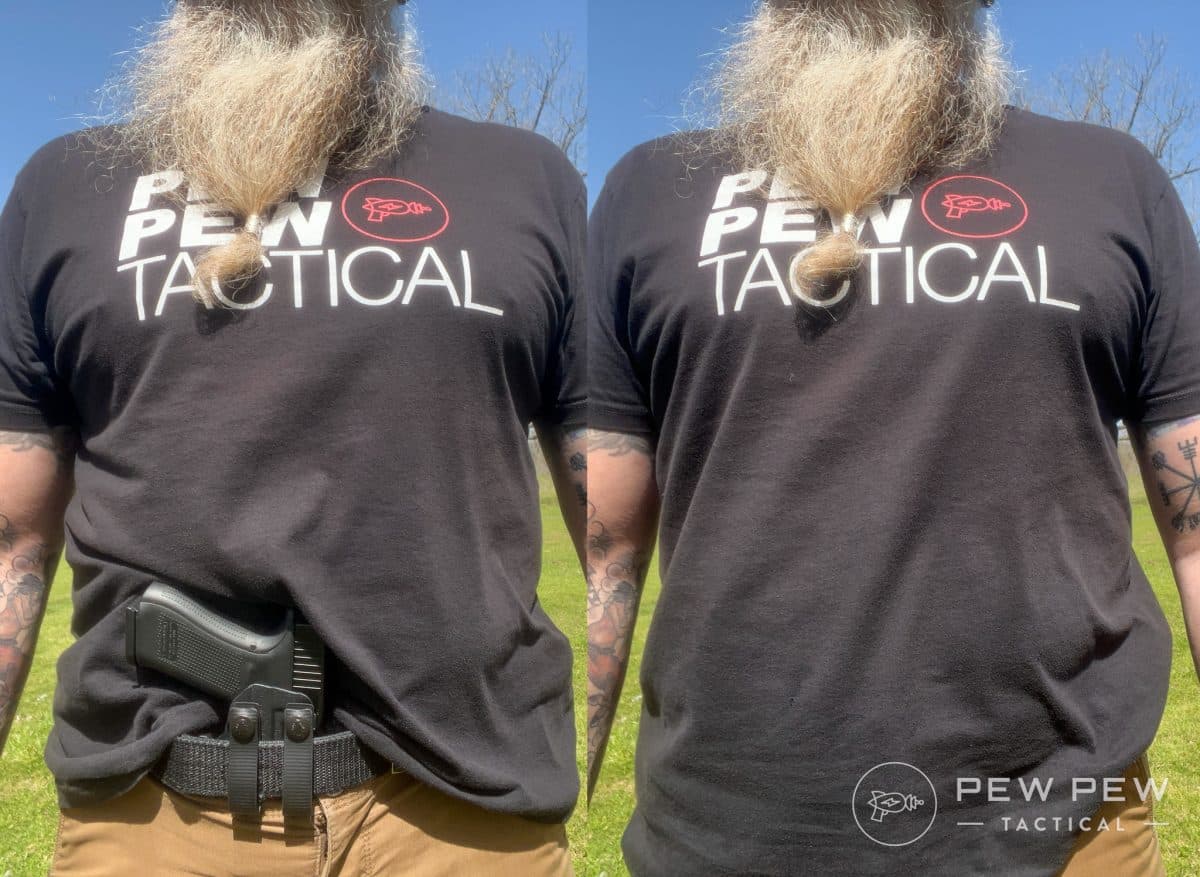
However, while moving around the range, I noticed how bulky the G17 felt. If I twisted it, it printed pretty clearly and was more visible.
In addition, simple movements that I’d take for granted otherwise became more difficult. For instance, bending over to pick something up was challenging as the bulk of the G17 would press into my body painfully.
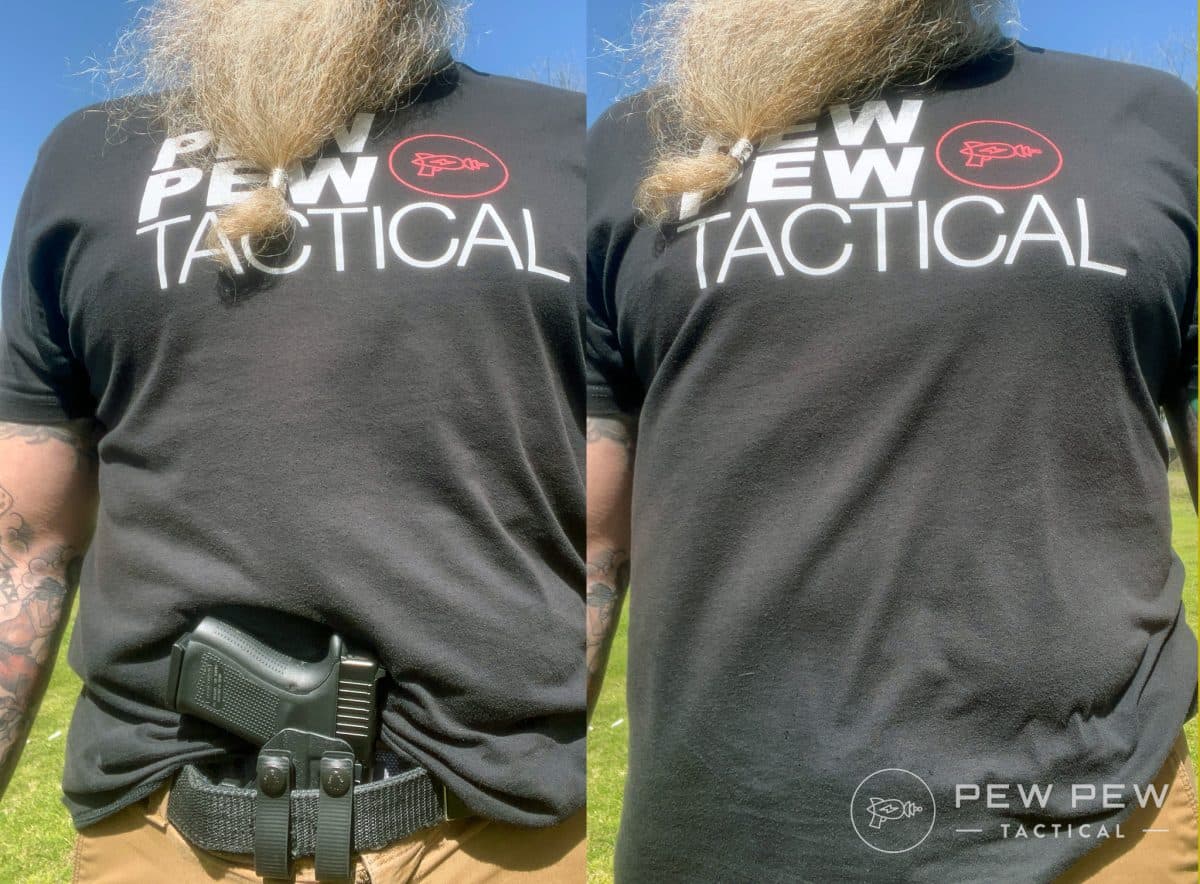
The Glock 19 in the same holster concealed a little better, disappearing under the t-shirt. Even with a twist, it wasn’t as visible thanks to the shorter grip length.
In contrast, moving around with the G19 holstered was a lot more comfortable too. Even though the size isn’t that much different, there was a noticeable increase in comfort and range of movement.
When comparing the draw from the Floodlight, two areas loomed in my mind. I thought the G17 might be easier to grab and establish my master grip, but I reasoned the shorter length of the G19 might make it quicker to present.
The only way to find out was to test, so I loaded up each gun and conducted a series of drills. At seven yards, I drew and fired three rounds from the holster as fast as I could.
Using an SG Timer, I started out fairly slow and began to push myself as my comfort increased. With the G17, my times were just over two seconds on average.
I then switched to the G19 and ran the same drill. Initial times were just under two seconds and even dipped down to 1.72.
Part of me thought the G19 might be faster, but I switched back to the G17 to test another theory. Running at the same pace, my times with the G17 turned out to be around 1.7, too.
In essence, I couldn’t determine a faster draw with either gun. Since I was the variable in the equation, draw and shoot times averaged the same.
While I found the grip of the G17 easier to grab at first, the grip of the G19 wasn’t much different. My hand felt a little more cramped on the G19, but there was still ample space.
History of the Glock 17 & Glock 19
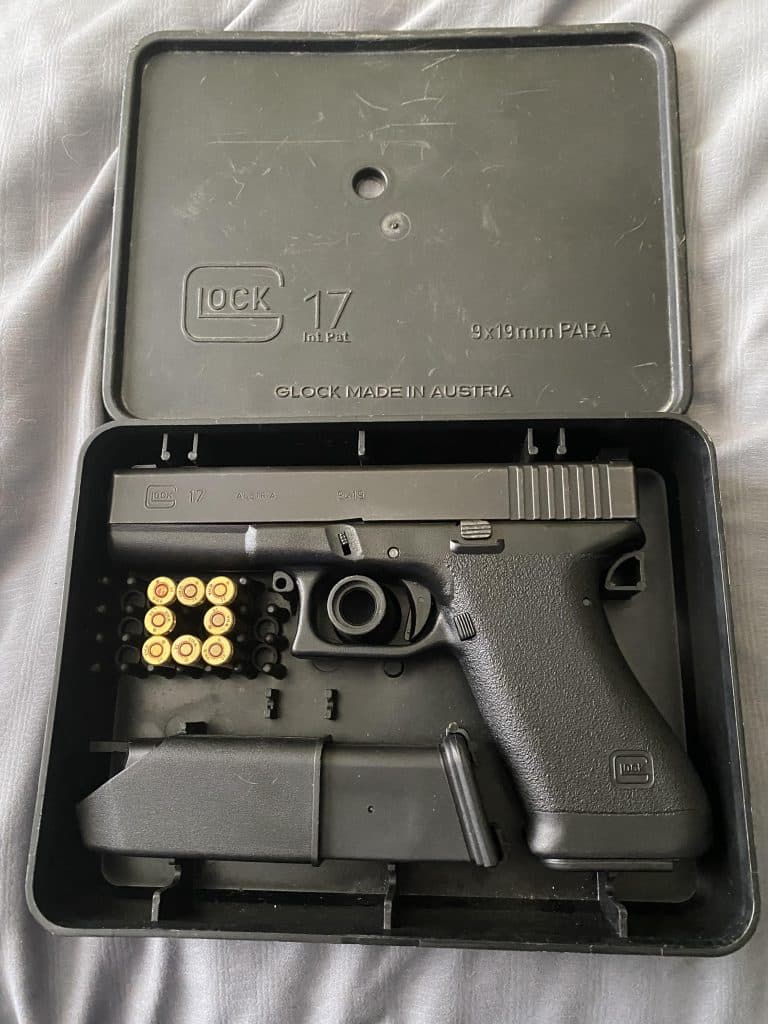
Gaston Glock invented the G17 (named for its patent number, not capacity) in the early 1980s. The plastic fantastic took the Austrian military by storm after surviving a grueling torture test.
Soon after, Austrian police took notice and began to adopt the new wonder gun with a polymer grip.

In the early days, there was actually some drama surrounding Glocks. When they came to America in the mid-1980s, some government agents tried to push the idea they could pass through metal detectors because they were mostly polymer.
These flames were fanned in Die Hard 2 when the main character identified a “Glock 7” made of porcelain that could also pass through metal detectors. All the furor led to the passing of the Undetectable Firearms Act of 1988, requiring guns to have a minimum of 3.7 oz. of metal.

The legislation ensured something that was already happening, and the Glock 7 was a myth. No working Glock could ever pass through a metal detector undetected because the slide and barrel are made of metal.
Despite the borderline lunacy of 1988, Gaston Glock kept trucking and even created a new model, the G19. This slightly scaled-down version of the G17 traded some capacity for a more svelte approach.
Both the G17 and G19 continued to evolve over the following decades, and many new models were added. In fact, there are now five generations of Glocks and over 50 models in different sizes and calibers.
(You can dive more into the history of Glock here!)
The first gun I purchased was a Gen 1 G17 back in the 1990s (I wish I still had that gun). However, I was entering the ranks of law enforcement and would spend much time with Glocks in the ensuing years.
Throughout much of my career, I trusted and used Glocks, either on or off duty—whether my assignment was Patrol, SWAT, or Search and Rescue. Eventually, I became a firearms instructor for my agency and a certified Glock armorer.
All this to say emphatically, I have a lot of experience with Glocks, particularly the G17 and G19. And I definitely have some thoughts on which is the better gun to carry.
How We Analyzed the Glock 17 & Glock 19
For this review, we used a Gen 5 G17 and a Ge n5 G19 MOS. Both guns were reverted to stock configuration.
We utilized standard Glock sights for accuracy and did not use any type of optic. Accuracy was established by shooting 10-round groups at 7 yards using 115 gr AAC 9mm ammo.
We also tested the trigger on both guns with a Lyman Digital Trigger gauge to get an accurate assessment of the actual trigger pull weights.
Additional testing consisted of mounting a Surefire X300 weapon light to each gun and drawing from a PHLster Floodlight carried AIWB for drills. Performance was measured with a Shooters Global SG Timer.
Meet the Experts
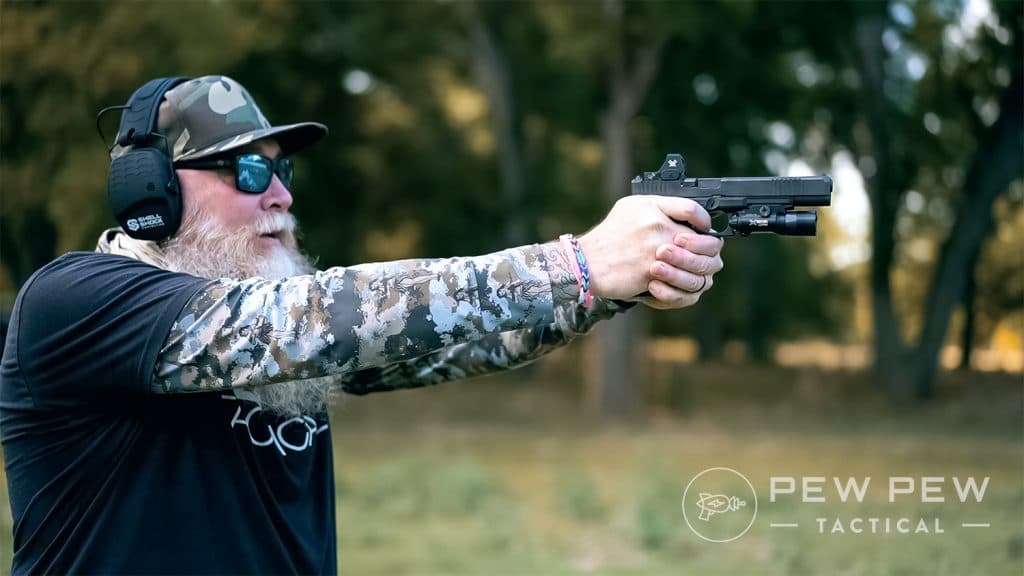
At the helm of this review is Pew Pew Tactical Content Producer Sean Curtis. Sean has been shooting since childhood but really began to delve into guns more during his law enforcement career. He spent over two decades in law enforcement, where he became a POST-certified handgun instructor and NLEFIA Red Dot Instructor and received CLEFIA Advanced Firearms Instructor Training and AR-15 armorer training. He has since attended a variety of training, including Tactical Performance Center Handgun Mastery & Carbine Mastery, and earned USCCA rifle instructor certification. Aside from training and prior to joining the Pew Pew Tactical team full-time, Sean wrote for several gun publications evaluating and testing guns and gear and has written hundreds of articles.
This review was edited and fact-checked by Editor-in-Chief Jacki Billings, who runs Pew Pew Tactical’s experienced team of reviewers. Jacki is a member of the Society of Professional Journalists, ACES: Society for Editing, and the Professional Outdoor Media Association and has her bachelor’s degree in Mass Communications. She has worked as a media professional for close to 20 years, specializing in gun media for almost 10 years, and has worked as an editor for five years. She uses her extensive professional journalism and editing experience to set testing protocols and editorial standards.
The Winner Is...
Sifting through a couple of decades with both guns and focusing my thoughts on the most recent testing, I came up with a few solid conclusions about which gun is better. The results fit categorically with my findings.
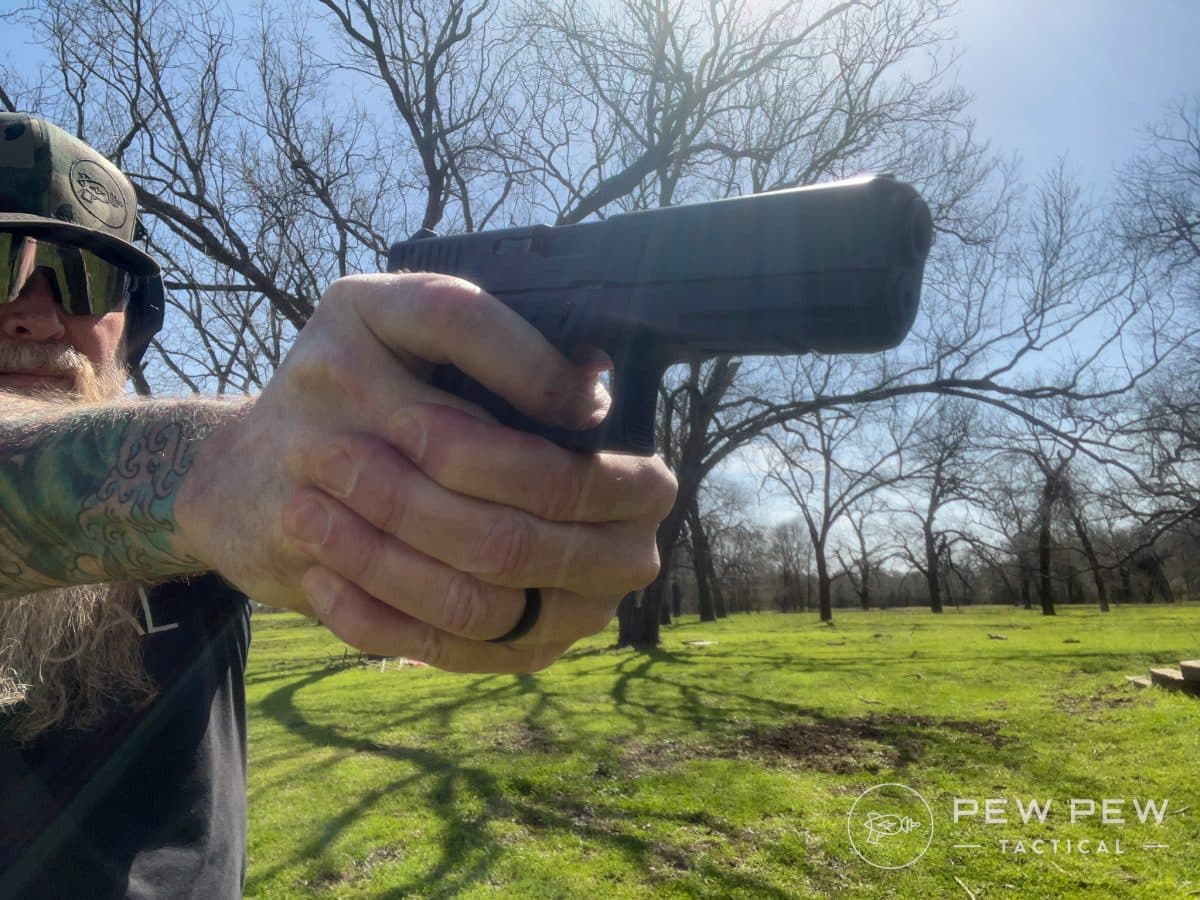
The tests I conducted revealed similar performance between both guns. Accuracy, draw, and velocity were close enough to be negligible, so I weighed other factors.
The Glock 17 has advantages because of its size. The capacity is slightly better and there’s just more room to get both hands on the gun — especially for bigger-handed shooters.
Accordingly, the G17 edges out the G19 for open carry, duty carry, and perhaps even competition. However, the G19 isn’t out of the running.
Undoubtedly, the Glock 19 is easier to conceal and is more comfortable to wear while doing so. Despite losing a couple of rounds of capacity, the tradeoff is well worth it to the concealed carrier.
The G19 is small enough that it’s more comfortable to wear, but it is still big enough to be an effective pistol for defense. Plus, you can probably still tie your shoes while concealing one.
Both guns can serve in either role and make great home defenders, but each shines in its respective categories.
Additional Glock Resources
We have even more Glock goodness in the articles below!
- Glock 19: 3,500+ Round Review
- Glock 17 Review
- Best Glocks
- Best Glocks for Concealed Carry
- Best Glock Magazines
- Best Glock Upgrades
- Best Glock Triggers
- Best Glock 19 Sights
- Best Glock 19 Holsters
Which do you think is better - the Glock 19 or Glock 17? Or is there another Glock that catches your eye? Let us know in the comments below!