
Best Pistol Red Dot Sights [Real-Views + Video]

Looking for the best red dot for your pistol? We cover the most popular models and their pros/cons, slide compatibility, and bang-for-the-buck-ness.

PPT Editor. Marine vet, hunter, and long-range shooter. Articles in 10+ major publications
We review products independently. When you buy through links on our site, we may earn a commission to help support our testing. Learn more.
If you’re not running a red dot on your pistol, you’re missing out! The performance advantages are real, and you have hundreds of options to choose from.
But with so many brands, open and closed emitters, and mounting footprints, how do you know which one to buy?
We narrowed the list down to our absolute favorites, then tested them to see where each one excels.
These, my friends, are the best pistol red dots available right now.
The Quick List
- Best CCW: Holosun EPS CarryJump to details ↓
- Best Budget CCW: Primary Arms Classic Micro Red DotJump to details ↓
- Best Duty: Trijicon RMR Type 2Jump to details ↓
- Best Budget Full-Size: Primary Arms GLx RS-15Jump to details ↓
- Best Enclosed Emitter: Trijicon RCRJump to details ↓
- Best for Competition: Vortex Defender-XLJump to details ↓
- Best Solar: Holosun 507C X2Jump to details ↓
Table of Contents
Pistol Red Dot Comparison Chart
| Emitter | Reticle (As Tested) | Window | Footprint | Price | |
|---|---|---|---|---|---|
| Holosun 507C X2 | Open | Green multi-reticle | 0.91" x 0.63" | RMR | $309 |
| Holosun EPS Carry | Enclosed | Red multi-reditlce | 0.77" x 0.58" | RMSc | $329 |
| Primary Arms Classic Micro | Open | Red 3-MOA dot | 0.83" x 0.59" | RMSc | $149 |
| Primary Arms GLx RS-15 | Open | Red ACSS Vulcan | 1.02" x 0.79" | C-More | $222 |
| Trijicon RCR | Enclosed | Red 3.25-MOA dot | 0.88" x 0.64" | RMR | $645 |
| Trijicon RMR | Open | Green 3.25-MOA dot | 0.87" x 0.63" | RMR | $519 |
| Vortex Defender-XL | Open | Red 3-MOA dot | 1" x 0.92 | DeltaPoint Pro | $399 |
How We Tested the Best Pistol Red Dots
Our search started with a brainstorming session with the staff here at Pew Pew Tactical. Together, we’ve spent countless hours using all kinds of pistol red dots. That experience informed our selections.

Testing included the following:
- Mounting: You’re responsible for installing your red dot, so we evaluated how easy each manufacturer made that process. Priorities included the necessary hardware, clear instructions with torque specs, availability of adapter plates.
- Optical Quality: Accuracy requires a clear view of the target, so we lined up each optic in front of a visual effects grid to check for distortion, discoloration, and clarity. I checked for parallax effect at 25 yards.
- Brightness: I cycled through settings manually, and checked automatic settings in daylight and in the dark. When available, I also tested automatic modes for brightness and reaction time – with some pretty interesting results!
- Waterproofing: I submerged all red dots except for the Trijicon RMR and Primary Arms Classic Micro for 10 minutes. Those two use exposed battery compartments that are not watertight until the optic is mounted.
- Drop Test: After establishing zero, I dropped each optic from waist height with an unloaded pistol, checked for damage, and re-shot the target to check for zero-shift.
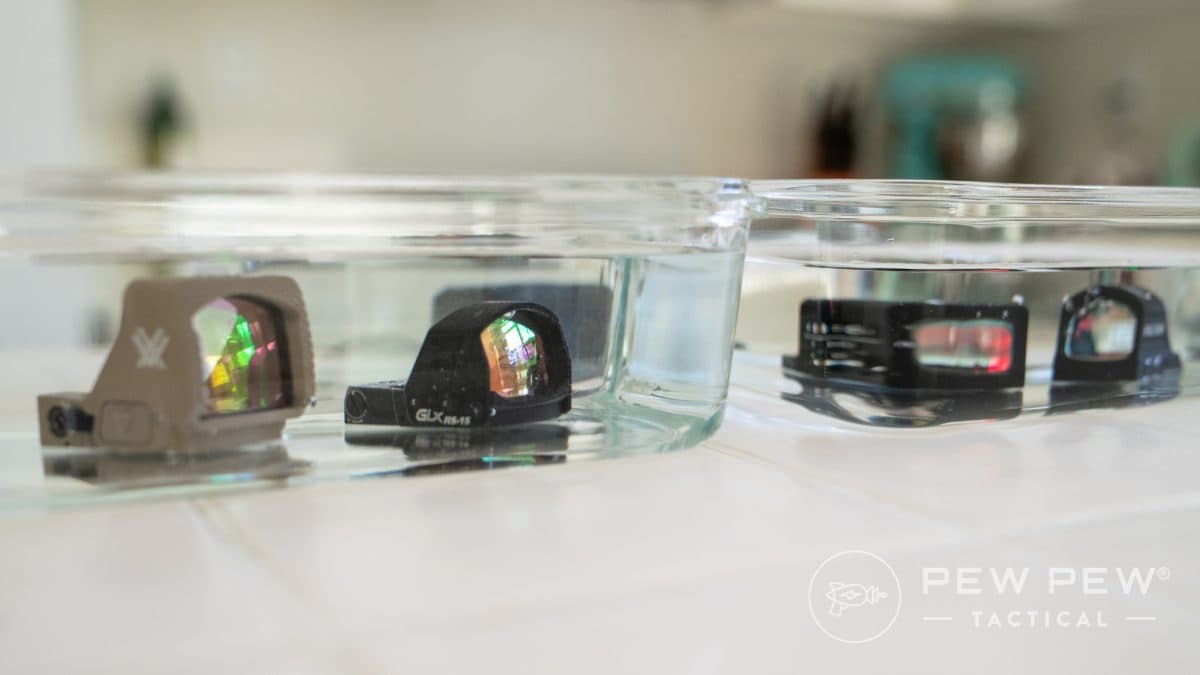
Of course, I also have some comments on what it’s like to shoot with these red dots.
In some cases, the red dots you see here are available with different reticles, in different sizes, and in multiple colors. I made note of those, so you know your options.
I also included a few alternate picks when the competition was especially tight. Sometimes, choosing the best pistol red dot comes down to personal preference.
Best Pistol Red Dots
1. Holosun EPS Carry - Best CCW
Pros
- Surprisingly compact for an enclosed emitter
- Solar power extends battery life
- Very rugged and well-built
Cons
- Sometimes confusing mounting footprint
- Laggy auto-brightness
Specs
- Emitter: Enclosed
- Reticles: 6-MOA red dot, red multi-reticle, 6-MOA green dot, green multi-reticle
- Brightness Settings: 8 daylight, 4 night vision
- Auto On/Off: Yes
- Adjustment: 1 MOA
- Window: 0.77" x 0.58"
- Footprint: Holosun K
- Battery: CR1620
- Country of Origin: Malaysia
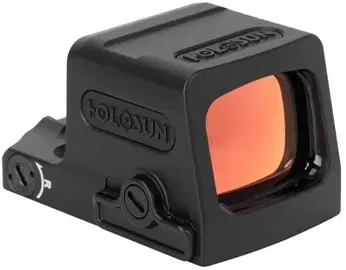
Yep, I’m going back to the tried and true Holosun EPS Carry for this one. This well-rounded pistol red dot has a multi-reticle, solar power, solid durability, and I’m still not sure how they made an enclosed emitter red dot fit a concealed carry pistol this well.
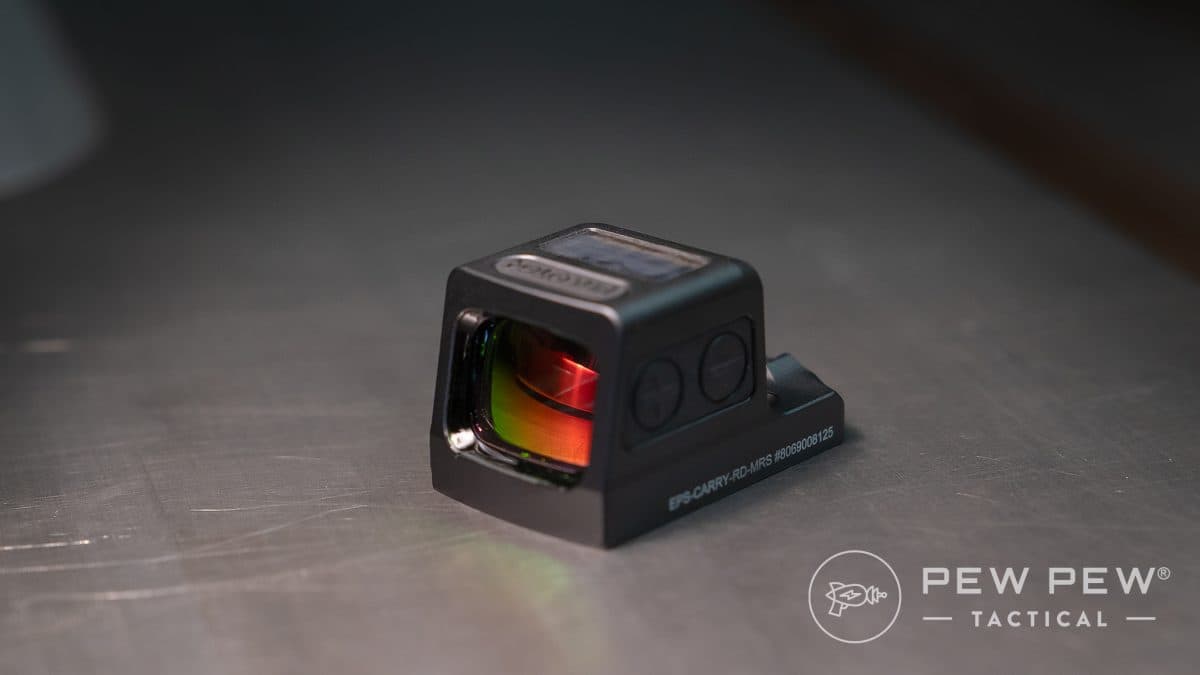
Holosun provides clear instructions and torque specs in the owner’s manual. The EPS Carry includes three sets of screws with blue thread-locker already applied.
Holosun’s K footprint is very similar to the RMSc, but they’re not completely interchangeable, and the included RMSc adapter plate won’t work with slides that have recoil lugs. If that’s the case, as with the Springfield Hellcat Pro from this test, you’ll need a different plate like this one from C&H Precision.
The hardware is labeled, but the writing is extremely small and difficult to read. The instructions don’t specify which screws are for which pistols, so you’re going to have to do some trial and error, torquing the correct screws to 15 inch-pounds per the manual.
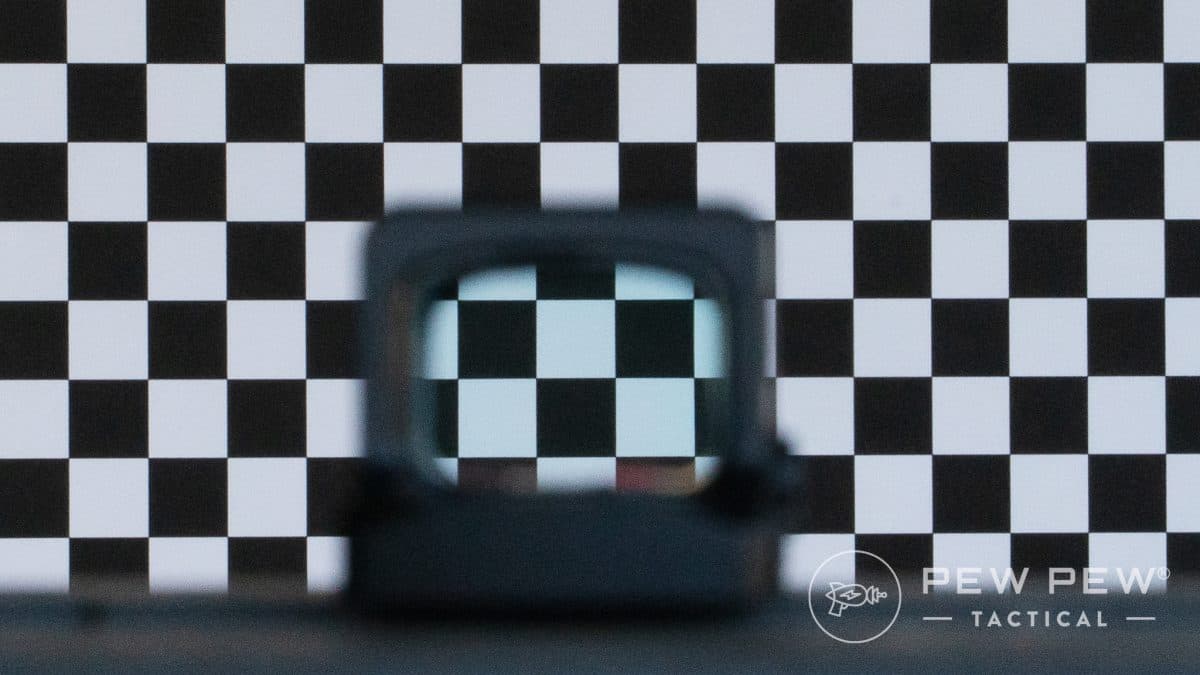
The view through the EPS Carry’s window is clear and bright. You might notice a very slight blue tint and no distortion around the edges. This is a relatively tiny optic – especially for an enclosed emitter – but the window doesn’t seem small when looking through it. Holosun did a great job of maximizing the amount of glass that fits in the optic’s frame.
The 12 brightness settings span from invisible without night vision to blazing bright. Eight are intended for daylight, and I find that to be kind of a sweet spot. More than that, and you’ll struggle to notice a difference without tapping through multiple settings. Fewer than that, and you might be left wanting something in between two settings.
There are three brightness modes: automatic, manual, and lockout. Manual leaves it up to you, and lockout prevents accidental changes; that’s simple enough. The auto setting warrants some forethought.
The optic’s solar panel functions as the sensor, which provides rapid adjustments in response to changes in overhead lighting. What it doesn’t account for is the lighting in front of the optic. If you activate a pistol light in a dark room, the reticle is going to get washed out.
The side-by-side buttons are large enough that I didn’t have trouble finding them by feel and discerning which was which. They have a satisfying click to them.
An enclosed emitter should be unfazed by water, and the EPS Carry held up its end of the bargain. A 10-minute bath left no lingering effects, and the reticle remained clearly visible the whole time the optic was underwater.
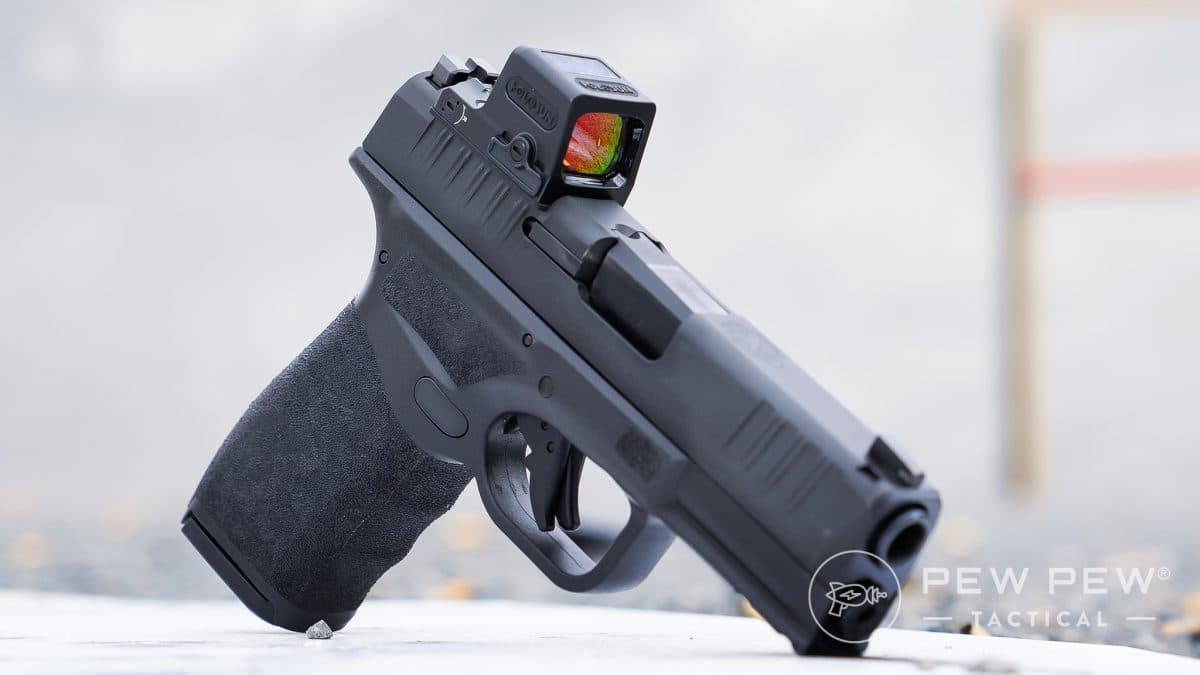
Shooting with the EPS Carry is intuitive and easy. The auto-brightness setting might not be ideal from a tactical standpoint, but it sure is handy on the range. Manually changing reticles on the fly is as easy as holding down the minus button. I didn’t observe any parallax effect with the EPS Carry.
The housing is small enough that I never had an issue with it snagging on my shirt during the draw stroke. I think the edges are rounded just enough that clothing slides off rather than getting caught.
The drop test – a particularly gnarly direct hit on solid steel – resulted in a few superficial dings. There were times later in the day that I thought shots might be drifting right, but that was inconsistent so I suspect the blame lies with me, not the optic.
The EPS carry is available with a 2-MOA red dot, 6-MOA red dot, red multi-reticle, 2-MOA green dot, 6-MOA green dot, and green multi-reticle. Only multi-reticle optics feature solar power.
Holosun also offers the standard EPS with the same reticle and solar options for full-size pistols.
Get the whole scoop in our Holosun EPS Carry review!
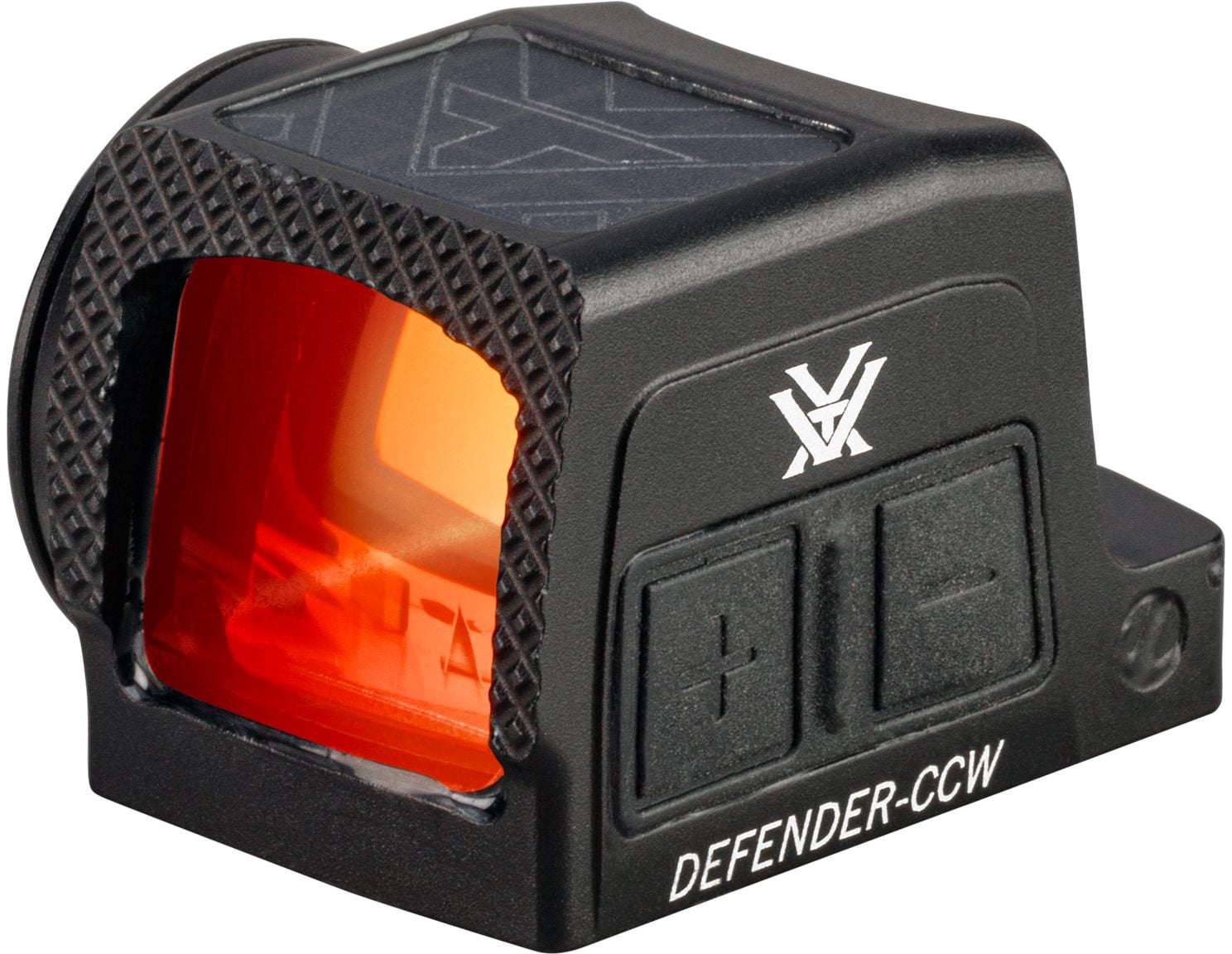
Want an alternate pick? Check out the brand-new Vortex Defender-CCW and Defender-ST enclosed emitter red dots. The Defender-CCW is a little larger than the EPS Carry, but I used it for about a month and really liked it.
2. Primary Arms Classic Micro - Best Budget CCW
Pros
- Super compact and lightweight
- Quality view through the glass
- Save your money for training ammo
Cons
- Instructions lack detail and torque values
- Must be removed to replace the battery
Specs
- Emitter: Open
- Reticles: 3-MOA red dot, 3-MOA green dot
- Brightness Settings: 10 daylight
- Auto On/Off: Yes
- Adjustment: 1 MOA
- Window: 0.83” x 0.59”
- Footprint: RMSc
- Battery: CR2032
- Country of Origin: China
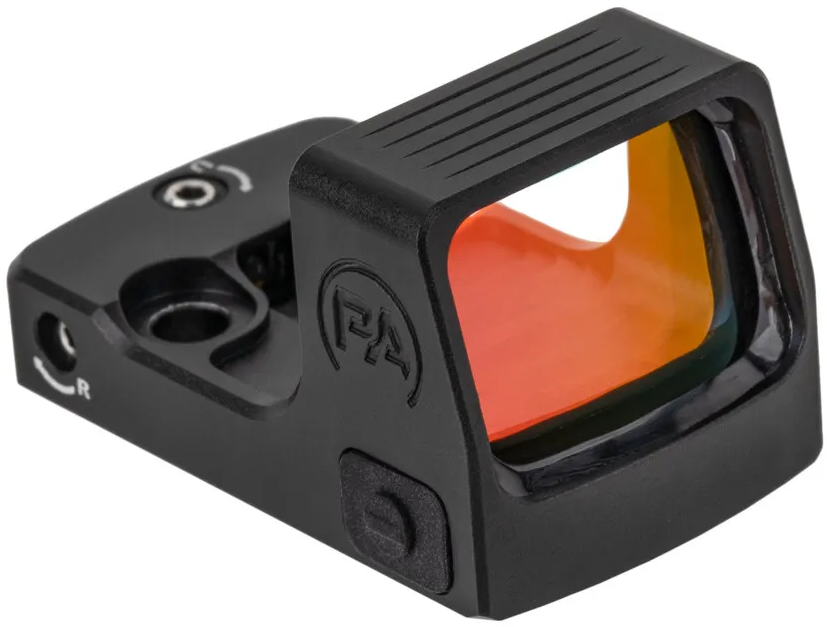
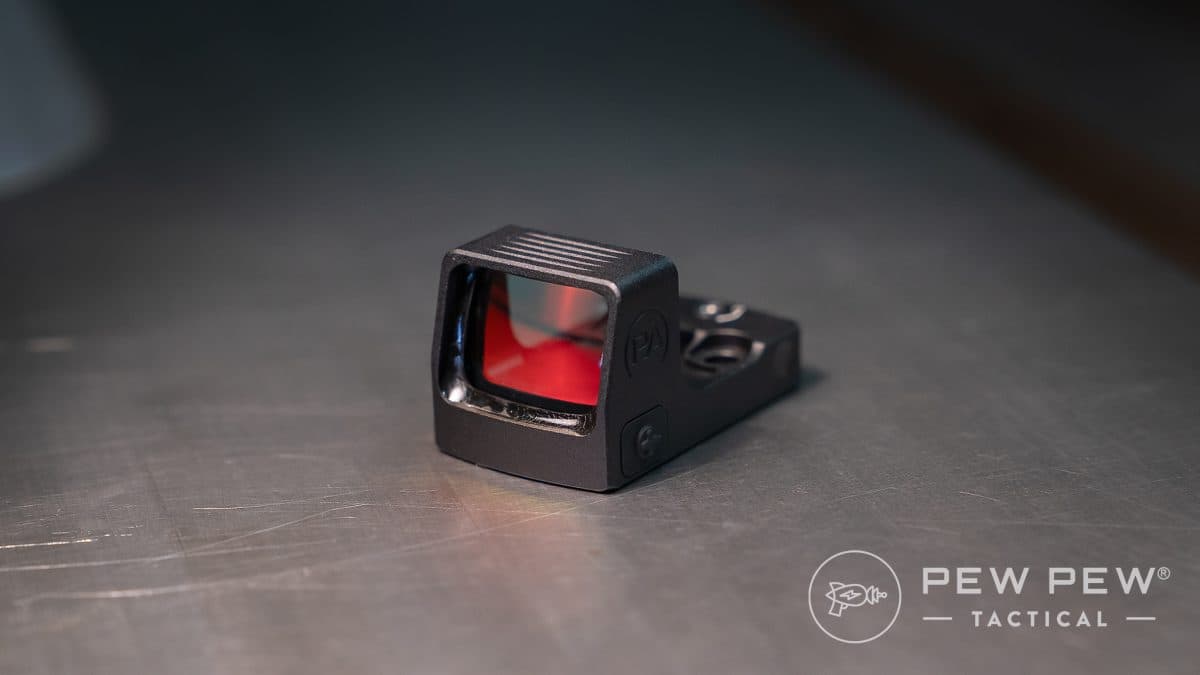
The Primary Arms Classic Micro keeps things simple. It’s lightweight, adds almost no bulk to a concealed carry pistol, and doesn’t break the bank. If you’re not hard on your optics, this one is worth a look.
Primary Arms ships this red dot with three sets of screws – all individually bagged, clearly labeled, and treated with blue thread-locker. The manual doesn’t offer guidance about compatible pistols, though, so you’ll have to figure that out on your own. No torque value is specified in the manual but I found it on the Primary Arms website (in this case, 12 to 15 inch-pounds).
I appreciate the rubber optic cover that comes with this red dot. I like to use those to keep fingerprints and oil off the window when I’m cleaning a pistol. Lots of more expensive optics don’t come with one, so it’s worth a mention.
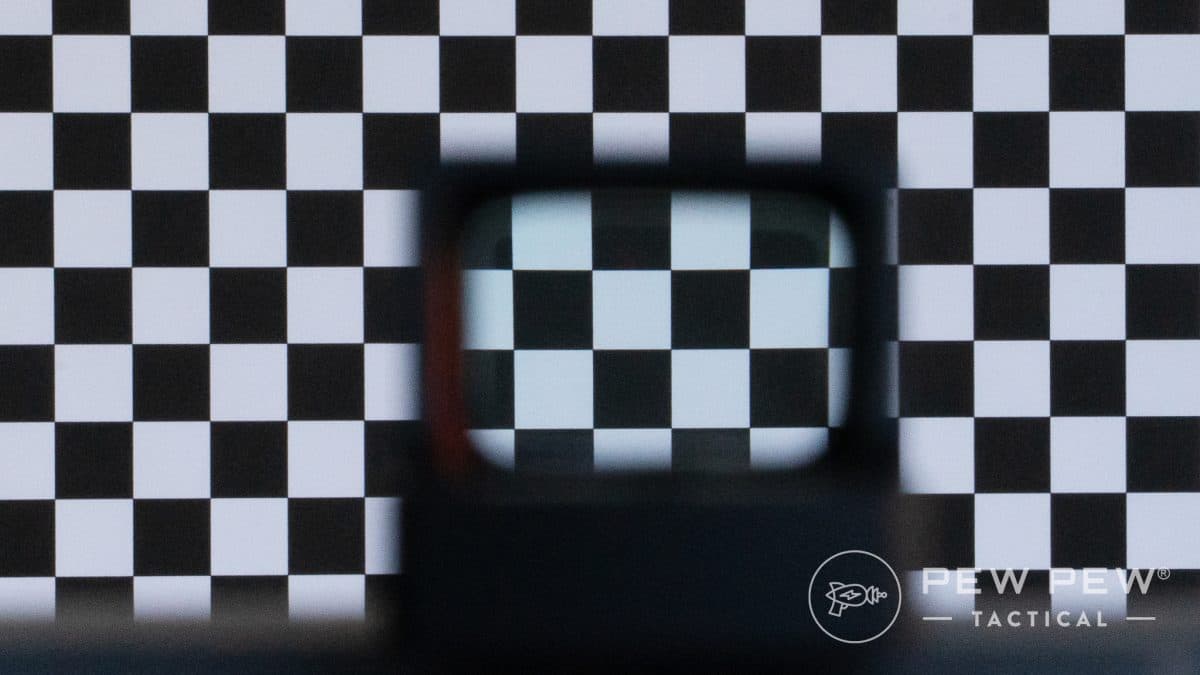
I’m pleasantly surprised by how good the glass is on this optic, given the entry-level price. There’s no discernible tint or distortion. I’d expect a tradeoff in battery run time from glass without any tint, but that doesn’t seem to be the case. You just get more than you pay for this time.
All 10 of this red dot’s brightness settings are daylight bright. That’s really not an issue unless you’re using night vision, and people who run night vision aren’t shopping for a $150 optic.
It’s not the sharpest, most defined red dot, but it’s not fuzzy. Once again, you get more than you pay for.
The buttons are very small, but at least there’s one on each side, so you know which is which.
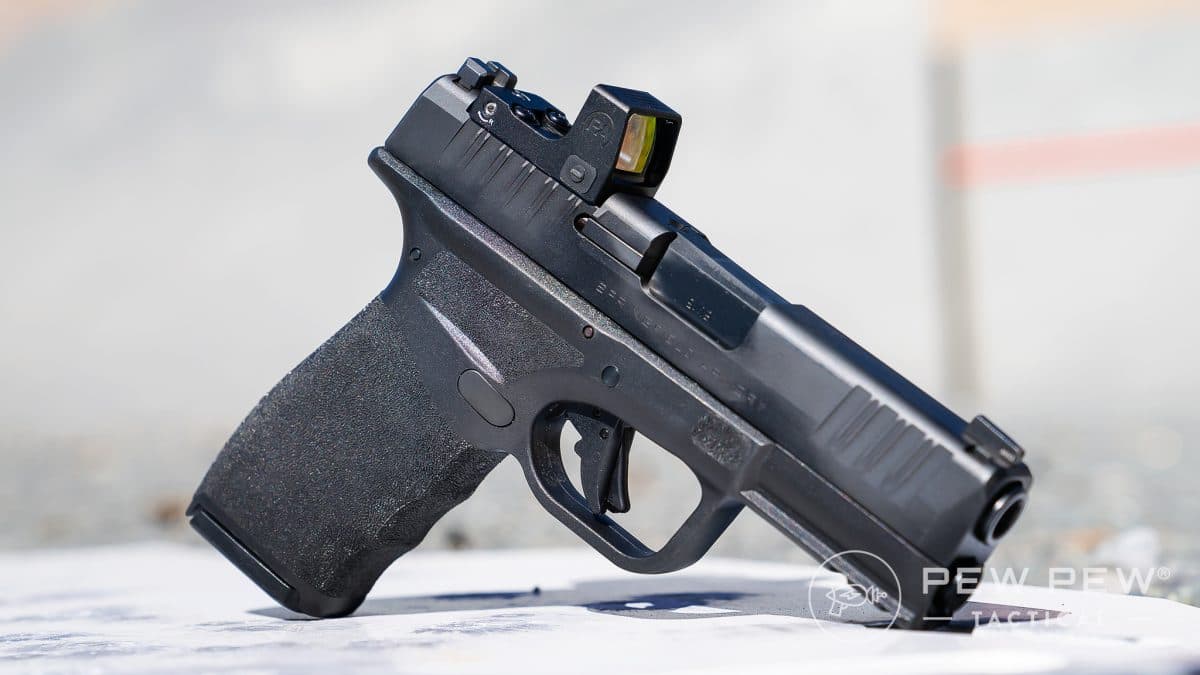
Don't forget the tiny Allen key that comes with this optic when you go to the range -- you'll need it to set zero. The turrets turn smoothly with no audible or tactile feedback so making adjustments takes a little bit of guesswork.
More so than any other optic in this test, the metal housing vanished to my eyes on the range. It’s so thin that all I saw was the range, my target, and a bright red dot. It’s about as close to running irons as you can get with a pistol red dot.
If I’m being transparent, I thought this little guy was a goner when it came time for the drop test. Nevertheless, the little red dot that could held up to the abuse and didn’t even exhibit zero shift.
I wouldn’t go so far as to call this a duty optic, but it’s not exactly fragile. This is a viable option for people who want to upgrade their carry gun on a budget.
We have a Primary Arms Classic Micro review if you want to know more.
What do you think of the Primary Ars Classic Micro? Rate it below!
Readers’ Ratings
4.98/5 (3623 Votes)Your Rating
3. Trijicon RMR Type 2 Adjustable - Best Duty
Pros
- Nearly ideal blend of durability and price
- Now available with a red or green reticle
- Mounting plates are widely available
Cons
- Strong blue tint and some visible distortion
- Requires removal to replace the battery
Specs
- Emitter: Open
- Reticles: 1-MOA, 3.25-MOA, 6.5-MOA red dot, 3.25-MOA green not
- Brightness Settings: 6 daylight, 2 night vision
- Auto On/Off: Defaults to auto brightness after 16.5 hours
- Adjustment: 1 MOA
- Window: 0.87” x 0.63”
- Footprint: RMR
- Battery: CR2032
- Country of Origin: USA
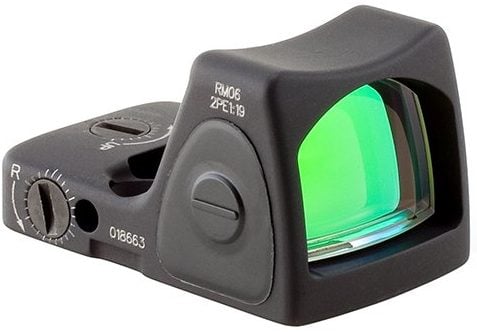
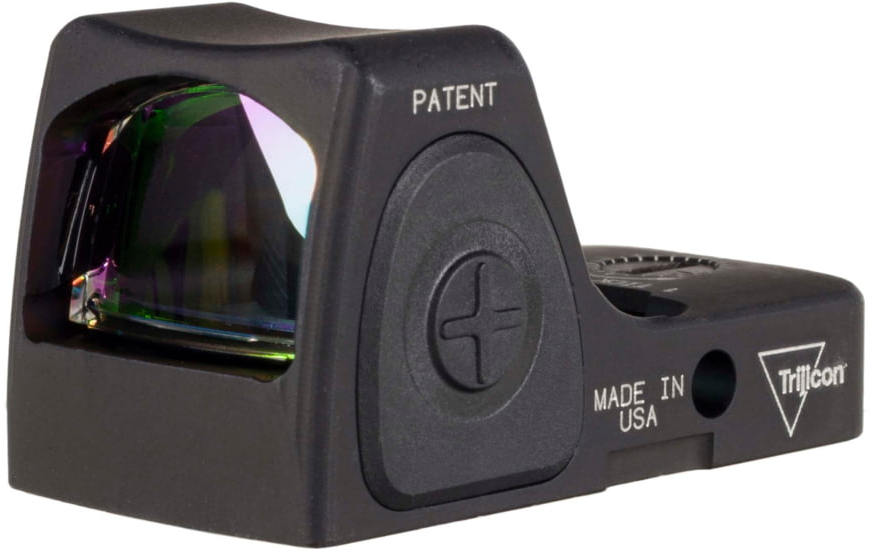
The RCR might be the valedictorian of the school of hard knocks, but the more affordable Trijicon RMR Type 2 Adjustable is still my favorite duty optic. It’s nearly indestructible, the view looks a little better because the housing is smaller, and now you have the option to get a green reticle.
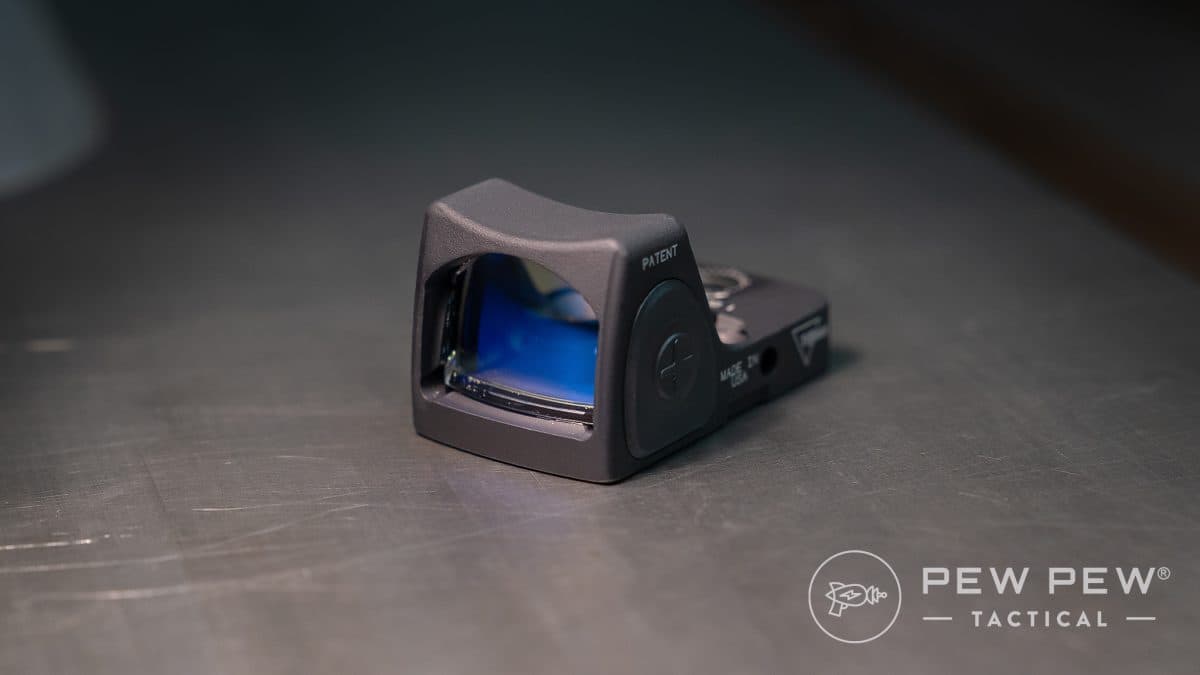
Mounting the RMR is convenient because it’s such a common footprint. Trijicon includes one set of screws for the Glock MOS system, and another for everything else. A torque spec of 15 inch-pounds is in the owner’s manual.
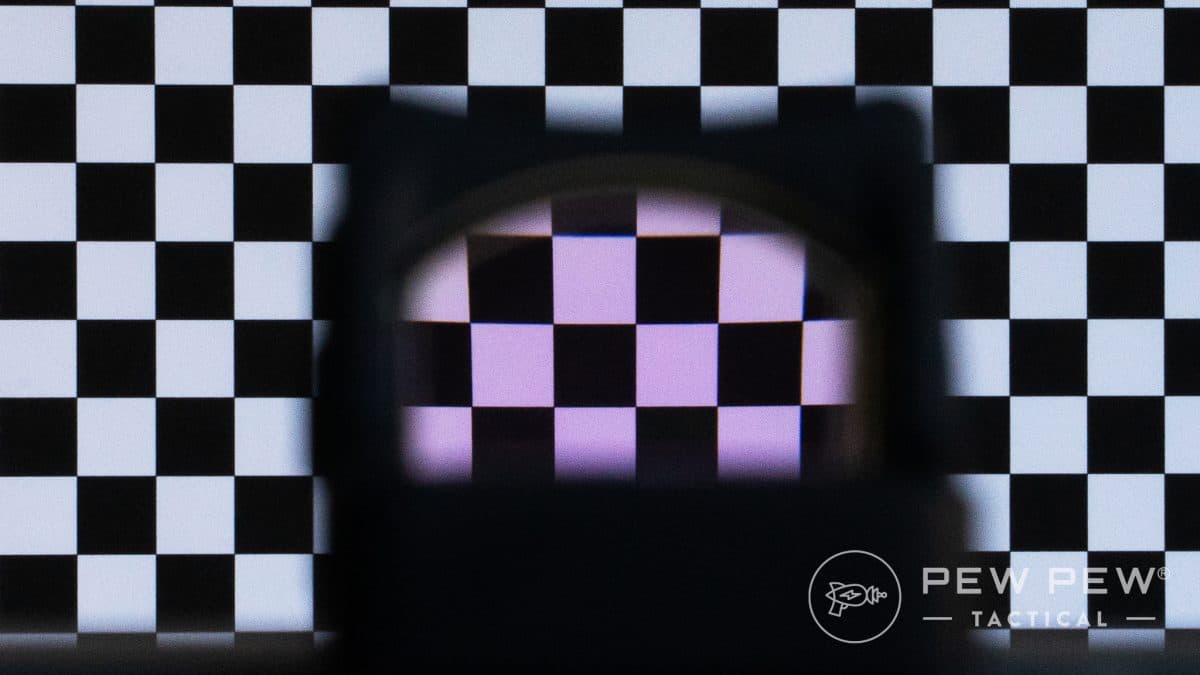
I don’t think the RMR ever won any awards for optical clarity, and I’m not going to break that streak. This glass is Barney purple with a noticeable fisheye effect around the edges. It appears to be ever so slightly magnified, as well.
As with the RCR, you’ll have to decide if you want Mercedes S-class optical quality or Toyota Corolla reliability.
The RMR has even fewer brightness settings than the RCR: six for daylight and two for night vision. It’s a very utilitarian approach that might leave you wanting more when you’re chasing precision on bullseye targets. The tradeoff is never being more than a click or two away from a usable setting – one of the reasons I have an RMR on my nightstand gun.
The RMR Type 2 Adjustable lets you control brightness manually or leave it up to the optic. The automatic mode’s reaction time appears to be quicker than Holosun’s, but that’s splitting hairs. The RMR senses ambient light rather than forward light, which makes the auto mode ineffective when using bright pistol lights in dark spaces.
Massive buttons on each side make adjustments easy; no fine motor skills required. It’s very obvious from handling the RMR that this is a combat optic, not a range-day toy.
The RMR’s emitter may not be as protected as the RCR’s, but it still took my water submersion test in stride. By the time I plucked it out of the water, it was dry and ready to rock.
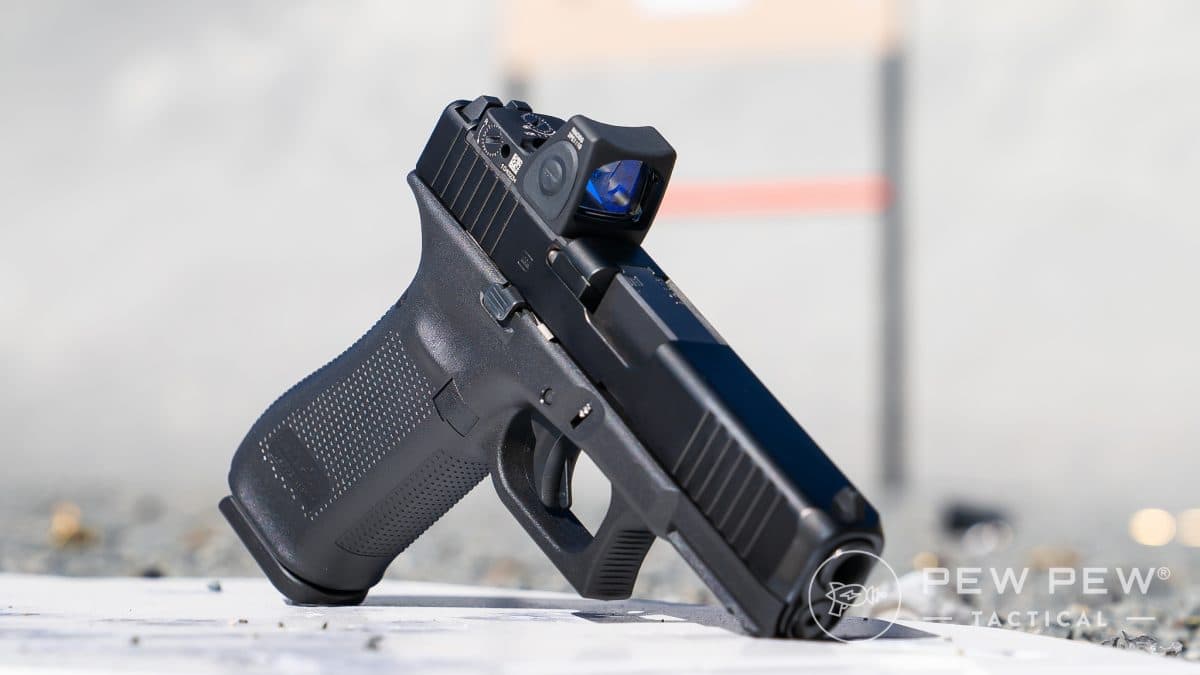
My main critiques – fisheye and tint – still exist on the range, but they weren’t distracting. By the time I broke my first shot, I was focused on more important things.
The RMR not only survived my drop test, it didn’t even sustain cosmetic damage. The pistol got scratched up; the steel target lost some paint; the RMR looks brand-new. There was no shift in point of impact, either.
Looking for something more compact? Check out the Trijicon RMRcc. It’s everything we love about the RMR in a smaller package that works with concealed carry pistols. It requires a rather expensive ($76 - $111 MSRP) adapter plate for any footprint, and they’re readily available from Trijicon.
4. Primary Arms GLx RS-15 - Best Budget Full-Size
Pros
- Large, clear window
- Innovative reticle helps guide you onto your target
- Affordable without being cheap
Cons
- Uncommon mounting footprint
- No torque specs in the manual
Specs
- Emitter: Open
- Reticles: ACSS Vulcan
- Brightness Settings: 10 daylight, 3 night vision
- Auto On/Off: Yes
- Adjustment: 0.5 MOA
- Window: 1.02” x 0.79”
- Footprint: C-More
- Battery: CR2032
- Country of Origin: Philippines
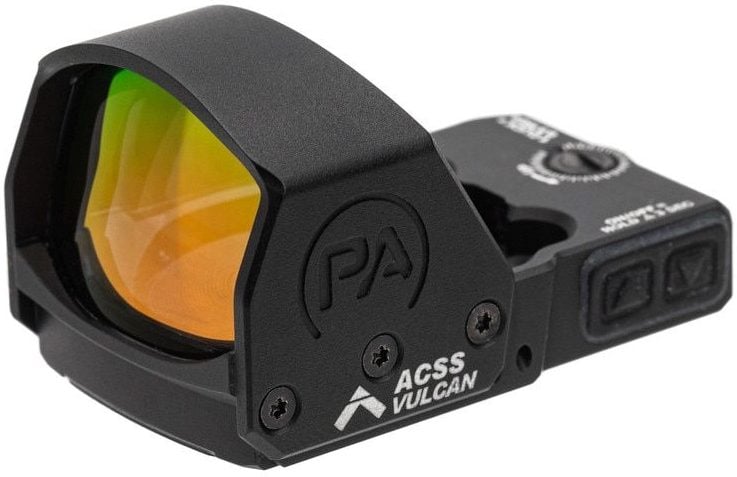
There’s a lot to like about this budget-friendly pistol red dot, but the ACSS Vulcan reticle steals the show. The huge outer ring will guide you to proper sight alignment, then wait politely outside the viewing window while you shoot.
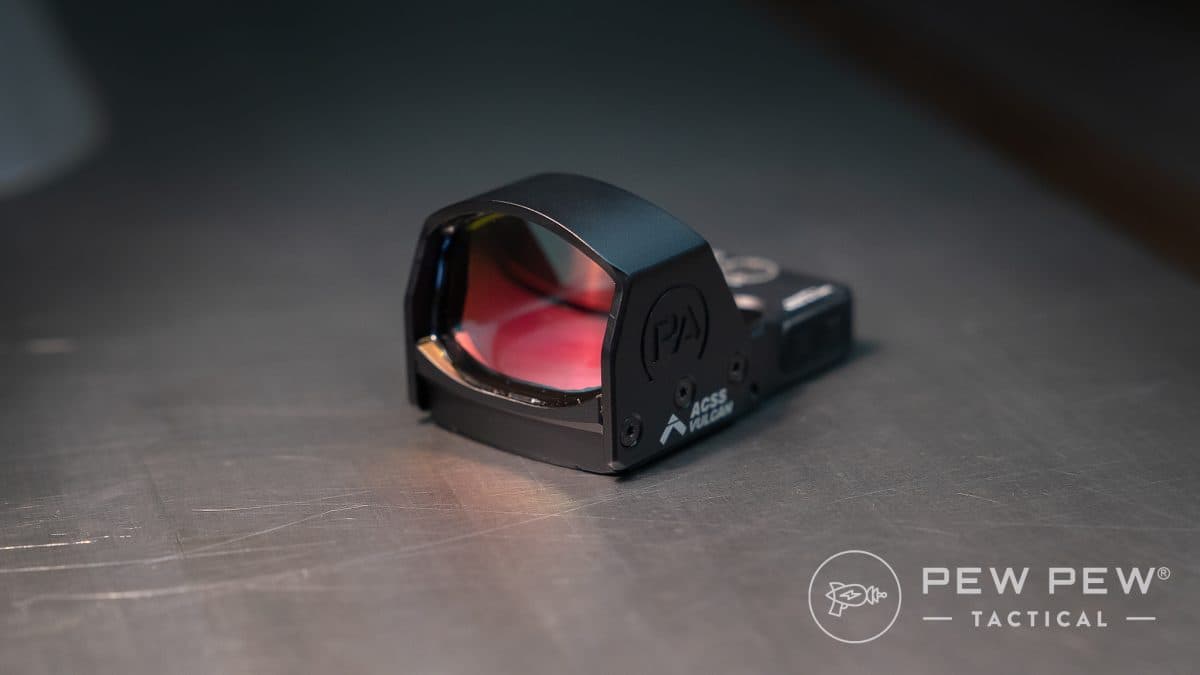
Primary Arms provides all kinds of mounting options for this optic, with six individually packaged and labeled sets of screws. They even throw in a small tube of red thread-locking compound.
According to the online FAQ, screws should be torqued to 20 inch-pounds (no mention of that in the paper manual). That’s getting up there, but I wasn’t worried since they thread into an adapter plate rather than the slide itself.
This red dot uses the less-common C-More footprint, but a Glock MOS plate is included. If you need something else, you’ll have to do some digging for a third-party solution. C-More might be the best place to start.
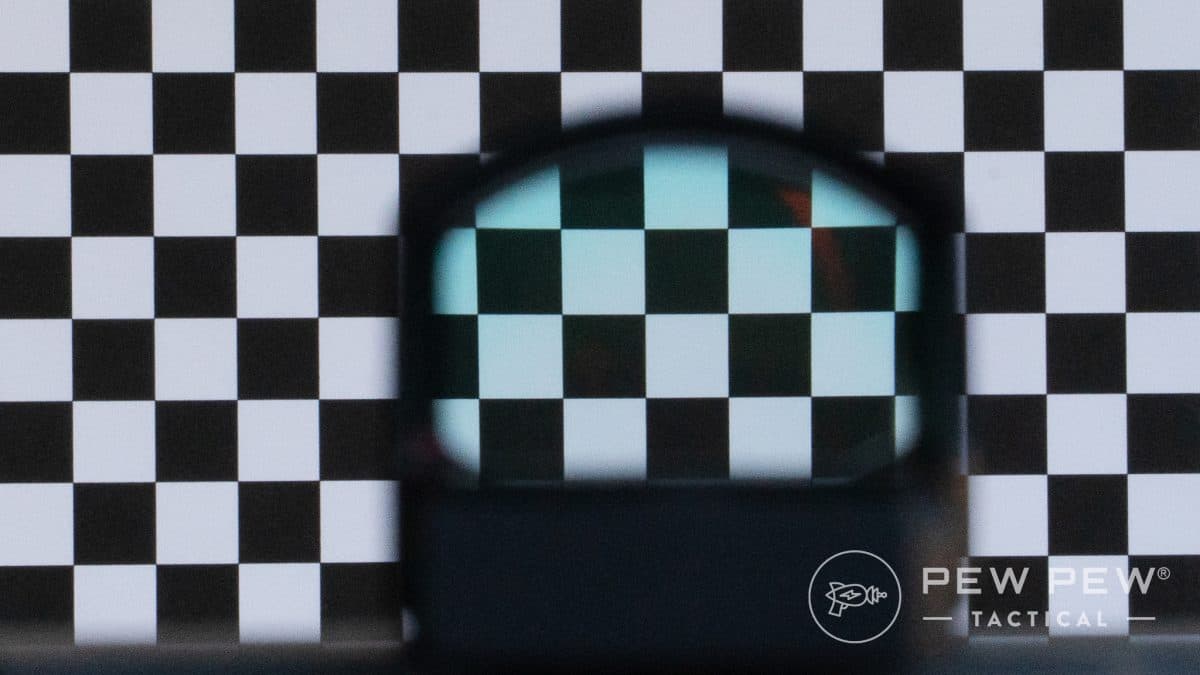
Optical quality is decent, but not the best in the group. I notice a teal hue and a slight fisheye effect around the edges.
The massive window makes up for it, in my book. Between that and the thin shroud, this looks about as close to a dot floating in space as I’ve seen.
The 13 brightness settings give you plenty to work with. The dimmest is barely visible to the eye while the brightest is clear and defined even in harsh midday sun. The ACSS Vulcan reticle is very helpful if your presentation isn’t totally dialed. Even if the dot is outside the window, the generous outer ring will show you which way you need to adjust.
My biggest gripe with this optic involves the buttons. They work well enough, but they’re absolutely tiny and sit next to each other on the right side, so using them on the fly is difficult at best. Feel is vague, so you have to watch the reticle to know what you’re pressing.
Can you trust a sub-$200 pistol red dot in the rain? In this case, absolutely. The GLx RS-15 was no worse for wear after sitting submerged for 10 minutes.
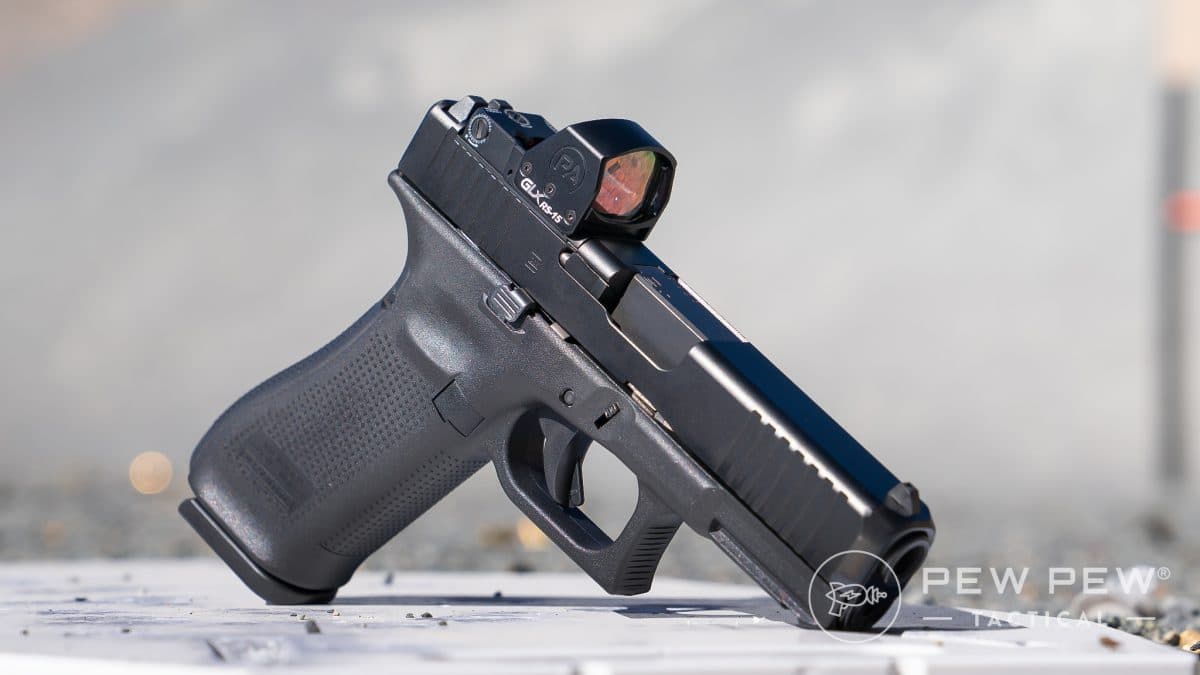
I’m not used to the ACSS Vulcan reticle, so it threw me off during my presentation at first. That’s a lot of extra red flashing across the window!
It grew on me, though. You’ll see it flashing in the vide,o but that’s due to the LED’s refresh rate in relation to the camera’s frame rate. You can ignore that; it’s steady to the eye.
I was concerned about how this red dot’s thin housing would hold up to a drop onto steel but it actually handled it well. It got some battle scars, sure, but the glass remained intact and I put the next three shots through the same hole right on the bullseye so you’ll hear no complaints from me.
5. Trijicon RCR - Best Enclosed Emitter
Pros
- Practically indestructible
- Fast, easy brightness adjustments
- No torque wrench required for installation
Cons
- May cost more than your pistol
- Large and blocky, with a surprisingly small window
Specs
- Emitter: Enclosed
- Reticles: 3.25-MOA red dot
- Brightness Settings: 7 daylight, 3 night vision
- Auto On/Off: No
- Adjustment: 1 MOA
- Window: 0.88” x 0.64”
- Footprint: RMR
- Battery: CR2032
- Country of Origin: USA
If you’ve ever looked at an RMR, a sledgehammer, or a tank and thought, “That looks kind of fragile,” the Trijicon RCR is for you. This absolute anvil of a pistol red dot doubles down on the brand’s reputation for durability with an enclosed emitter and a housing that feels as secure as a bank vault.
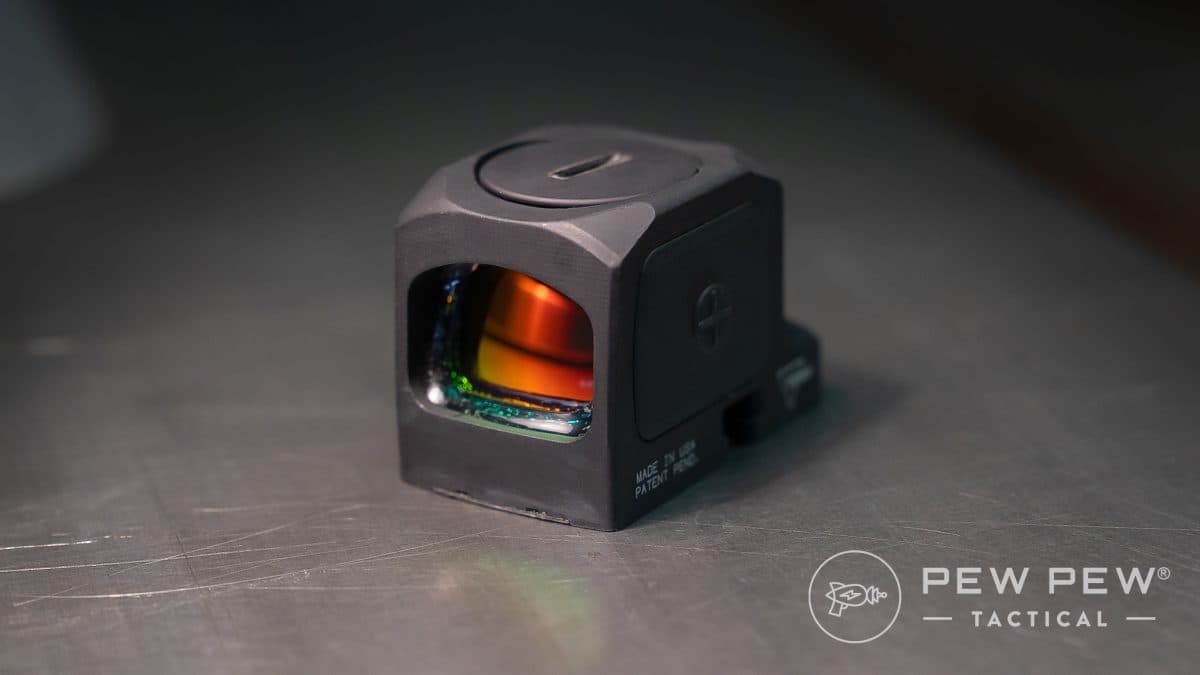
The RCR has the most quirky mounting procedure of any pistol red dot I’ve seen. It uses the RMR footprint, so that’s easy enough, but the screws have holes in the side rather than a Torx pattern on the top.
To install the RCR, I slotted the screws into the optic from the side, then lined them up with the holes on the mounting plate, and rotated them from the side about a quarter-turn at a time with the provided tool.
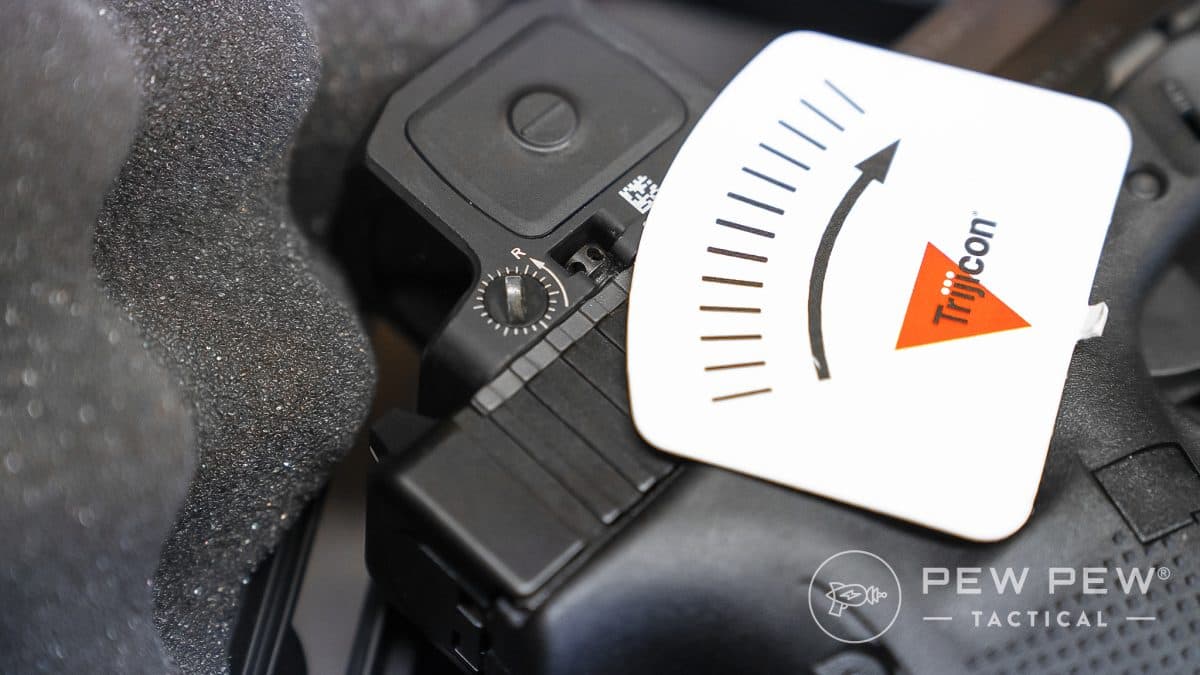
Since a torque wrench doesn’t work with this design, Trijicon includes a paper card that’s marked with lines indicating how far to turn the screws once they feel snug. It’s unconventional, for sure, but this method works and it’s very visual – no expensive torque wrench required. Two screw lengths (with spares for each) and a single-use tube of Loctite come in the hardshell case.
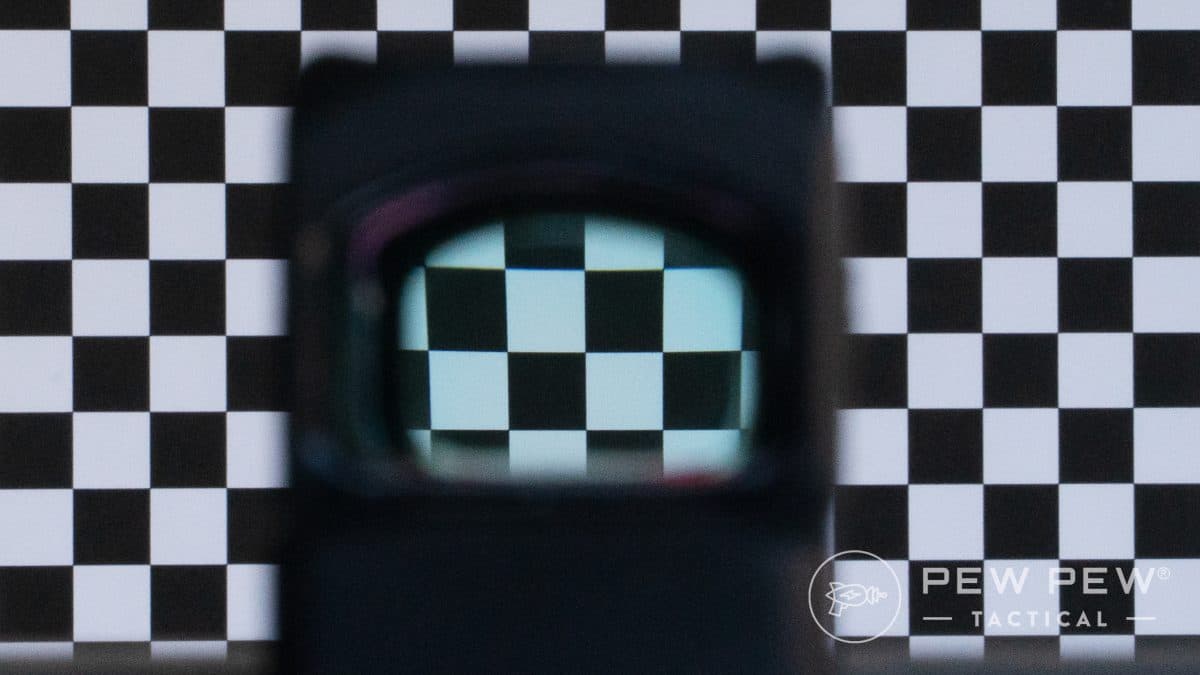
Trijicon red dots typically have a strong tint, and that’s true of the RCR. The windows have a significant purple hue and a noticeable fisheye effect around the edges.
It’s a tradeoff I’ve come to expect with Trijicon’s red dots. I make jokes about them looking like a stained glass window and then use them anyway, because their track record of durability is second to none.
Trijicon takes a less-is-more approach to brightness settings with three for night vision and seven for daylight. It’s a philosophy of speed: in a defensive situation, you don’t need to find the perfect brightness setting eventually; you need to find a usable one right now. Whether you agree with Trijicon is a matter of preference (I do).
The buttons are very stiff, so they don’t offer much tactile feedback, but I appreciate that they’re massive and placed on either side of the optic. That lets me reach for one side or the other (left for up, right for down) and mash it without looking, even through a concealing garment.
My water test didn’t have any effect on the RCR. It’s well-sealed and remained functional throughout.
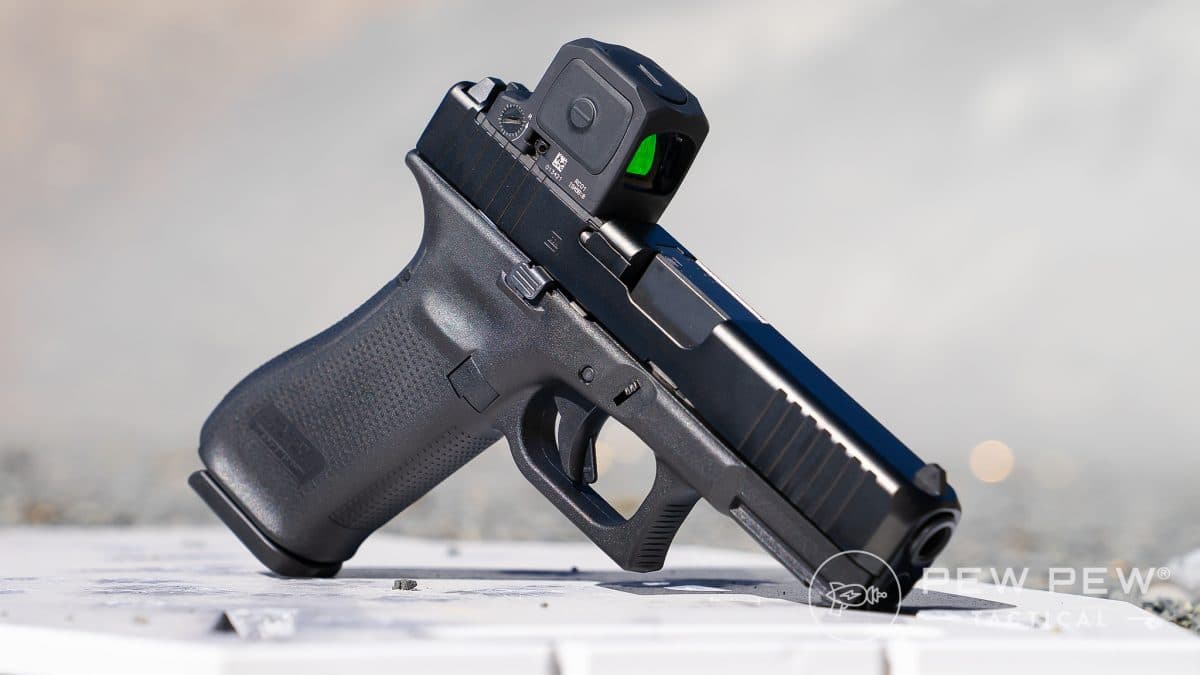
Have you ever been in a bunker? That’s about what it feels like to aim with the RCR. The housing is massive, and I never forgot that on the range. But the dang thing works. It outshone the bright desert sun like a champ and kept me on target.
I didn’t observe parallax effect, but the fisheye look remained noticeable.
Obviously, the RCR survived the drop test. Surprisingly, so did the steel plate. Unstoppable force, meet immovable object.
Ready for more thoughts on this optic? Check out our Trijicon RCR review!
The clear alternative to the RCR is the Aimpoint ACRO P-2. The Pew Pew Tactical staff debated this at length, and there really isn’t a bad choice between the two.
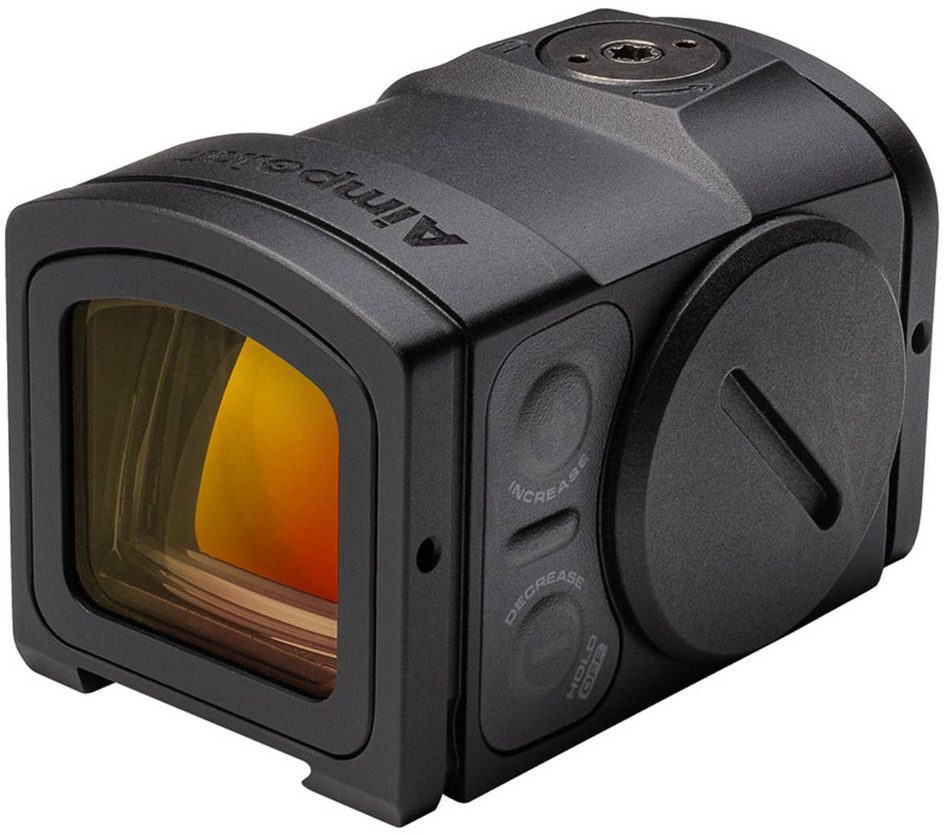
The ACRO P-2 has better glass, but it comes with a polarizing mounting footprint. We ultimately gave the RCR an edge in durability,y and, since that’s the whole point of using an enclosed emitter red dot, it won out for this list.
For my money, I’d be happy with either one.
6. Vortex Defender-XL - Best for Competition
Pros
- Massive, crystal clear window
- Red and green reticle options in several sizes
- Super crisp dot
Cons
- No multi-reticle option
- Might be easier to find mounting solutions if it used the RMR footprint
Specs
- Emitter: Open
- Reticles: 2-MOA red dot, 5-MOA red dot, 8-MOA red dot, 3-MOA green dot
- Brightness Settings: 10 daylight, 2 night vision
- Auto On/Off: Yes
- Adjustment: 1 MOA
- Window: 1” x 0.92”
- Footprint: DeltaPoint Pro
- Battery: CR2032
- Country of Origin: China
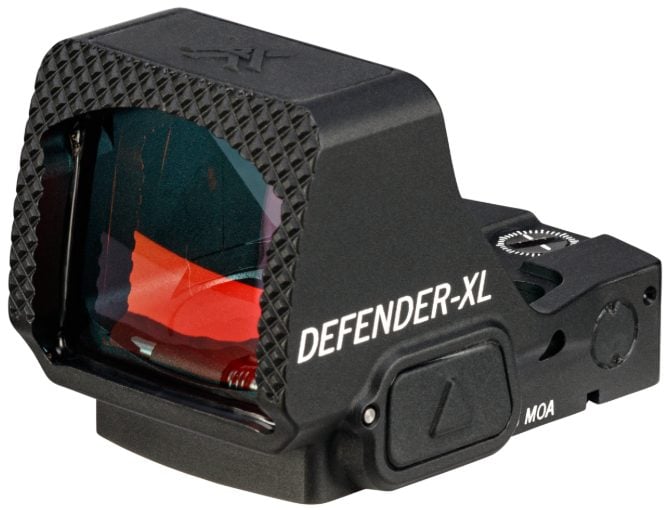
Right now, there’s no better competition pistol optic than the Vortex Defender-XL. Yes, the panoramic glass is incredibly clear, and sure, it’s tough. The Defender-XL is also affordable for the average shooter, which means more money for training ammo, professional instruction, and match fees.
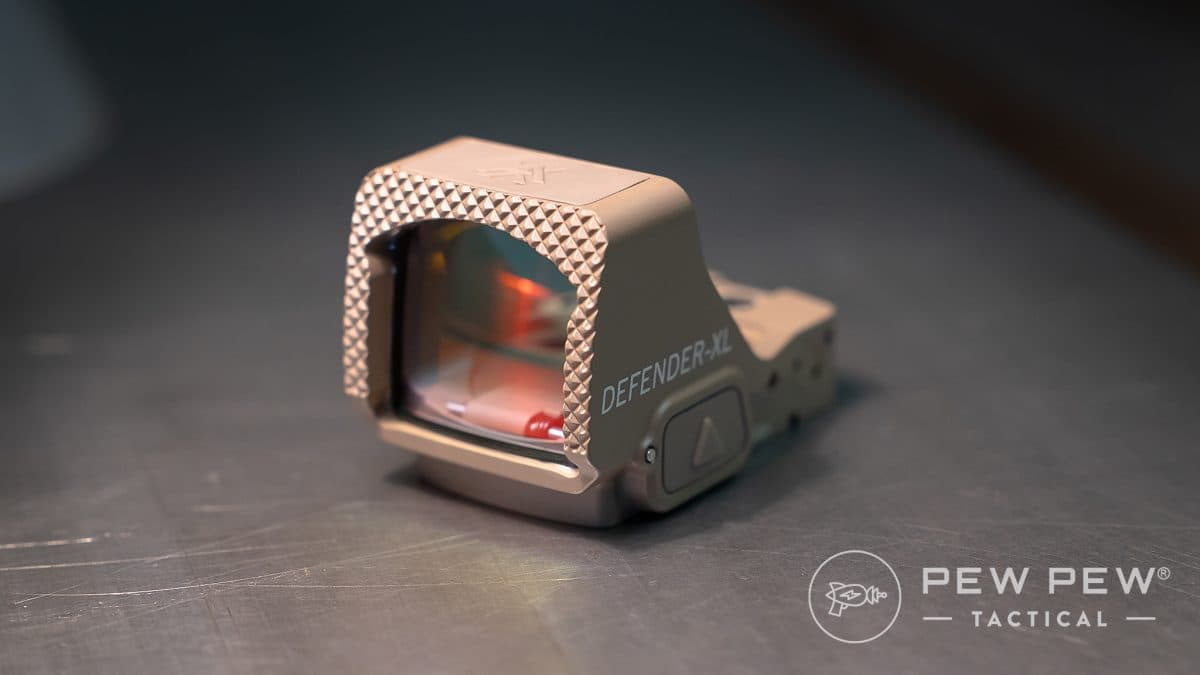
I’ve stood on this soapbox before: nobody optic company does mounting solutions better than Vortex. The Defender-XL comes with a huge assortment of screws that are not only labeled with their thread type, but also which pistols use them. Blue thread-locker is applied, and Vortex provides a torque spec of 10 to 12 inch-pounds when using thread locker.
This red dot uses the DeltaPoint Pro footprint. There’s a Glock MOS plate and a Picatinny mount in the box, as well, so most people should be covered without chasing down a third-party adapter.
This is another option that comes with a silicone cover to protect the optic when you aren’t using it.
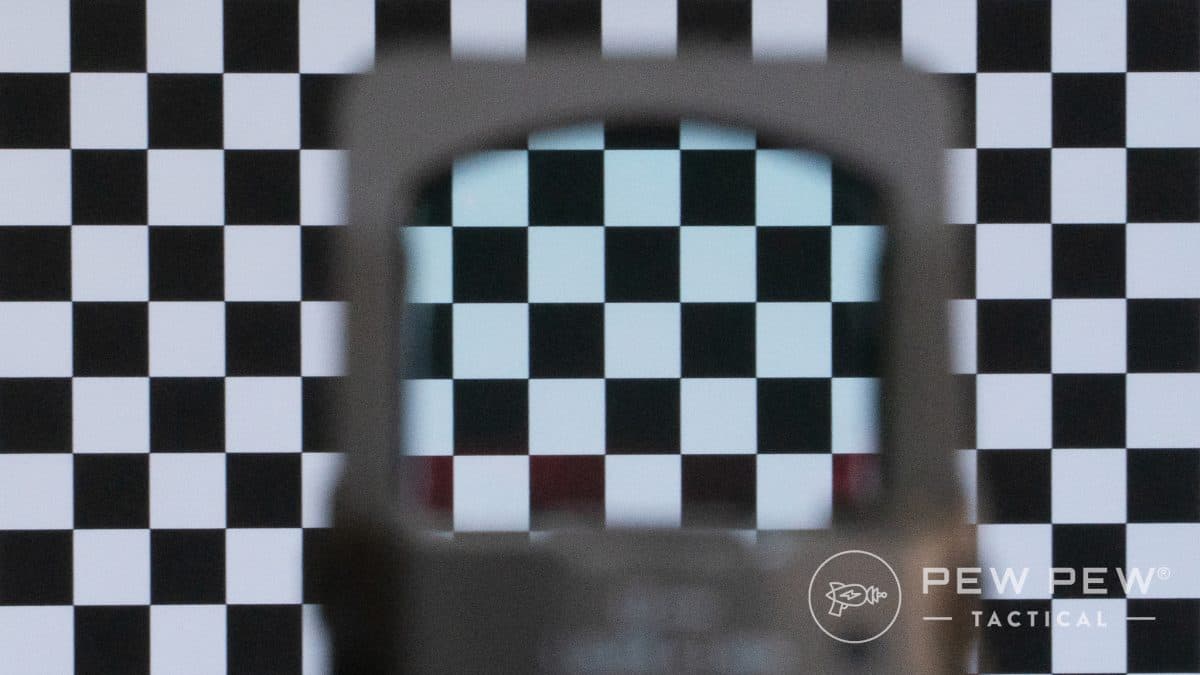
The supersized window is crystal clear, with no tint or distortion. That’s one of the main reasons I recommend it for competition, although it’s just as nice on range guns and larger defensive pistols.
The Defender-XL features 10 brightness settings for daylight and two for night vision. That’s a pretty common split, and one I’m content with.
The buttons are fairly large, sit on opposite sides of the optic, and provide the best tactile feedback of the group. They’re smaller than Trijicon’s buttons but have a more positive feel, so I’d say the two brands achieve similar usability through different approaches.
The Defender-XL proved its watertight abilities during my testing. I was very interested to see that the shape of the optic trapped a small air bubble over the emitter, so when I removed it from the water, the LED was completely dry. Nifty!
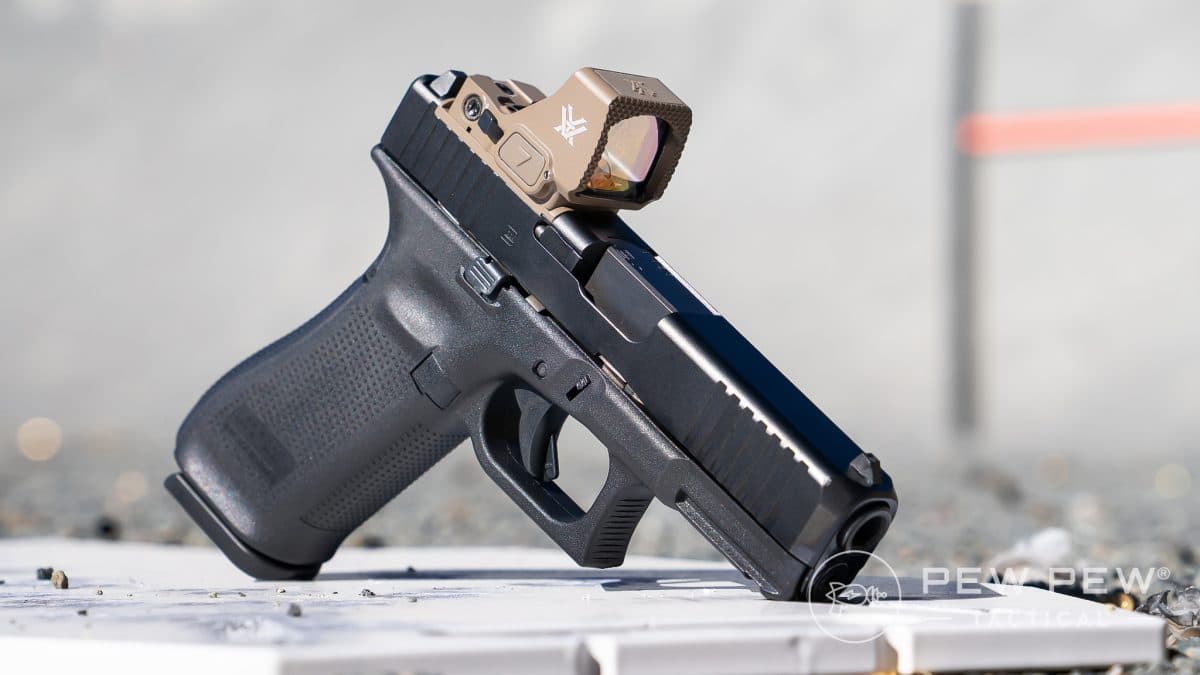
Shooting with the Defender-XL had me chuckling because the glass is so massive. It felt like cheating at first, and after a few magazines, I started to wonder if I could carry it as my EDC.
The reinforced housing shrugged off the impact from my drop test, and that beautiful pane of glass remained good as new.
If I were going to shoot competitively, this would be an easy pick. It made my shooting faster and more accurate, and I’d never worry about it falling apart on me. A competitive price seals the deal.
The Defender family also includes two smaller optics.
The Defender-ST is more of a duty optic for full-sized pistols, and the Defender-CCW is a compact optic for concealed carry pistols. Red and green dots are available in all three sizes.

It doesn't seem right to talk about competition pistol red dots without mentioning the Trijicon SRO.
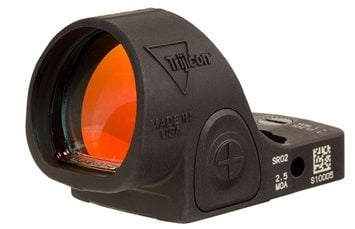
It’s one of the most popular optics among competitive shooters who put a premium on speed, but it’s also priced out of reach for a lot of recreational shooters.
7. Holosun 507C X2 - Best Solar
Pros
- Unlimited solar power
- Solid optic for the money
- Available with a red or green dot
Cons
- Solar panel and glossy finish are susceptible to scratches
- Not sure I trust auto-brightness
Specs
- Emitter: Open
- Reticles: 2-MOA red dot, 2-MOA green dot
- Brightness Settings: 10 daylight, 2 night vision
- Auto On/Off: Yes
- Adjustment: 1 MOA
- Window: 0.91” x 0.63”
- Footprint: RMR
- Battery: CR1632
- Country of Origin: China
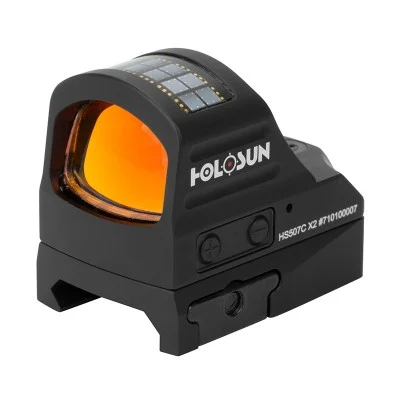
Battery life – or, more accurately, battery run time – is hard to measure because it depends on several factors, including your own setting selections. One thing we can all agree on is that a solar panel like the one on the Holosun 507C X2 is a great way to put more range time between battery replacements.
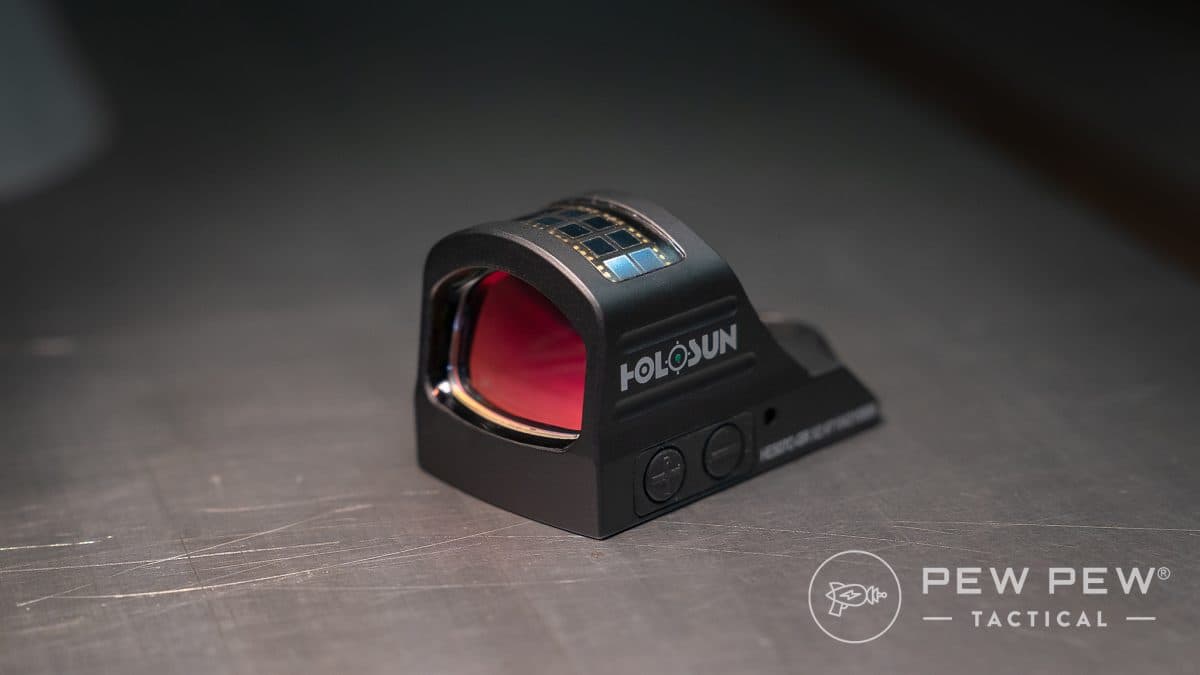
Holosun provides two sets of screws (and spares) with the 507C X2. They have the same fine-print labeling as the EPS Carry’s hardware, and once again, it’s up to you to figure out which ones work with your pistol or mounting plate.
The 507C X2 uses the RMR footprint, although Holosun calls it “an industry standard footprint” on the website and in the owner’s manual. According to the manual, screws should be torqued to 15 inch-pounds with non-permanent thread-locking compound.
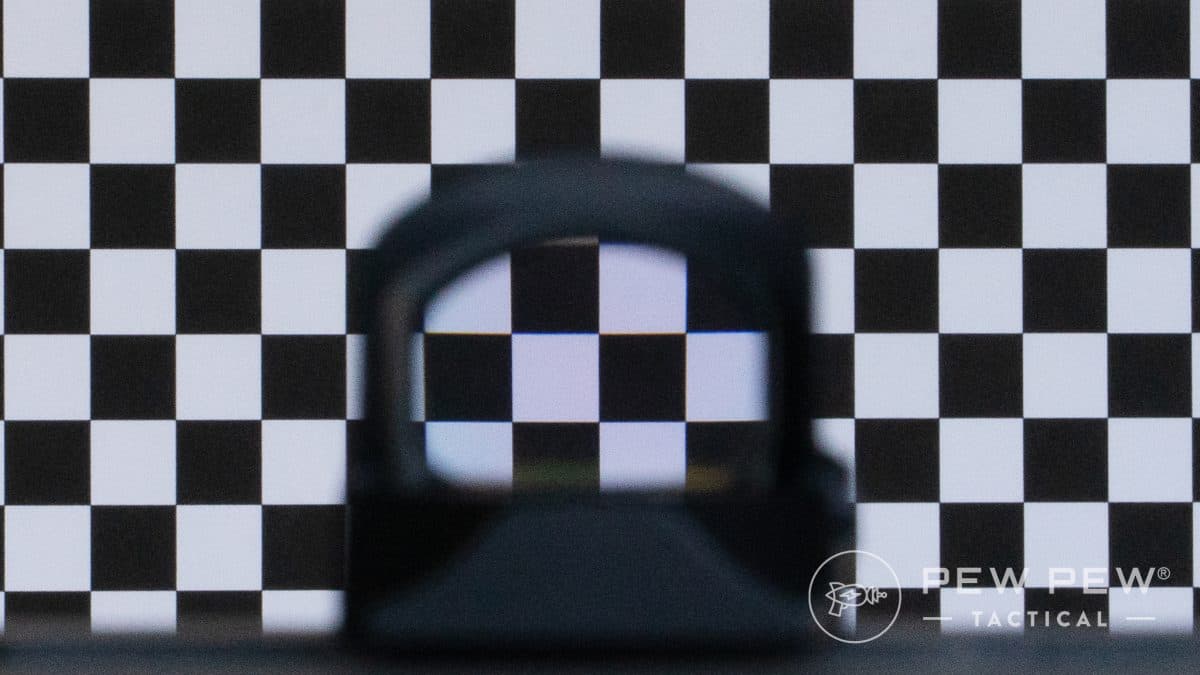
As I’ve come to expect from Holosun, the glass in the 507c X2 is very clear and free of imperfections and distortion. There’s a purple tint, but only enough to see when I focus on the glass itself. When I sight in on a target, everything looks clear.
The 507C X2 has a fairly standard range of 10 daylight brightness settings and two night vision-compatible settings. The buttons to control brightness and reticle selection are next to each other on the left side of the optic.
Once again, auto-brightness is the way to go at the range, but I’d stick to a carefully selected manual setting for defensive uses. Remember that a dot that’s too bright is suboptimal, but a dot that’s too dim is invisible.
This Holosun has an exposed emitter, but it still handled my water test just fine. I could even see the reticle when I looked through the glass container where it sat submerged.
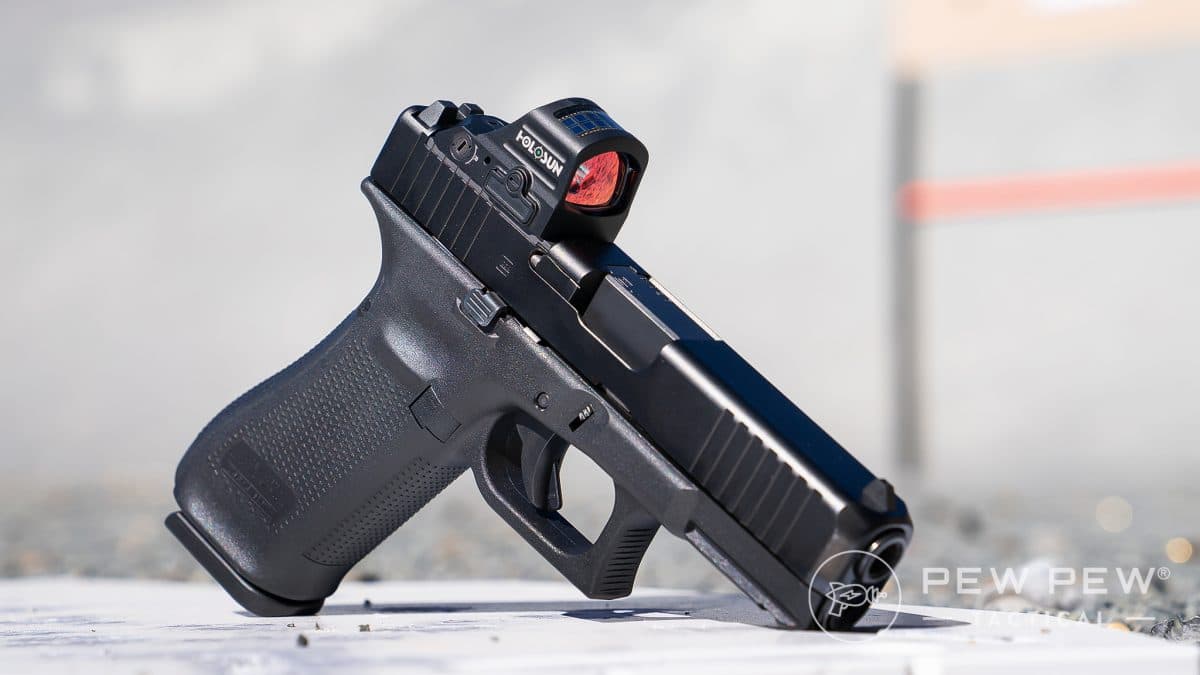
The 507C X2 adds quite a bit of heft to the slide; I suppose all that solar wizardry has to go somewhere. The multi-reticle is super bright, though, so that’s all I saw once I presented the pistol.
I didn’t notice any parallax effect, and the green LED kept up with the bright midday sun better than red alternatives. Many people find that green dots appear sharper to their eyes, but for me, it’s actually the opposite – do some experimenting and find out what your eyes prefer.
The large, exposed solar panel is more vulnerable than solid metal, but the 507C X2 emerged from my drop test with just a superficial scratch along the leading edge. There was no meaningful damage and no shift in the point of impact.
Still curious? Check out our Holosun 507C review for more info!
Looking for something a little more unique? OpticsPlanet’s OPMOD series gives you the option to get the same great red dot with a splash of color.
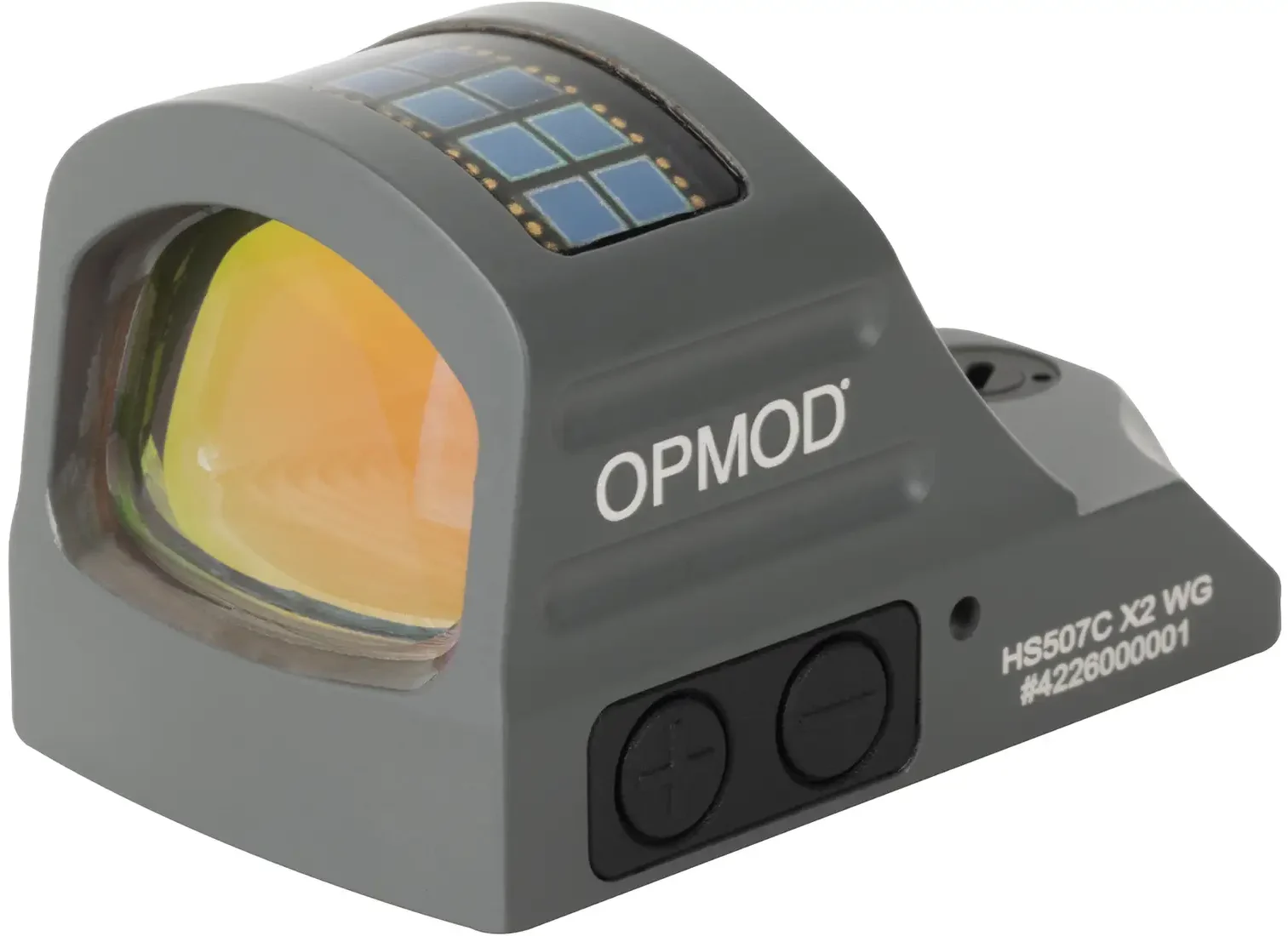
The 507C X2 is available with a red or green multi-reticle. The 407C X2 is a similar optic but with a dot reticle only.
How to Pick the Best Pistol Red Dots
Still not sure how to pick one red dot over another? Here are some factors to consider.
Mounting Footprints
If you already have a pistol, the first thing you need to do is determine which mounting footprint it uses.
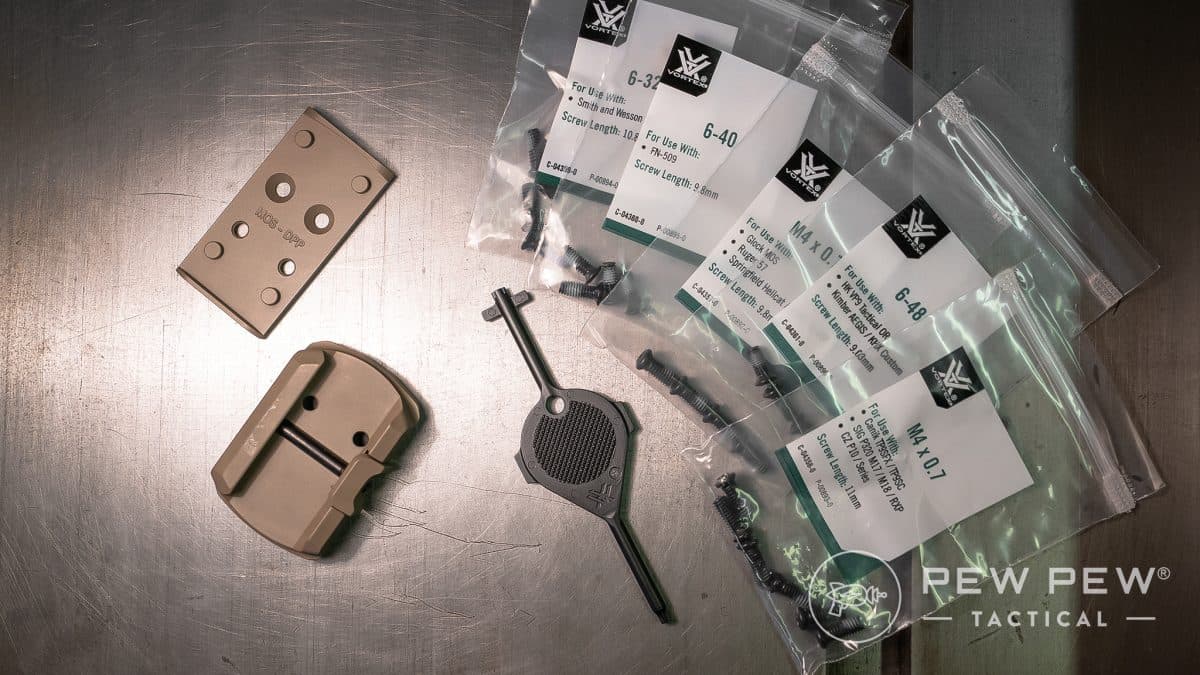
Some pistols are cut for a specific pattern. In the case of the Springfield Hellcat Pro from this test, it’s the Shield RMSc footprint.
Other pistols, like this test’s Glock 45 MOS, give you more options by using adapter plates.
This approach lets you pick any optic as long as there’s a factory or aftermarket plate but it also raises the optic higher off the slide. That could block your factory irons, so you might have to buy suppressor-height sights if you want a backup sighting system.
Open vs Enclosed Emitter
The debate over open and enclosed emitters is a spicy topic. People tend to have a strong preference for one or the other, and both camps have valid points.
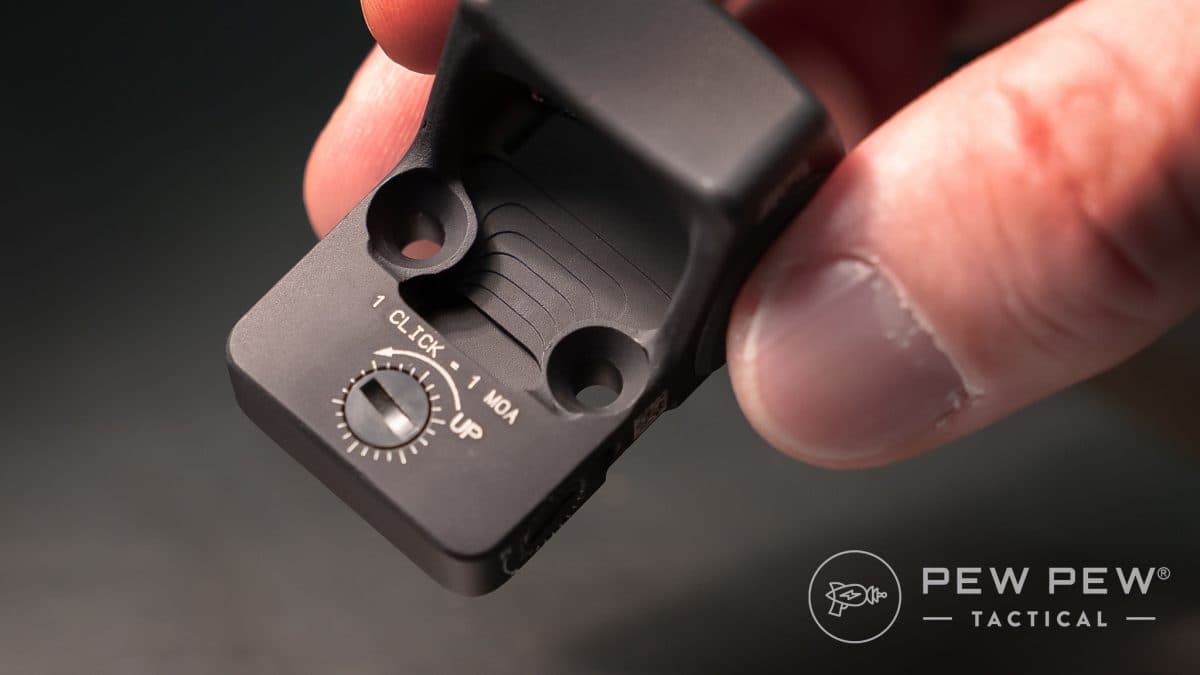
The emitter is the LED that projects a reticle onto an optic’s window.
Open emitters are exposed to the elements. That makes the optic vulnerable to water and debris that can cover the LED, although that’s uncommon. The good news is that obstructions are generally very easy to clear, and simplicity is often associated with reliability.
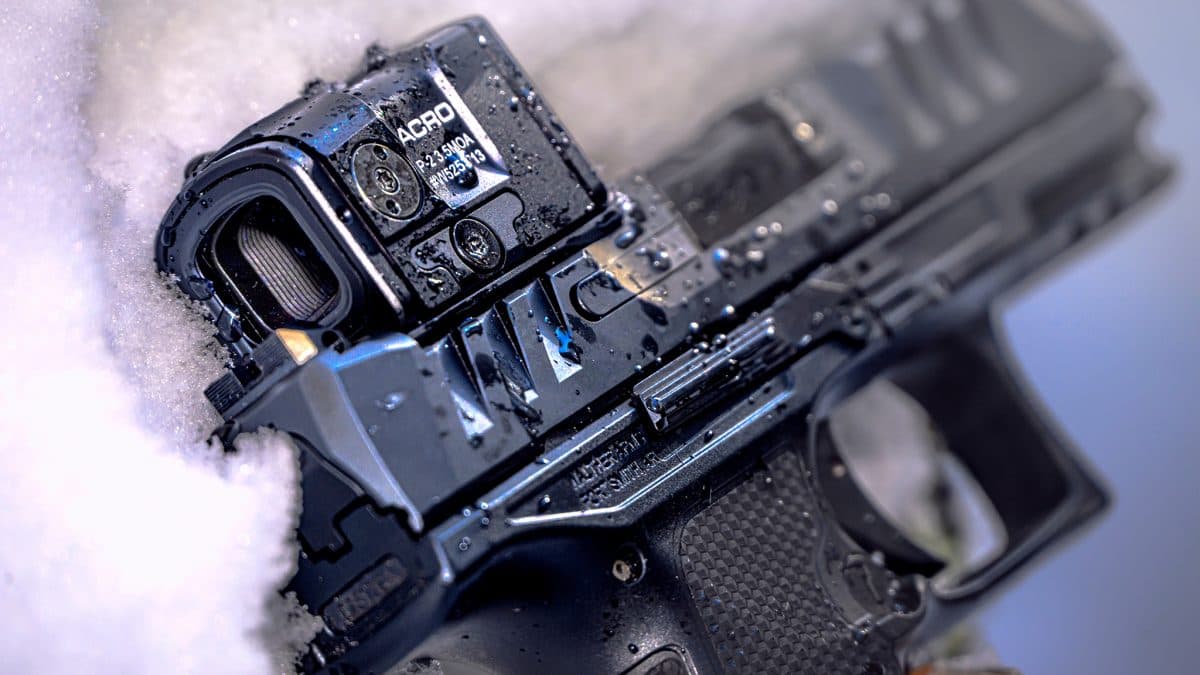
Enclosed emitters use two windows instead of one, with the emitter safely tucked away between them. That eliminates the risk of something blocking the emitter.
The downside is increased complexity and potential points of failure. If the seals fail, moisture inside the optic can fog up the windows from the inside, and you won’t be able to wipe it off or use your iron sights.
In the simplest terms, open emitters are more prone to malfunctions, but they’re easy to fix on the fly. Enclosed emitters rarely experience malfunctions, but they’re generally more serious.
Reticle
We colloquially call these optics pistol red dots, but that’s not always strictly accurate.
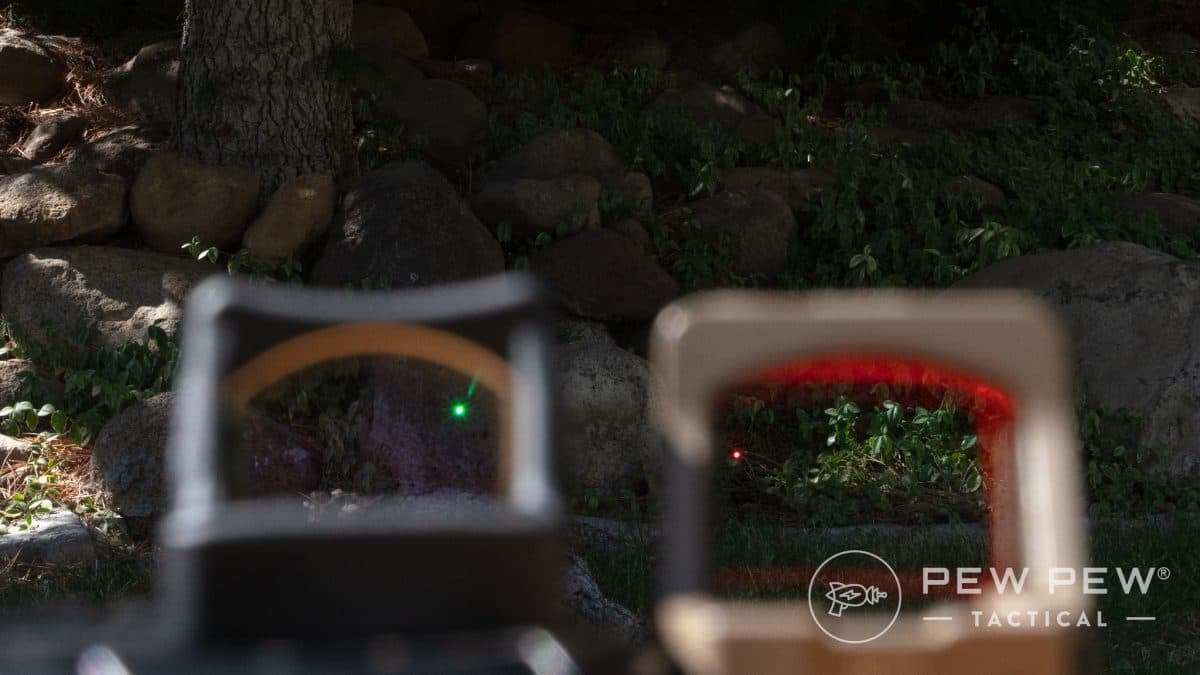
These days, you can choose from red dots and green dots. Red is more common and typically draws less power from a battery. Green is easier for some people to see, especially those with astigmatism, and might offer better contrast depending on your environment.
You have options when it comes to size, as well. Dots are measured in minutes of angle, with 1 MOA being roughly equivalent to 1 inch at 100 yards. Smaller dots are more precise; larger dots are easier for your eye to find in a hurry. I consider 3-MOA dots to be a sweet spot that works in a range of situations.
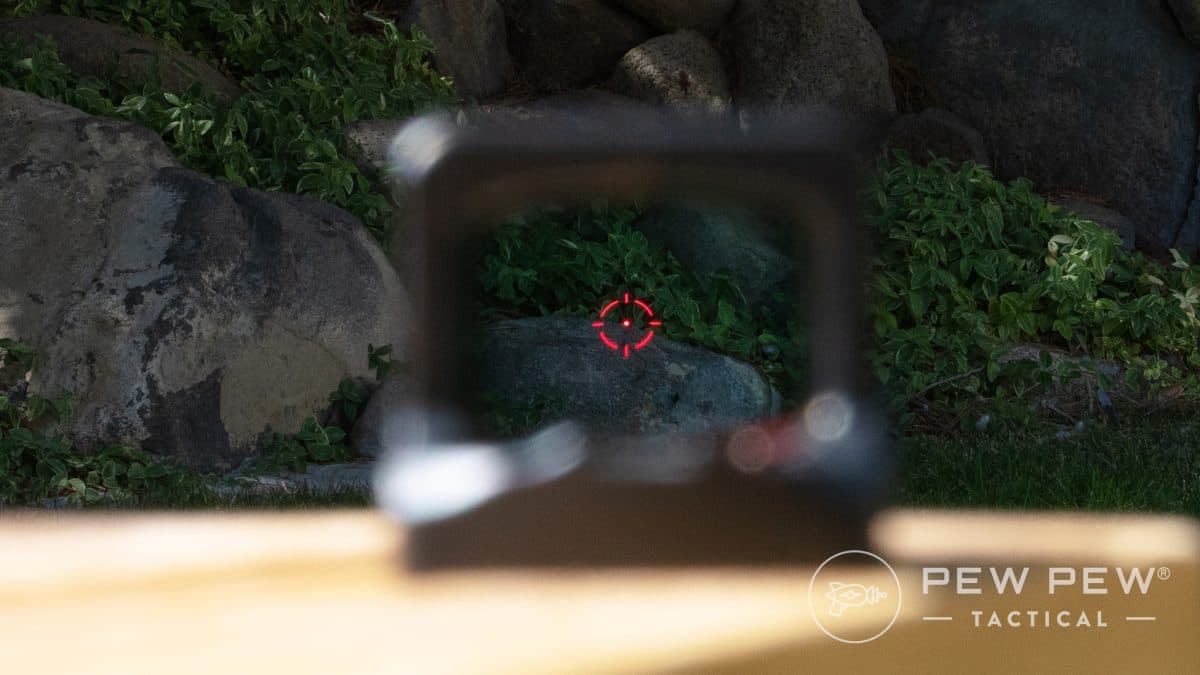
In addition to simple dot reticles, you can also get various multi-reticles that let you choose from a dot, a ring, or both. What you choose is a matter of personal preference. If you’re not sure, a multi-reticle will give you the most options.
Optical Quality
Optical quality is key, and it boils down to a few different factors.
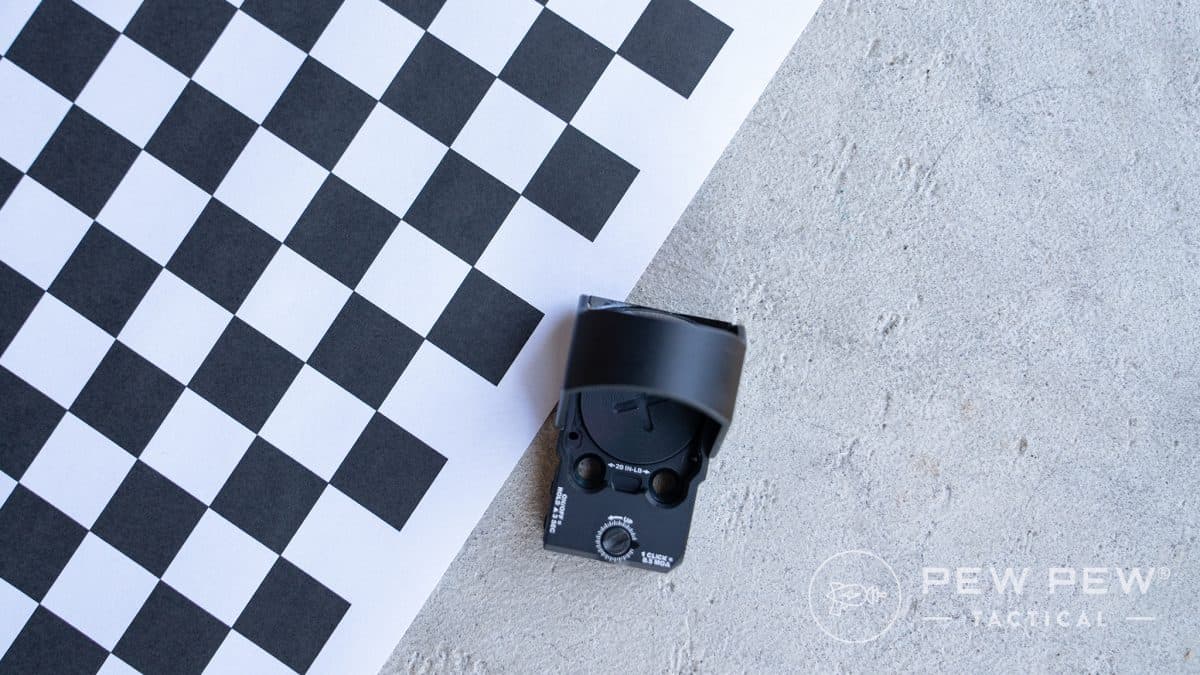
First up are distortion and clarity. Some glass warps your view of the target, which is distracting and could obscure finer details. Inexpensive glass may even include imperfections that clutter your view. We want to minimize these effects as much as possible.
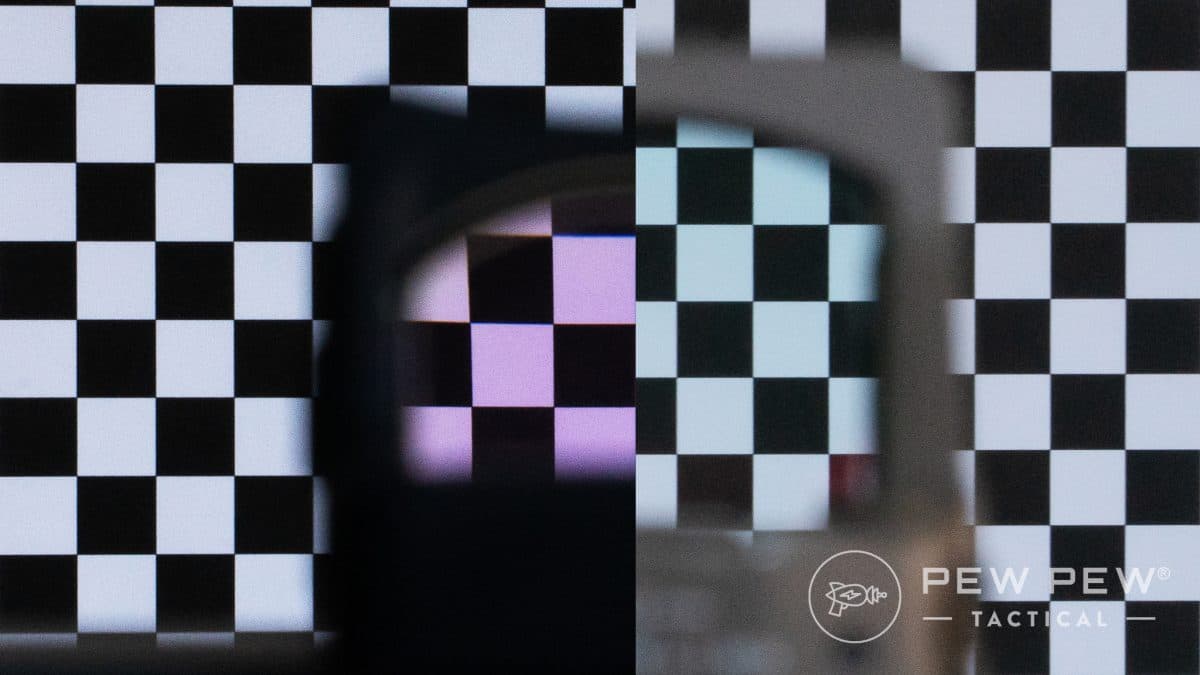
Next up is discoloration. You’ll notice that some pistol red dots look perfectly clear, while others have a noticeable tint. That’s likely a choice made by the manufacturer. Clear glass is easier on the eyes, but it drains the battery faster. Tinted glass might make the world look blue, but the battery may last longer.
Another phenomenon you might experience is parallax. Once your reticle is aimed at a target, the dot should ideally stay put when you move your head slightly to the side, up, or down. If it doesn't, you’re seeing a parallax error, and it can cause you to miss.
Battery Life
Battery run life is a major priority for all manufacturers, because nobody likes swapping out batteries – especially if you have to take your optic off your pistol to do it.
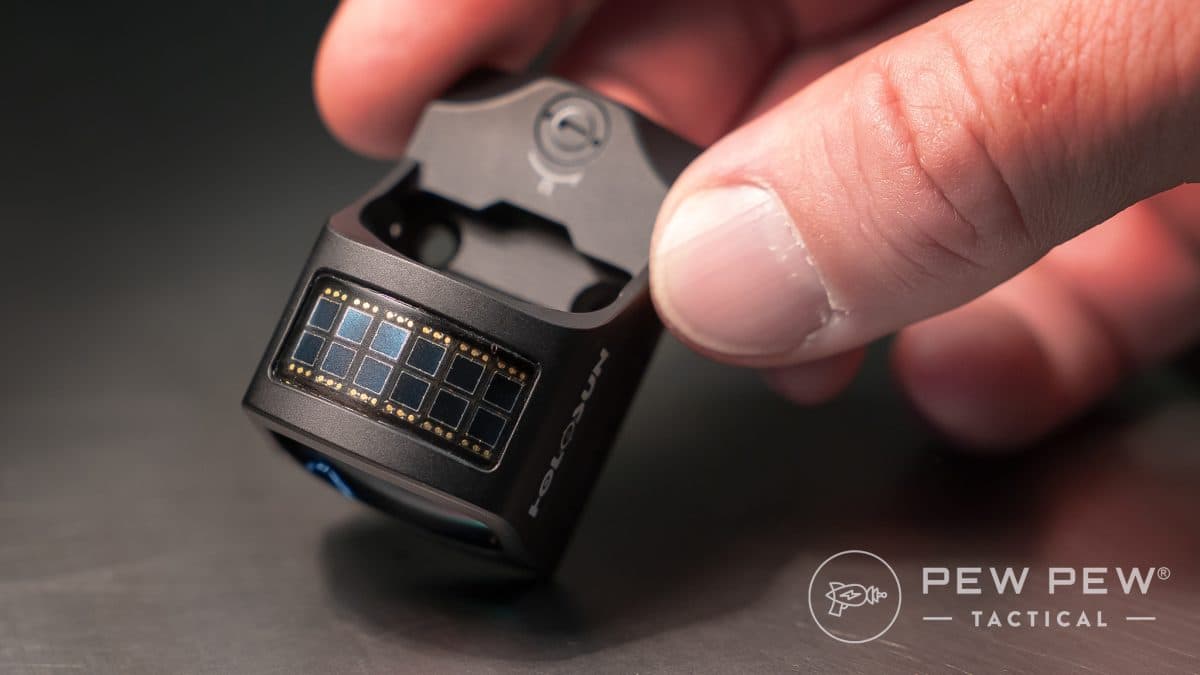
Automatic shutoff features are common. They put your optic to sleep when motion isn’t detected for a certain amount of time. As soon as you move your pistol, the red dot will wake up and be ready before you have time to present it.
Another way to extend battery life dramatically is through solar power. Some pistol red dots have a solar panel that takes over automatically when enough sunlight is available. That allows your battery to shut off and save its energy for later.
Price
As always, you have to consider price when buying a red dot for your pistol.
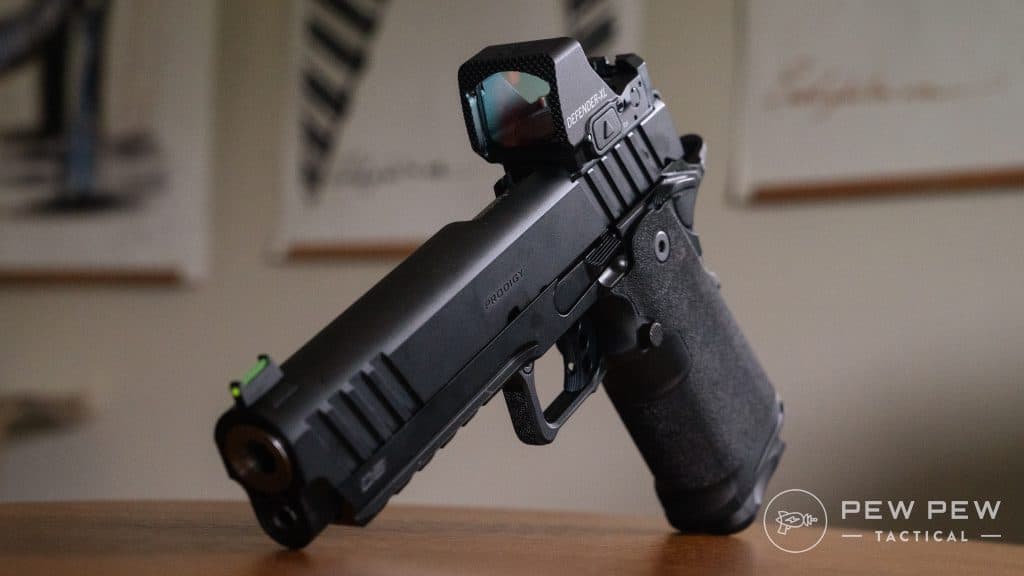
Are premium optics better than inexpensive ones? Yes, but that may not matter if they’re out of your budget.
It’s better to have a good optic that you train with regularly than factory iron sights and an all-or-nothing attitude.
Meet the Experts

Editing this article is Scott Murdock. Scott is a Marine Corps veteran who competed and qualified as a rifle and pistol expert while in service. In addition to shooting, Scott has written for a variety of publications, testing, researching, and evaluating guns and gear. He brings that knowledge and skillset to this article, editing and fact-checking for accuracy.
Editor-in-Chief Jacki Billings runs our experienced team of reviewers. She is a National Rifle Association Basic Pistol Instructor as well as a member of the Society of Professional Journalists, ACES: Society for Editing, and the Professional Outdoor Media Association. Jacki has a bachelor’s degree in journalism and has worked as a media professional for close to 20 years, specializing in gun media for almost 10 years. With 2,000+ articles to her name, she uses her professional journalism and editing experience to set testing protocols and editorial standards for Pew Pew Tactical.
Final Thoughts
Everyone has their own preferences when it comes to picking the best pistol red dots, but at least now you have enough information to make an informed buying decision.
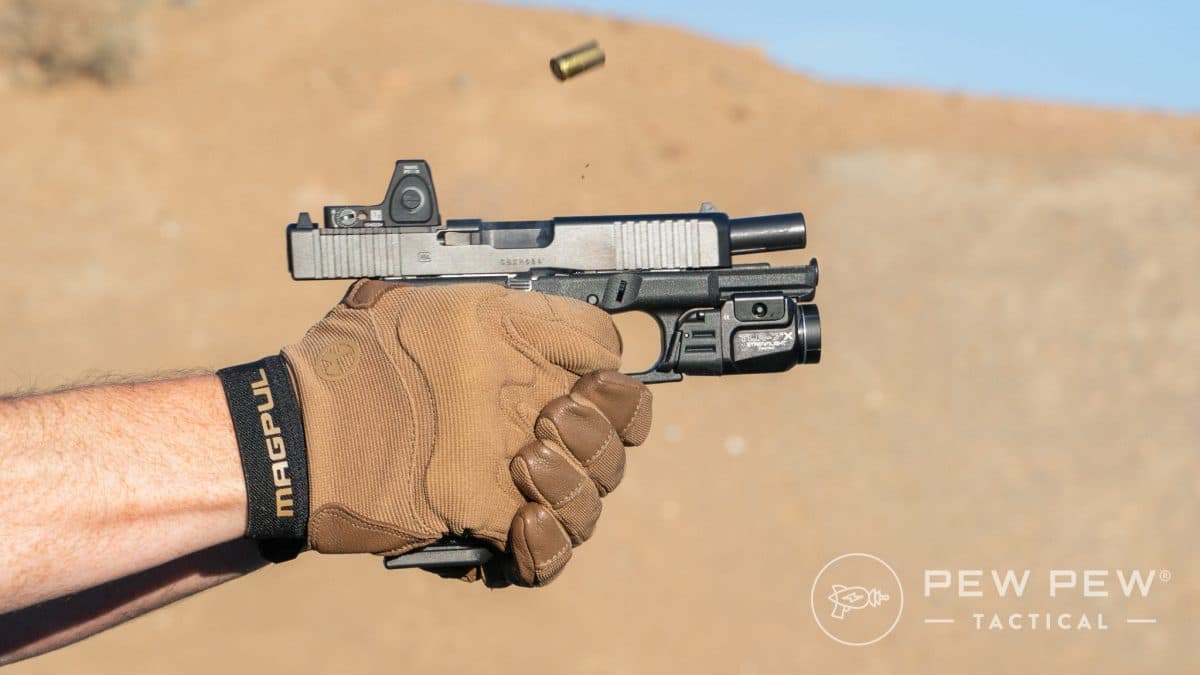
Fair warning, you’re going to end up with more than one – and that’s ok! Come on back and let us know what you bought, and why you chose it.
Are you already using a red dot, or are you still rocking iron sights on your pistol? Let us know in the comments! Looking for more great optics? Come see the Best AR-15 Scopes & Optics!
Latest Updates
September 2025: Complete overhaul with new products and supporting content.