If your life depends on it, what kind of ammo should you use? Hollow Points or Full Metal Jacket? Find out the difference and our recommendations for the best defensive ammo for each caliber.
We review products independently. When you buy through links on our site, we may earn a commission to help support our testing. Learn more.
Nothing will make up for shooting skill…
If you don’t hit your target it won’t matter if you were using the Golden Gun and firing depleted uranium rounds – you still missed. But that doesn’t mean what you shoot isn’t important.
There’s an unwritten rule of firearm ammunition: use hollow points for your carry/home defense guns and use full-metal jacket (FMJ) for practice.
This is mainly due to the fact that FMJ rounds are significantly cheaper than your average hollow point.
It’s also due to the fact that, from a “put the attacker down” point of view, FMJ rounds aren’t exactly ideal.
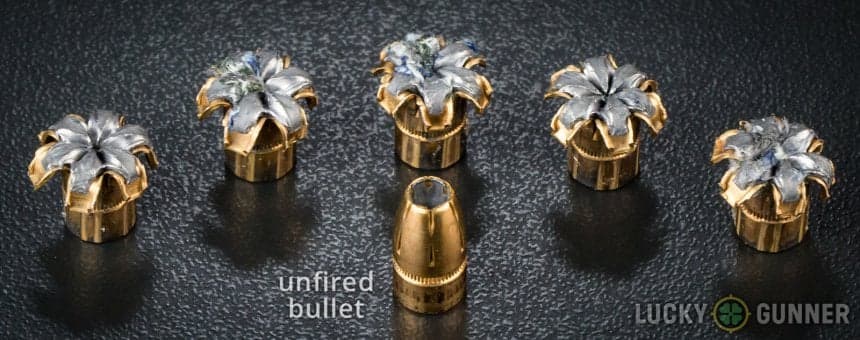
9mm 115 gr Federal FMJ vs 124 gr Federal Hydrashok, Top
That’s not to say that FMJ rounds are useless for defense.
Far from it, in fact.
Most NATO militaries use only FMJ rounds. This is due to an international treaty that was signed many years ago that forbids the use of expanding rounds. That same treaty also bans the dropping of grenades from hot air balloons, mind you, so some of the stuff might be outdated in the grand scheme of things.
However, the USA never ratified that section of the treaty…and the US Army just recently adopted hollow point ammo along with the new Sig Sauer M17 pistol.
But I digress, the FMJ is still a bullet and will still punch a hole in your average bad guy. Stories of people “shrugging off” FMJ rounds because they “just passed right through” are rare and often exaggerated.
So Why Do We Use Hollow Points Then?
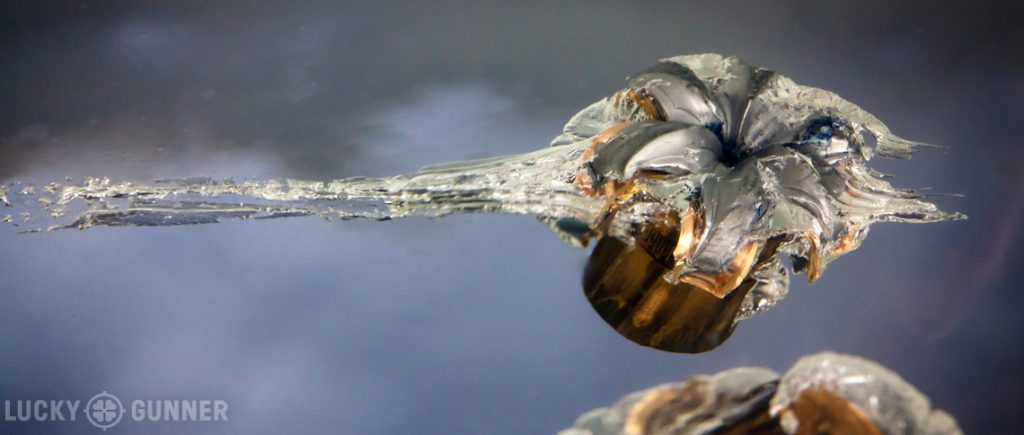
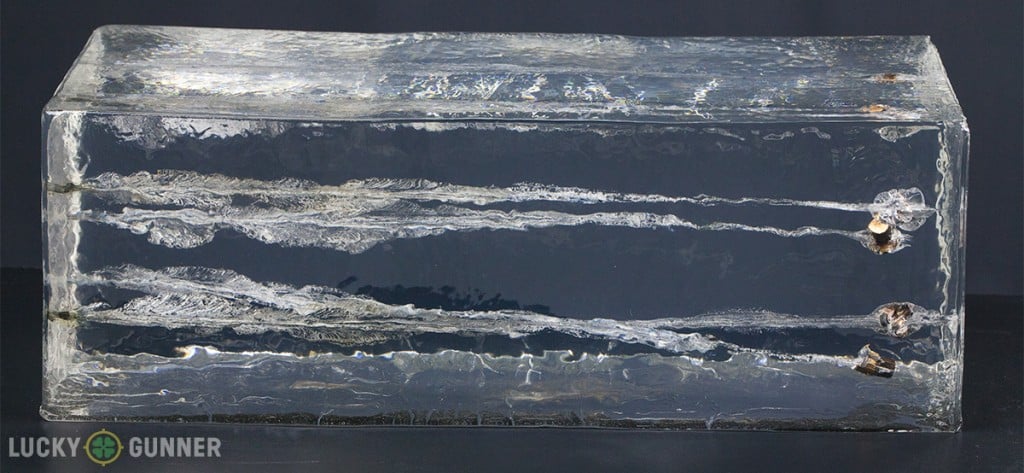
Ballistics Gel Testing, Lucky Gunner
While a full metal jacket round will still drop a bad guy, a hollow point will do it just a little bit better. That’s not to say there aren’t all kinds of misconceptions about hollow points as well. What I want to do today is talk about both rounds and touch on the misconceptions of both.
Or if you’re ready…check out our Ammo & Reloading Definitive Guide for our favorite ammo picks for common calibers.
Full Metal Jacket
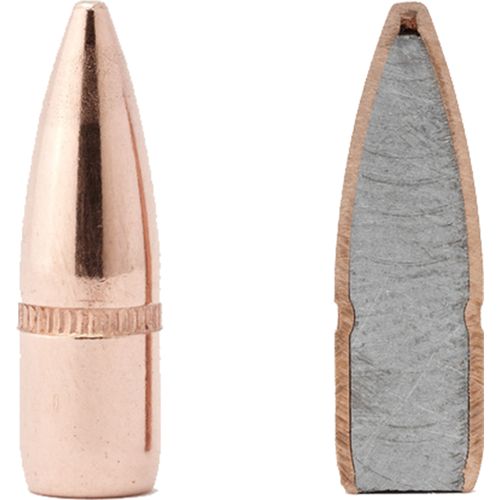
A full metal jacket round, as we talked about in our Basic Bullet Guide, is a soft lead bullet that’s been encased in a harder metal.
When passing through soft tissue and other stuff, the bullet retains the majority of its shape. The upside of this is that, in theory, it has an easier time retaining its lethality after passing through a barrier among other things. It also has an easier time working in almost any gun you put it in.
The main thing, however, is that it’s just far cheaper to manufacture FMJ ammo.
FMJ Cut
So why does FMJ ammo have that “less lethal than hollow point” thing associated with it?
It comes down to physics…
Because the bullet is just passing through, for lack of a better term, it retains a great deal of its energy. This ultimately results in 2 small holes (entrance and exit wound) and also allows the bullet to possibly continue on for a long time and hit something you don’t want it to.
Don’t get me wrong, I don’t want 2 small holes punched in me and I don’t think anyone else does either.
It’s a safe bet that anyone, and I do mean anyone who says that a person could just shrug off a shot from an FMJ round (or a given caliber) would not be willing to stand downrange of said caliber and attempt to shrug it off.
That being said, what about the common alternative?
Hollow Points
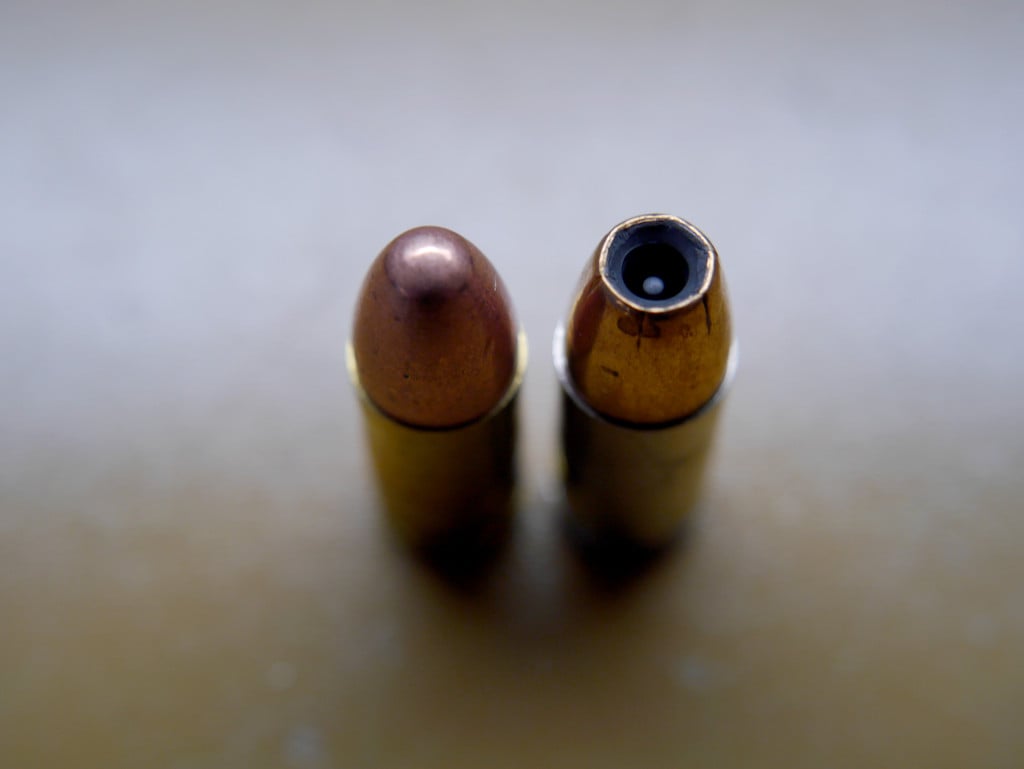
Take an FMJ round, then drill a hole in the tip. Hey look, the point of the bullet is now hollow. I wonder what we could call it…
Ok, it’s a bit more involved than putting a hole in a round with a drill press but still.
That hole is there to create a weakness.
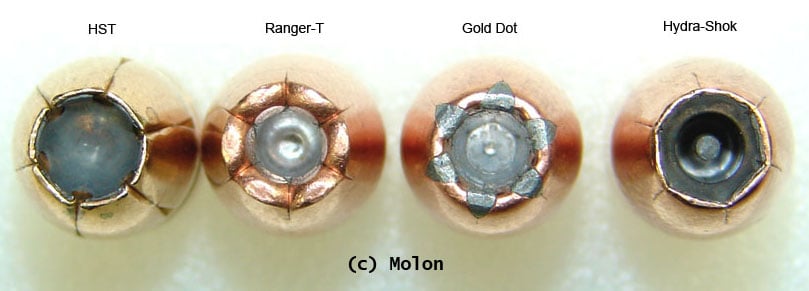
Overhead Hollow Point Comparison, ar15.com Molon
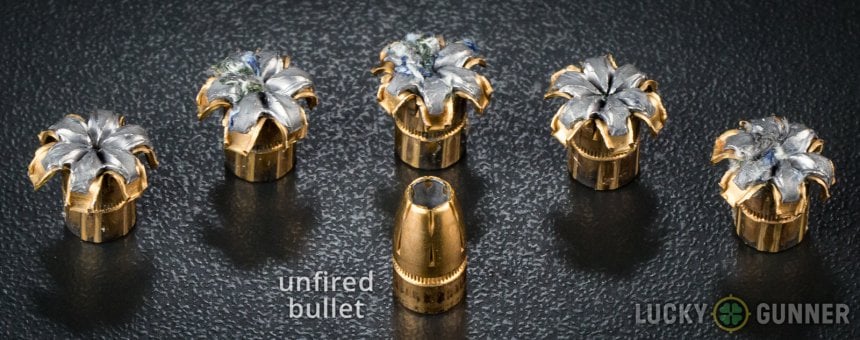
That weakness causes resistance when it hits something squishy and that resistance causes the bullet to start expanding. That expansion is the key point.
Remember Newton’s Law: energy cannot be created or destroyed, only transferred. With the expansion, the majority of the energy from the shot gets dissipated into the thing what you shot.
Ideally, this results in a much larger wound cavity and no exit wounds meaning the bullet stops inside the body. Chance being what it is, that doesn’t always happen exactly as planned but there it is.
147 Federal HST Expansion
To finish up here, I want to take a moment to explain what a hollow point isn’t.
First off, it’s not some magical death talisman. Aside from how Hollywood likes to portray them, the person isn’t going to go flying across a room if you so much as graze their shoulder. All it means is that this bullet is going to impact a bit harder and probably not punch all the way through someone. If it does go through, it’s probably not going to have much power after that.
It’s also not a “cop killer” round as some like to paint it. Even low-end body armor is far more likely to stop a hollow point than it will an FMJ round.
Finally, barriers and such aren’t going to affect hollow points as much as you would think.
First off, they need a great deal of resistance to expand which the momentary contact with a barrier just isn’t enough to cause. Mind you, it will start to expand in most cases but they’re made to fully expand via soft tissue contact. Secondly, most hollow point rounds made in the USA are meant to satisfy the FBI Ballistic Test requirements.
They’re pretty extensive so I’ll just give you the Reader’s Digest version: gel penetration of a minimum of 12 to 18 inches through bare gel, heavy clothing, steel, wallboard, plywood, and glass.
5 Shots into Ballistic Gel
Conclusion
Like I said in the beginning…FMJ for practice and hollow points for everyday carry and such.
Does that mean you should never practice with hollow points?
Heck no!
You need to know how your gun is going to react with that ammunition. Guns don’t always like every bit of ammo you feed it. Put at least a box or two through your gun when practicing but, beyond that, save yourself the money at the range.
Recommendations