
[Review] Primary Arms HTX-1: Best American-Made Pistol Optic?

The Primary Arms HTX-1 is an American-made enclosed emitter reflex sight - but is the optic that calls Houston home worth your money? We test it to find out.

Retired LEO. SWAT Commander. POST/NLEFIA/USCCA Instructor. Former FFL. Gun Writer 10+ years
We review products independently. When you buy through links on our site, we may earn a commission to help support our testing. Learn more.
Primary Arms HTX-1 Pros & Cons
Pros
- Fits 95% of optics ready guns
- Enclosed emitter
- ACSS Vulcan option
Cons
- Expensive
The Bottom Line
The HTX-1 is an all-American, hard-use, enclosed emitter optic with a price to match.
American-made optics are rare, and American-made enclosed emitter optics...even rarer. Primary Arms is trying to change that with the HTX-1.
The HTX-1 is an abbreviation for Houston, Texas, where it is designed and made. For consumers wanting to keep their dollars state-side, it offers an opportunity to get a well-made optic made right here in the USA.
The HTX-1 was marketed with words like “innovation” and “revolutionary," but is the HTX-1 truly a revolution or just another marketing gimmick?
I got my hands on one, mounted it up, and tested it at the range over the course of 300 rounds to find out.
Keep reading as I dive into the specs, features, and range performance of this optic.
Table of Contents

How We Tested the Primary Arms HTX-1

For this review, we tested the HTX-1 shooting for accuracy and also ran a series of drills on an array of steel targets.
I went through 300 rounds of ammunition, using both practice ammo in the form of AAC 115gr FMJ, as well as a 124gr Federal Premium HST defensive ammo.
Primary Arms HTX-1 Specs & Features
Specs
- Weight: 1.74 oz.
- Battery Life: 10,001 - 25,000 Hours
- Illumination Settings: 11 settings (3 night vision)
- Dot Size: 4 MOA dot (optional ACSS Vulcan 240 MOA)
- Objective Lens: .88 x .64”
- Waterproof: Yes
- Footprint: Glock MOS/Trijicon RMR
- Battery: CR2032
Features
- Autolive (shake awake)
- Modular chassis
- Made in America
- Waterproof/Shockproof
Internals
While the external features on the HTX-1 are arguably more exciting for the innovation they bring, the internals complement the entire package nicely. First off, there are two different models (and price points) to choose from.
The first is a standard red dot, 4 MOA in size. The second is the 4 MOA dot surrounded by the ACSS Vulcan segmented ring that is 240 MOA.
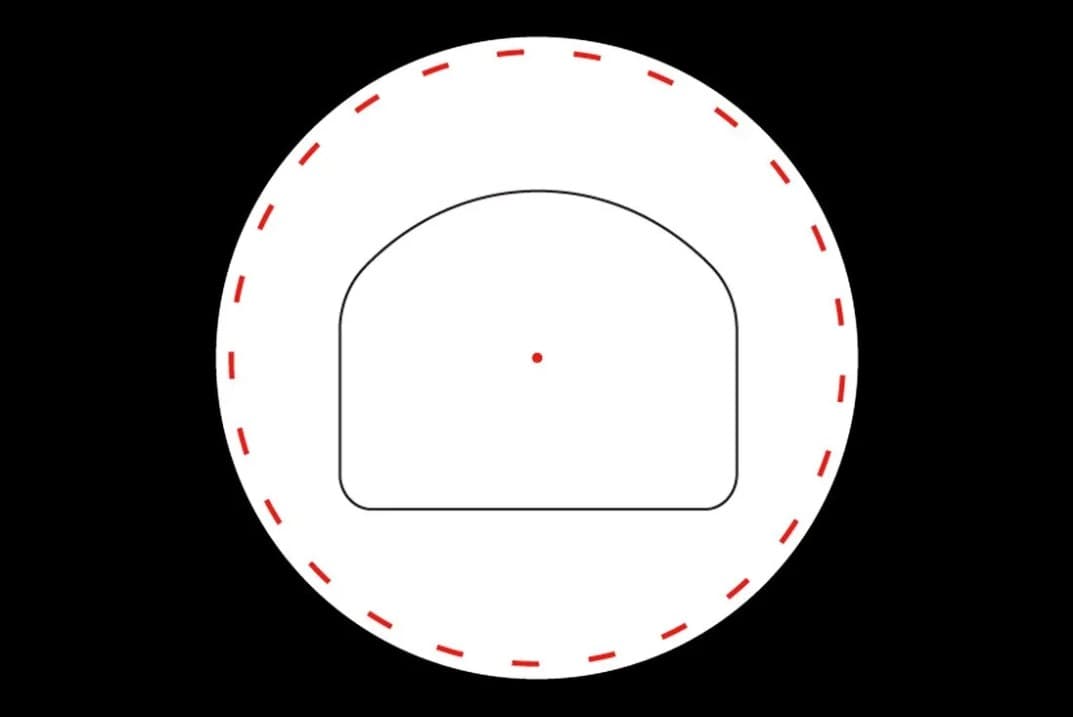
Brightness settings are plentiful, with eleven total levels possible, the lower three of which can be used with night vision. The uppermost brightness is very strong and easily capable of being used in full sun.
Another important feature is Autolive, Primary Arms’s version of shake awake. On the ACSS Vulcan model we tested, the outer ring drops out after 30 seconds.

After three minutes, it shuts down too. This feature saves a lot of battery life, and I was never able to move the gun and not see the dot.
While both the 4 MOA dot version and the ACSS Vulcan version both indicate an approximate 20,000-hour battery life, it would appear that the dot-only version would likely have better battery life. This is based simply on the lack of illumination that the same battery would have to support.
Externals
One of the most exciting updates regarding external features is the patented chassis system Primary Arms created for the HTX-1. It accomplishes a couple of things very neatly.
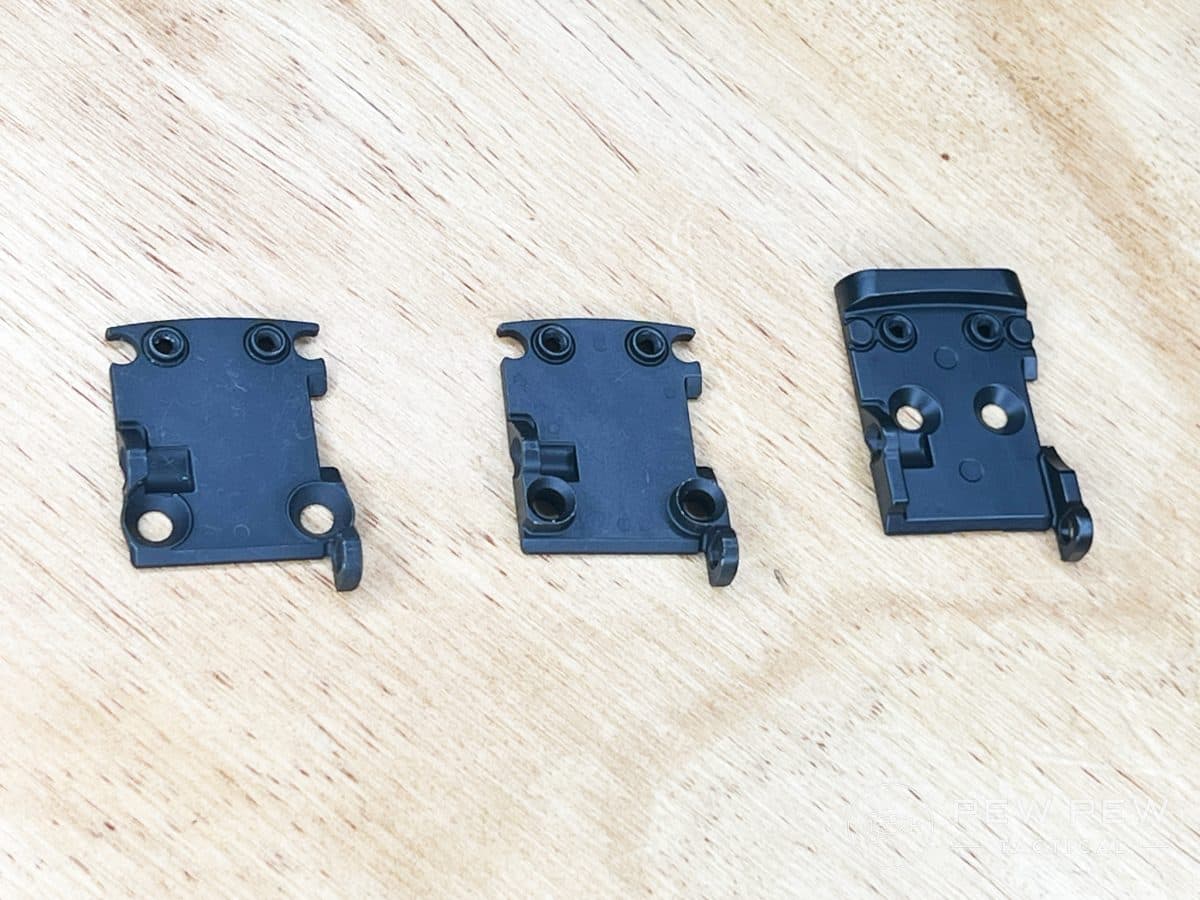
First, it does a great job of securing the optic, and second, it mounts the optic low enough that co-witnessing with standard-height sights is possible.
Interestingly, the system is non-footprint specific. So, it doesn’t matter what you mount the HTX-1 on.
According to Primary Arms, the HTX-1 will mount up to about 95% of pistols cut for optics available on the market. You might wonder how they achieved this.

For our test, I mounted the HTX-1 to a Gen5 G19 MOS using one of the three chassis in the package. In the box, I looked over the mounting instructions and saw a guide that pertained to the handgun I’d chosen.
The chassis for the Glock MOS was in a small yellow bag, and the screws were in a separate black bag. All the color-coding correlated to the diagram-filled instructions and couldn’t have been easier to follow.
I first mounted the chassis to the slide and torqued it to spec. I noted the chassis did not take up the entire space of the optic cut.
This was because the HTX-1 fills this area closer to the rear sight. I placed the optic in the chassis, then inserted the appropriate screws in the front.
The distance and clearance make this a tough reach for the T-10 Torx you need, but Primary Arms thought of that. They include an extended wrench so you can complete the task.
What was very different was installing a screw through the side of the chassis into the body of the HTX-1. I can’t think of an optic that utilizes this approach, but it’s cool because it saves space while still securing the optic.
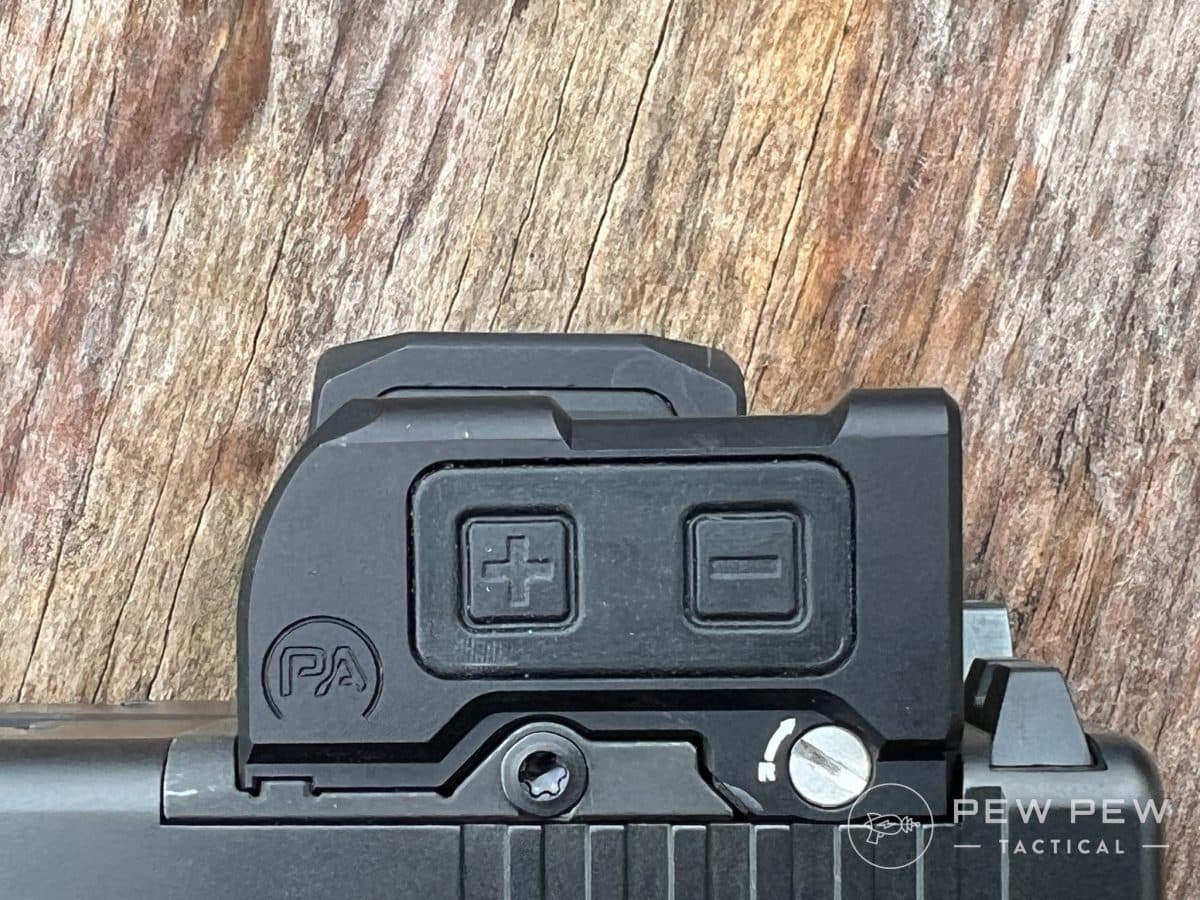
The result, when all is said and done, is an extremely low-sitting optic mounted to the slide. It’s so low, in fact, that I could still use the standard polymer sights on my G19 while looking through the optic.
It’s very trendy right now to have enclosed emitters that look like mail or bread boxes on top of your gun. The HTX-1 is low-slung, sitting less than an inch above the surface of the slide.
This is accomplished by the chassis, but also due to the design of the body of the HTX-1 having a low base. The viewing window is ample, without feeling like a giraffe looking over a short wall.
The body is made from 7075 aluminum and features an anodized finish. The left side features up and down buttons for adjusting brightness, while the right contains the battery compartment.
I’ve learned that opening these with a big screwdriver is one of the easiest ways to wreck your finish. Thankfully, Primary Arms includes a 4-lugged plastic wrench that will open and close the battery compartment without marring that beautiful black aesthetic.
The eyepiece lens is protected with a thicker collar, as is the objective side. Notably, the front lens is even more protected because it is recessed behind shoulders that extend past the glass.

In addition, the lenses are covered in multi-coat, designed to increase light transmission while simultaneously reducing glare.
In summary, the unit is tank-like, without being too tall. Plus, it’s secured to the G19 with a total of 6 screws.
How Does the HTX-1 Shoot?
After mounting the HTX-1, I took it to the range and spent some time zeroing at 10 yards. Out of the gate, the optic was okay on elevation but well left of aim.
Using a small screwdriver, I adjusted windage to the right several clicks at a time, then confirmed with three-shot groups. With ear pro on, I could barely hear the detents, but I could feel them.

Most importantly, I saw the effect of the windage adjustment and finally shot a three-shot group of touching rounds in the bullseye. For the remainder of testing, the zero held its place.
I then used the HTX-1 from a draw to try to quickly acquire targets and fire shots on steel. It is here that I have two mindsets.
As an instructor, I will tell you that you shouldn’t rely on a giant 240 MOA ring on the outer periphery of your dot to acquire a sight picture. You should be practicing your draw stroke repeatedly so that you automatically present to a target focus with your dot confirmed.
However, as someone who shoots a lot of different guns and dots, I can tell you the ACSS Vulcan ring is pretty darn cool, and a bit of a cheat code. If my presentation was a little bit off, the outer ring clued me in to make quick adjustments and break my shot.
I feel like it actually helped me reacclimate to the Glock grip angle during presentation. In addition, at closer distances, if the ring was on target, I would often hit with little confirmation.
In short order, I was running at speed, hitting an array of steel with confidence. The HTX-1 was great for transitioning between targets, and my confidence built the more I shot it.
Adjusting brightness was accomplished by the – or + buttons on the left side of the unit. These are rubberized and sized big enough that even fat thumbs can activate them.
As far as reliability, this was a fairly short introduction. I fired 300 rounds, primarily of AAC 115gr FMJ, but also some Federal 124gr HST. The HTX-1 stayed locked in the chassis and did not move.
It also never came off the zero I established. While I did not outright abuse the HTX-1, I wasn’t exactly careful with it either. Continued testing will reveal the legacy of its reliability.
Primary Arms HTX-1 View-Through
One of the things I appreciate most about the HTX-1 is the size of the viewing window without adding a bunch of height. You can see it here, compared side by side with the Trijicon RCR.
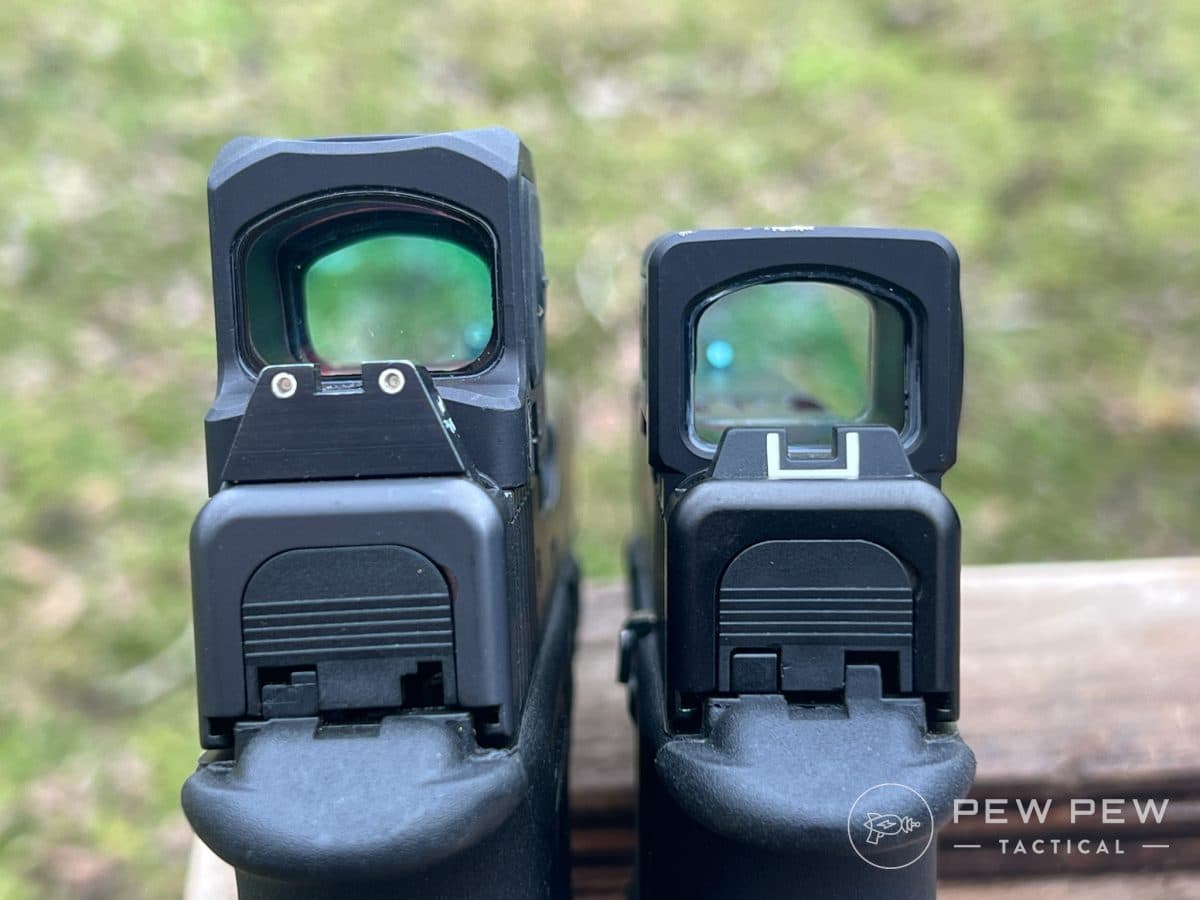
I’m also including a video of the view-through from a few orbiting angles. Keep in mind, I tested the ACSS Vulcan model, which has the outer ring and is a little more expensive.
Who Is the Primary Arms HTX-1 For?
By all accounts, this is a hard-use red dot designed to run in austere environments and conditions. Not only is it ruggedized, but the feature set lends it to serious shooters.
Another level of appeal comes from those who really want an American-made optic. It is expensive to manufacture things in our country for a number of reasons I won’t delve into.

Should long-term testing prove the electronics' reliability, I could easily see government contracts for this optic in professional applications as well.
The HTX-1 is a very new initiative from Primary Arms, and it falls within their PLx, or platinum (read premium), line. While there are several optics within the PLx lineup, this is their first enclosed emitter.
As mentioned, the HTX-1 is noteworthy because it is made in Houston, Texas, and joins a very limited club of American manufacturers making red dots in the United States.
By the Numbers
Clarity: 8/10
Multi-coat lenses, ample window, and a low profile that doesn't make you sacrifice that view-through.
Durability: 7/10
Long-term reliability is an unknown, but on the onset, it offers a solid build with a 6-screw mount...and it survived initial testing.
Ease of Use: 8/10
The HTX-1 has an innovative mount, solid instructions, and all the hardware you need to get it running. On the range, it is simple to use. Minor dock of points for the awkward T-10 Torx reach during install, though.
Shooting Performance: 8/10
Based on our limited test, the HTX-1 had perfect reliability. It did not loosen in its mount, lose zero, or flicker or dim during recoil.
Value: 6/10
This is an expensive optic, though it is competitive in price with other red dots in this category.
Overall: 7/10
FAQ
Final Verdict
I’m glad to have another American-made optic in the hard-use category. While it is expensive, it’s fairly competitive for the segment.

The innovation of the chassis mount is pretty cool, and initial tests seem to indicate the HTX-1 will hold up to some abuse, though time will tell.
Will you be dropping some coin for the HTX-1? Let us know in the comments below. For more options, check out Best Enclosed Emitter Pistol Optics [All Budgets].
Meet the Experts

At the helm of this review was Pew Pew Tactical Content Producer Sean Curtis. Sean spent over two decades in law enforcement, where he became a POST-certified handgun instructor and NLEFIA Red Dot Instructor and received CLEFIA Advanced Firearms Instructor Training and AR-15 armorer training. He has since attended a variety of training, including Tactical Performance Center Handgun Mastery & Carbine Mastery, and earned USCCA rifle instructor certification -- all using optics to accomplish his training and missions.
This review was edited by Editor-in-Chief Jacki Billings, who runs Pew Pew Tactical’s experienced team of reviewers. Jacki is a member of the Society of Professional Journalists, ACES: Society for Editing, and the Professional Outdoor Media Association, and has her bachelor’s degree in Mass Communications. She has worked as a media professional for close to 20 years, specializing in gun media for almost 10 years, and has worked as an editor for five years. She uses her extensive professional journalism and editing experience to set testing protocols and editorial standards.