
How To Reload Your Shotgun: Load Like the Pros
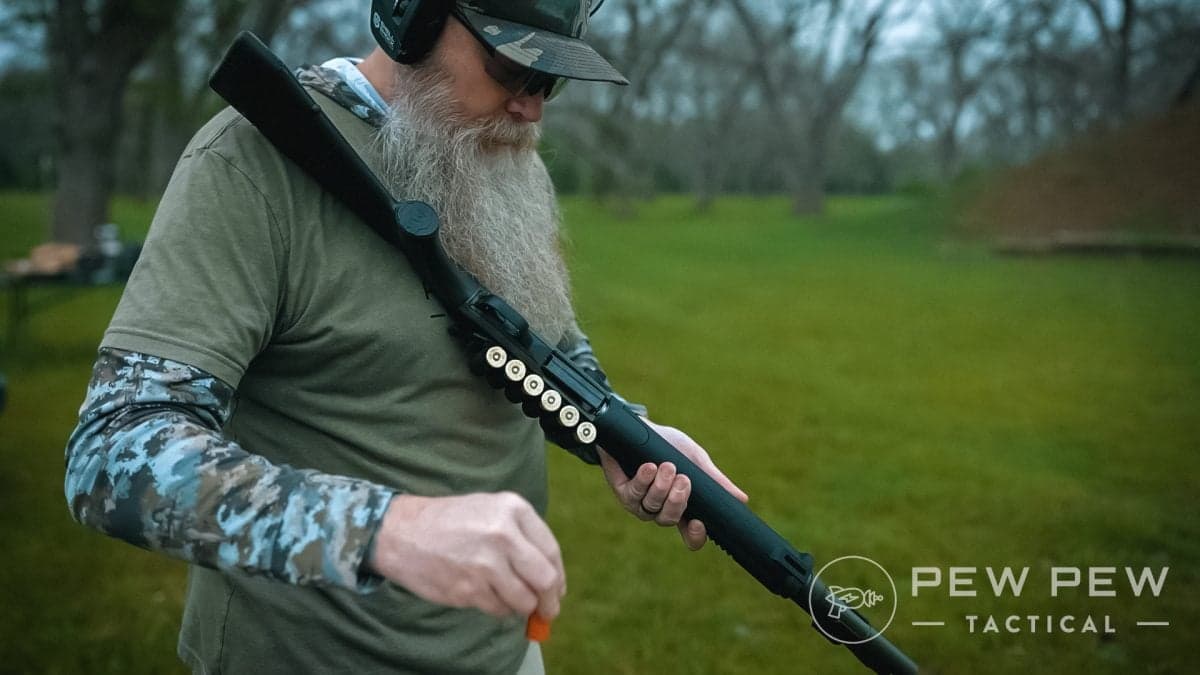
Do you know how to reload a shotgun? We cover all the techniques and break down the steps for reloading your shotgun.

Attorney. Firearms instructor. IDPA/USPSA/3-Gun Competitor. Author of "Dry Fire Primer"
We review products independently. When you buy through links on our site, we may earn a commission to help support our testing. Learn more.
I’m a shotgun nut. I love scatterguns and always have. My first gun was a .410-gauge Remington 870 that I received at the age of 8.
That gun and I were absolute terrors to squirrels and rabbits during the fall season. I recognize the strengths of shotguns, but I also acknowledge their weaknesses.
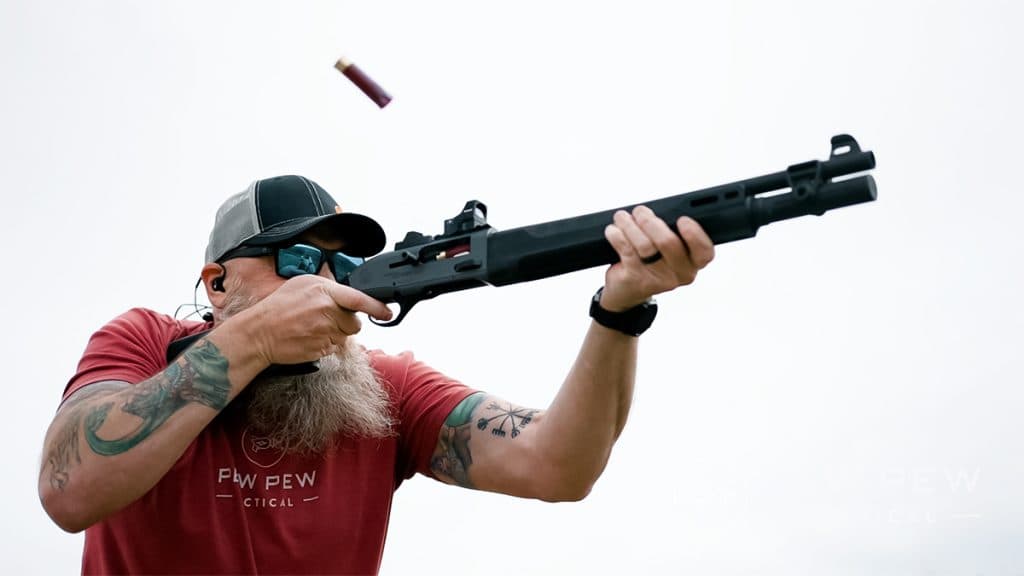
One weakness often cited is how slow shotguns can be to reload. Specifically, the traditional tube-fed shotgun can be exceptionally slow to reload and requires a little more skill than slamming a box in the gun and hitting the bolt release.
Reloading a shotgun efficiently requires technique, and we plan to teach you some of those techniques today.
We are going to cover three types of shotgun reloads. Simple admin reloads, competition reloads, and tactical reloads.
Shotgun Loading Positions
Depending on the type of reload and your goals, you will need to assume one of three recognized shotgun reloading positions.
Shouldered
Shouldered means the gun is up in the shoulder with the firing hand typically supporting the weapon. These reloads use the support hand to load the gun. With a shouldered position, the gun is oriented to the target and ready to fire immediately.
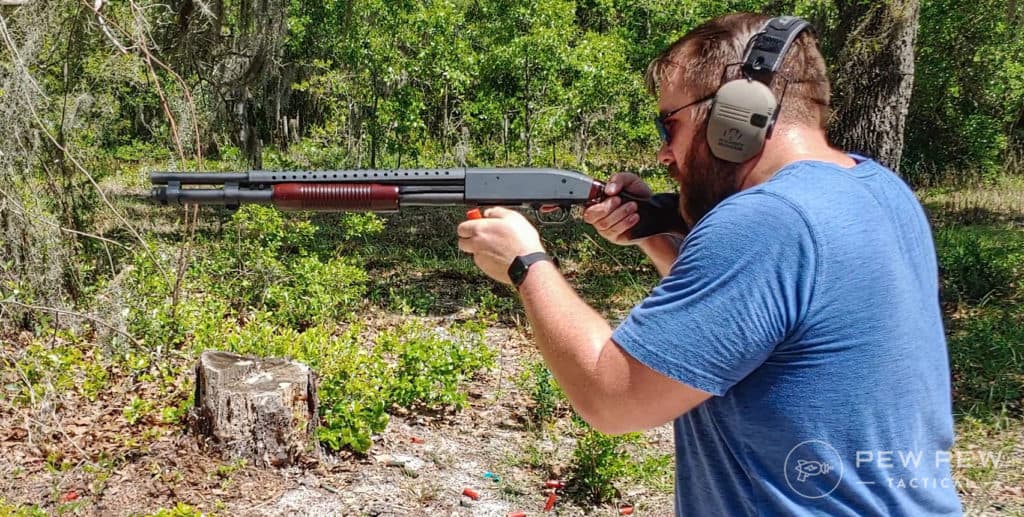
The shouldered reload is typically used for tactical reloads and some limited competition use.
Port up
In the port-up reload position, the loading port is pointed sideways or facing up. The gun is either upside down or 90 degrees, with the stock locked under the shooter's dominant shoulder. Either hand can be used to load or support the gun.

The port-up position is typically used in competition settings or for admin loads. It allows for a faster multi-shell reload than other options.
Violin
The shotgun violin position has largely replaced the port-up position. It’s a good balance of speed in loading the gun and shouldering to shoot the gun. To assume a violin position, you’ll rotate the gun until the ejection port faces up.
The stock goes up and over the dominant shoulder, and the support hand holds the forend. The dominant hand loads the gun, and the loading port faces the dominant hand side. This allows for a speedy and controlled reload.
How to Reload Your Shotgun
Admin Load
An admin load is loading the gun for the range, your patrol car, or anything else that doesn’t require speed. It’s just loading the gun, essentially.
- Point the gun in a safe direction. No specific position is required as long as it's pointed in a safe direction.
- Using either hand, load one shell at a time into the magazine tube. Press the shell fully into the magazine tube.

Most shotguns are loaded with the chamber empty because shotguns aren’t drop-safe, as a rule of thumb. That’s all there is to an admin load.
Competition Loading
Shotguns have been used for sporting purposes since their inception. For this article, we are talking about dynamic shooting sports. This isn’t trap and skeet. It’s shooting sports like 3-Gun and IPSC shotgun, where reloading needs to be quick and efficient.

These reloads are run via an ammo-holding device known as a caddy. This isn’t like a golf caddy, but now that I mention it, having a guy pass you shotgun shells sounds fun.
A caddy is a belt or chest-mounted device that holds shotgun ammo. It’s designed for quick and efficient reloads.
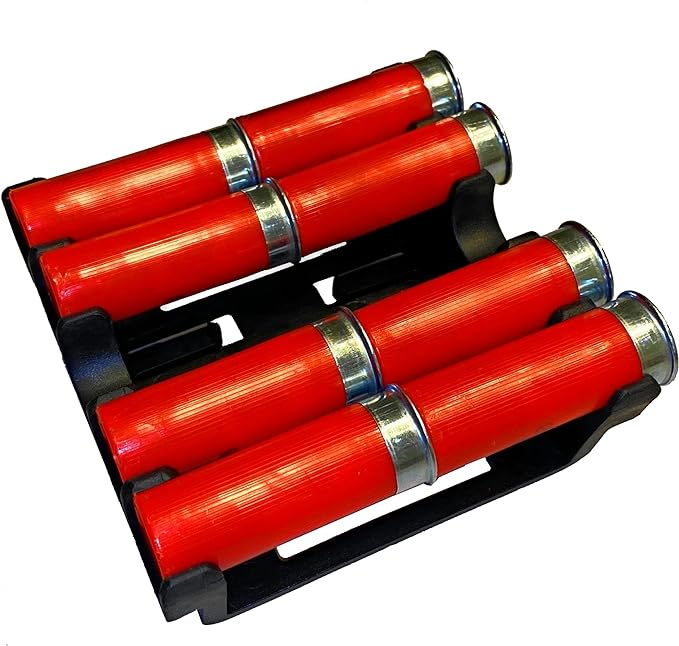
This also assumes you’re using a competition-ready shotgun with a loading port wide enough to support competition-style reloads.
These loading techniques can theoretically work in any gun, but a competition loading port is necessary if you want a fast, consistent, and intuitive reload. These ports are often wider and chamfered for a smooth reload.

There are three types of loads used in action shooting competitions.
Load Two
Load two, also known as the twin load, is a simpler method for loading a shotgun. It’s easier and requires less dexterity and practice to master. Also, you might only need to load two, and that’s enough reason to master the load-two technique.
Twin loading is much easier on an unmodified gun, meaning the loading chamber isn’t a competition-style design.

The load-two requires you to use a port-up or violin-style loading position. Shouldering the gun doesn’t really work. You’ll need to pick whether you want to use your strong hand or your weak hand to load. The dominant hand is better for multiple shell loads, but I’m no pro.
Use what’s faster and easier for you.
- Retrieve two shells from your caddy.
- Stack the shells vertically in your hand. The primer should be against your thumb, with the shells held just by your fingertips.
- Bring them to the gun’s loading port at a slight angle, trying to stay in line with the port.
- When the shells are against the gun, you can move your fingers and use the pressure of your hand against the gun to keep the shells in line and in your hand. Your thumb should remain over the rear of the top shell.
- Push both shells into the loading port.
Be sure to keep your wrist straight during the loading process, and don’t use it to apply pressure. The movement should come from your elbow and drive the shells into the magazine tube.
Quad loading
Loading four shells at a time is a little more complicated. It requires a fair bit of practice but uses many of the basics you use when loading two.

- Start with the gun in a violin or loading port-up position.
- Retrieve the shells with your chosen hand. Stack the shells two vertically in a row of two. You’ll have an inside and outside row. Only the tips of your fingers will support the bottom row, which is closest to your wrist. Your thumb will be on the primer of the top shell of the bottom row.
- Bring the shells to the gun, trying to keep them flat.
- Line up the bottom two and then roll the top two away from the bolt and alongside the gun’s receiver. Your finger pressure will keep the top row retained.
- Push the bottom row into the magazine using downward elbow movement.
- The top row now becomes a twin load. Support it with the tips of your fingers until it's flat against the gun, with your thumb on the brass. Drive the shells into the gun using the same downward elbow movement, and you’re good to go.
Check out this video from Lena Miculek on how to execute twin loads and quad loads!
Match Saver Load
Finally, let’s look at using a match saver. A match saver, or similar device, positions a single shell just forward of the ejection port. The idea is simple: You run dry unexpectedly and need to load that chamber.
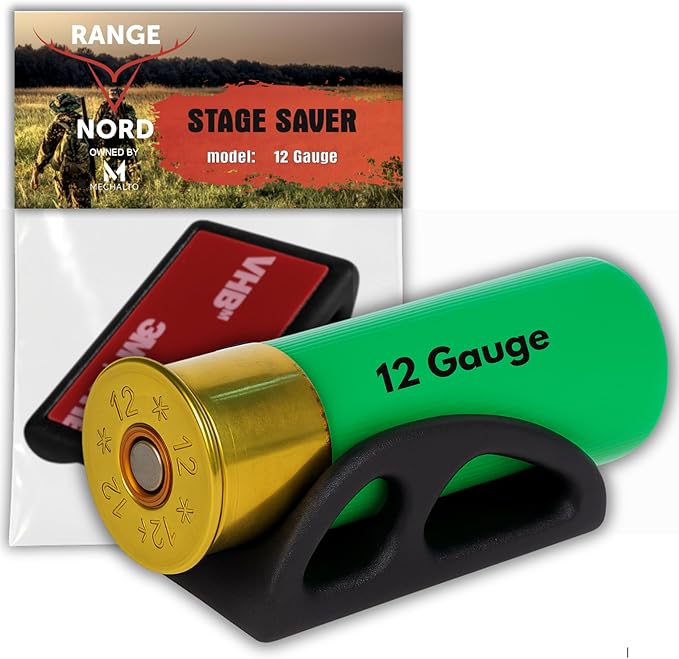
- You use the fingers of your support hand to push the round from the Match Saver to the chamber.
- In the same movement, have your hand reach the bolt release and press it.
That’s all there is to it! Check out the demonstration from Black Ring Tactical below!
Tactical Loading
In defensive shotgun situations, having to reload is quite rare. Typically, when the shotgun’s deployed, it’s capable of ending the threat with just the rounds in the tube. Exceptions exist, and for that reason, shotgun loading should be a part of your skill set.
Tactical loading a shotgun uses the shouldered position with the gun oriented towards the threat. It also assumes you’re loading through a side saddle or a belt/chest-mounted system. Unlike competition caddies, the tactical shell holders use loops, which offer greater retention.
Tube Load
The standard tube load is often used to top off a shotgun after it’s fired a few rounds. This keeps the gun going without needing to reload from empty. Tube loads can be done with one round or two, but they are not the same as twin loading.
- Using your support hand, you’ll retrieve a cartridge from your side saddle or belt. You aren’t just plucking the round from the device.
- When drawing a shell from either platform, you’ll rotate your hand around until your thumb is facing downward.
- Draw the shell or shells with your thumb and pointer finger. If drawing two, you’ll position both between your thumb and pointer finger.
- Rotate the hand up and toward the loading port.If you’ve drawn one round, rotate it to meet the loading port and position your thumb over the brass. Use your elbow to press it into the tube.
- Press the first shell using your elbow, then reposition the thumb behind the second round and press it in.
Loading a single shell is easier and more intuitive while loading two is faster overall. I recommend starting with single shells, as it is the easier option to reload and successfully execute under stress.
Port Load
The port load is the tactical version of the match saver. You will use this if you’ve run dry and need to get the gun ready to fire again as quickly as possible. This is also known as the emergency reload.
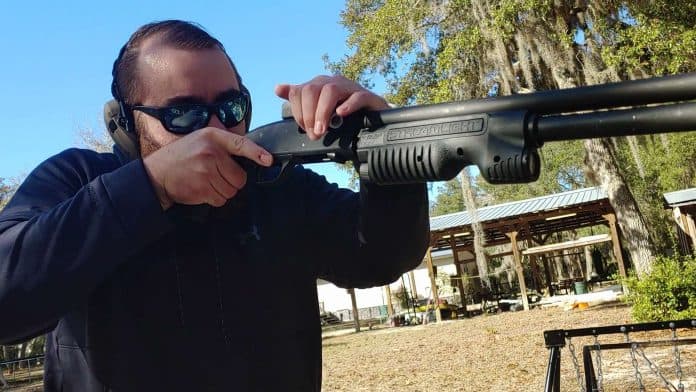
The idea is to grab a single round, load it into the open ejection port, and then close the action as fast as possible.
You can go over the top of the gun or under the gun. Typically, under is faster for pump actions. On a semi-auto, it doesn’t matter a whole lot, but under tends to be a little more intuitive for most people.
For the “under” method:
- Make sure the thumb of your loading hand is pointed forward and your palm is facing up.
- Grasp the shell with your fingers.
- Come under the gun and press the shell directly into the chamber.
- Close the action and assume a firing stance.
Chris Baker from Lucky Gunner has some excellent insight into defensive shotguns reloads in the video below!
Meet the Experts
Pew Pew Tactical author Travis Pike wrote this article. Travis spent a lifetime shooting as a kid and later joined the United States Marine Corps, where he spent five years as an infantryman. His experience as a machinegunner, recreational shooter, and hunter has given him unique insight into various weapon platforms. Additionally, Travis has thousands of articles to his name with a variety of publications, and has tested countless guns and other firearm accessories.
Editing and adding to this article is Pew Pew Tactical Editor, Wyatt Sloan. Wyatt is an NRA-certified instructor with previous experience as a USPSA competitor, long-range shooting, and hunting. Wyatt personally owns over 200 firearms and has 10 years of home-based FFL firearm sales. He has over a dozen shotguns himself and definitely has big love for scatterguns.

Editor-in-Chief Jacki Billings runs our experienced team of reviewers. She is a National Rifle Association Basic Pistol Instructor as well as a member of the Society of Professional Journalists, ACES: Society for Editing, and the Professional Outdoor Media Association. Jacki has a bachelor’s degree in journalism and has worked as a media professional for close to 20 years, specializing in gun media for almost 10 years. With 2,000+ articles to her name, she uses her professional journalism and editing experience to set testing protocols and editorial standards for Pew Pew Tactical.
Final Thoughts
Loading shotguns isn’t hard, but there is more to it than putting the magazines in and getting after it. Shotguns will always be slower to reload, but a little practice and proper technique can help reduce that gap.

Remember, a slow, successful reload is better than a botched fast one. And as always, safe practice is the best practice! Be sure to utilize training tools like snap caps to help you train frequently and safely.
With that said, which techniques do you use? Let us know in the comments below! Don't have a shotgun yet or are looking for another one? Check out our article and video on the Best Tactical and Home Defense Shotguns!