
Rifle Caliber Guide [Definitive Guide+Videos]
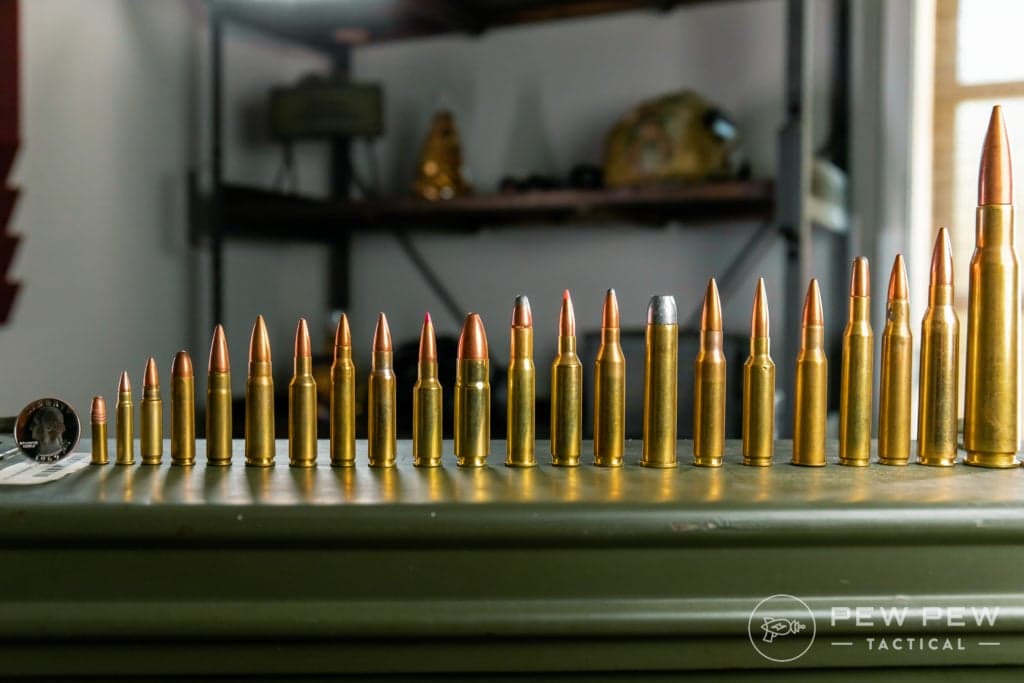
Quickly learn about the pros and cons of popular rifle calibers with our handy guide. We also cover average price, recoil, and recommended ammo for each.

PPT Founder. NRA Pistol Instructor. USPSA/3-Gun/NRL22 Competitor. 250+ articles
We review products independently. When you buy through links on our site, we may earn a commission to help support our testing. Learn more.
Want to learn all about the most popular rifle calibers? You're in the right place!
We'll cover the pros and cons, average price, recoil, and recommended ammo for a bunch of popular rifle calibers.
There are hundreds of firearm calibers, so in order to keep this article from becoming a 500-page dictionary, we are just covering some of the more popular calibers.
And for the calibers we shoot regularly, we've got some short video clips!
Table of Contents
What Does Caliber Mean?
Here are the definitions and units of some of the things we'll be using to compare the different calibers.
- Bullet weight: Measured in grains (gr). 7000 grains make up a pound, so it's a really small unit.
- Velocity: Speed of the bullet in feet per second. This is expressed as either ft/s or FPS.
- Energy: Measured in foot-pounds (ft/lbs), a rough approximation for the power of the round.
And for terminology's sake, a "bullet" is just the metal projectile while the entire thing is called a "cartridge" or "round."
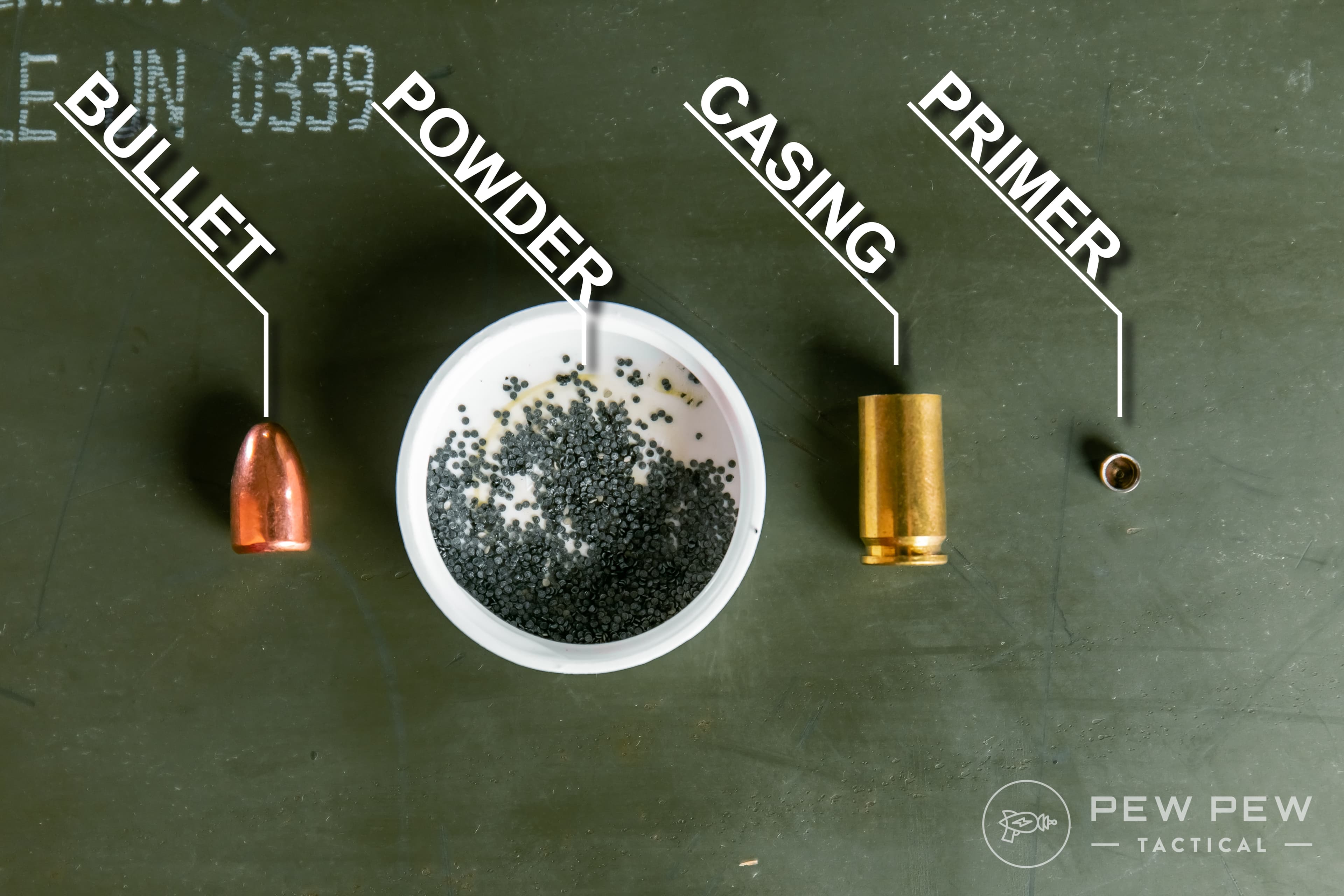
So what is "caliber" exactly?
Caliber is the size of the bullet's diameter and can be measured in both imperial (inches) and metric (mm) units. If it doesn't say "mm" after, it's likely in inches (because 'Murica).
Popular Rifle Calibers Part 1: Small & Intermediate
Like we said, there are a lot of calibers we're going through. We separated this guide into two parts, with Part 1 covering small and intermediate cartridges, and Part 2 going over larger, full-power cartridges.
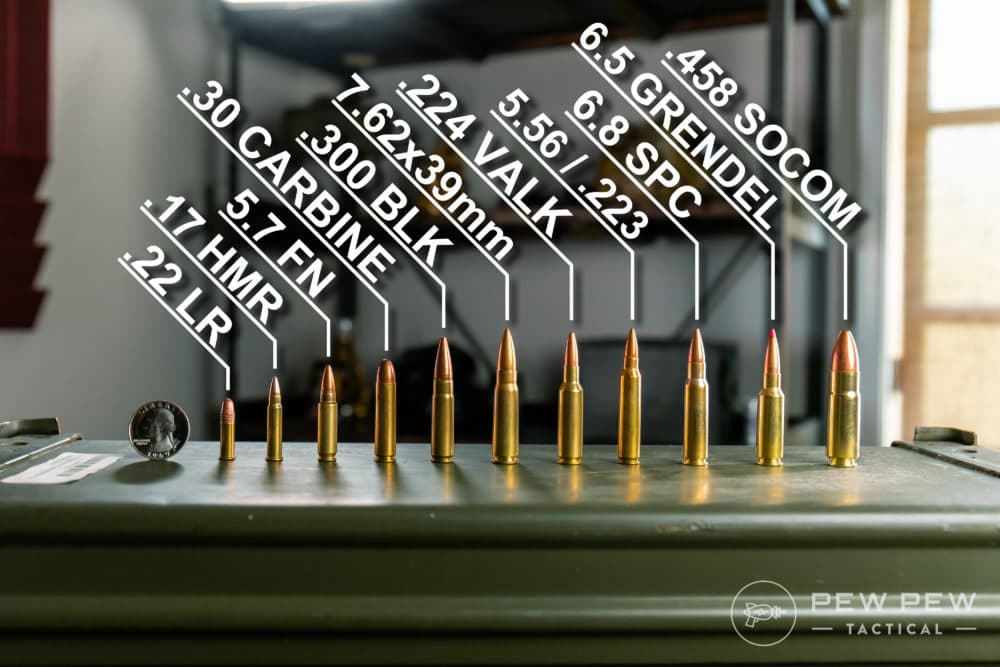
1. .22LR
Specs
- Bullet Weight: 30-40 gr
- Velocity: ~1,200-1,700 fps
- Energy: ~125-200 ft/lbs
- Price Per Round: ~$0.05
This tiny, low-recoiling round is popular for both rifles and pistols.
In fact, the .22LR is probably the most popular rifle round out there, thanks to its low recoil and low cost.
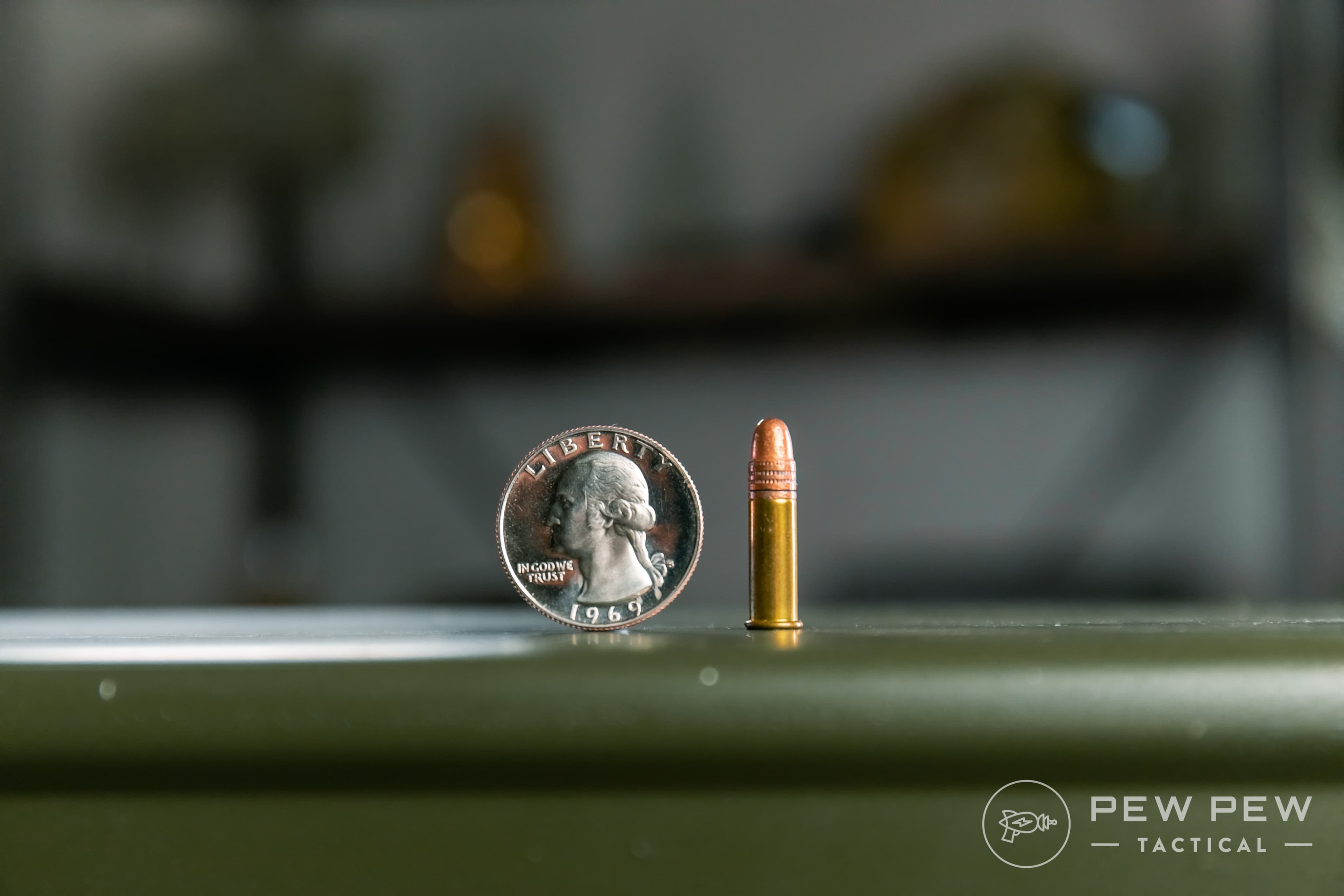
The LR stands for Long Rifle, but you will often hear people refer to .22LR simply as .22 due to its ubiquity and widespread use.
This is a rimfire cartridge because the firing pin hits the rim of the case instead of a primer in the center.

Its small size and high velocity make it ideal for hitting small game like squirrels at range, and its nearly non-existent recoil makes it a great round for beginners and children who want to shoot but don’t want the shoulder bruises that come with a larger round.
Here I am shooting a Browning Buckmark pistol in .22LR.
And when you move to a rifle, there is even less recoil. Below, I am shooting a Ruger 10/22 rifle chambered in .22LR.
Although .22LR is usually reserved for target shooting or small pests, that doesn't mean it's not deadly to human targets either. With the right ammo choice, you can get some surprising terminal ballistic results. However, we still recommend stepping up in caliber for serious defensive usage.
Take a look at our Best .22LR Ammo: Accuracy, Plinking, and Hunting.

2. .17 HMR
Specs
- Bullet Weight: 17-20 gr
- Velocity: ~2,350-2,650 fps
- Energy: ~250 ft/lbs
- Price Per Round: ~$0.20
The .17HMR (Hornady Magnum Rimfire) is an ultra-light bullet designed to have as flat a trajectory as possible for a rimfire round.
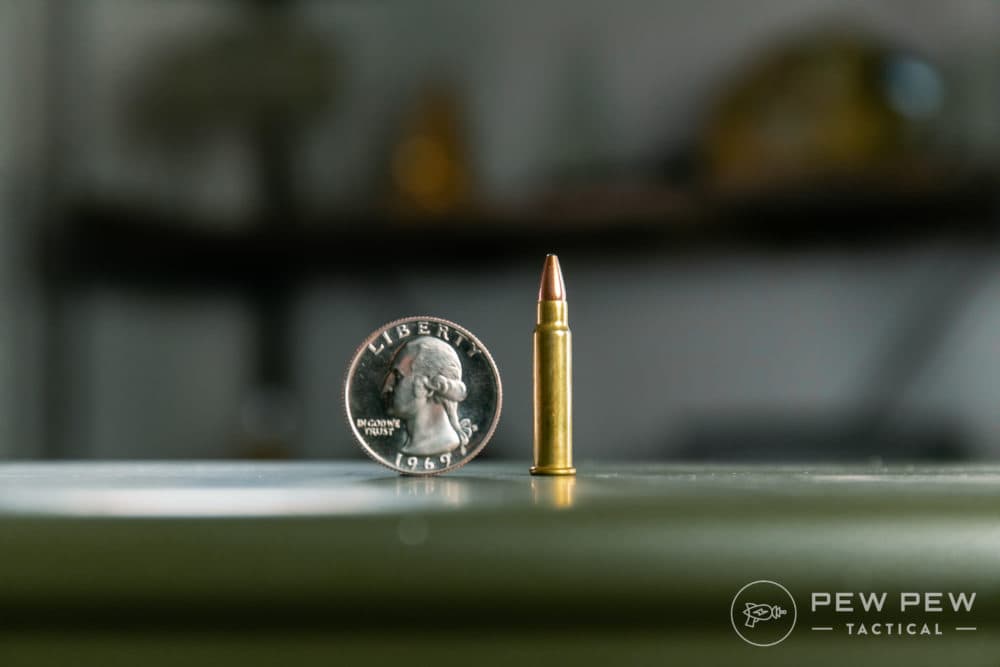
With .17 HMR, it has about twice the velocity of standard .22LR ammo, and puts out about 50-100% more energy at the muzzle.
Its flat shooting trajectory makes it great for precision rimfire shooters, while the energy it delivers downrange makes it good enough for varmint hunters looking to put down small game.
Having only sprung onto the scene in 2002, .17 HMR enjoyed a quick rise to popularity. There are dozens of loadings available, and new rounds are still being developed for it.
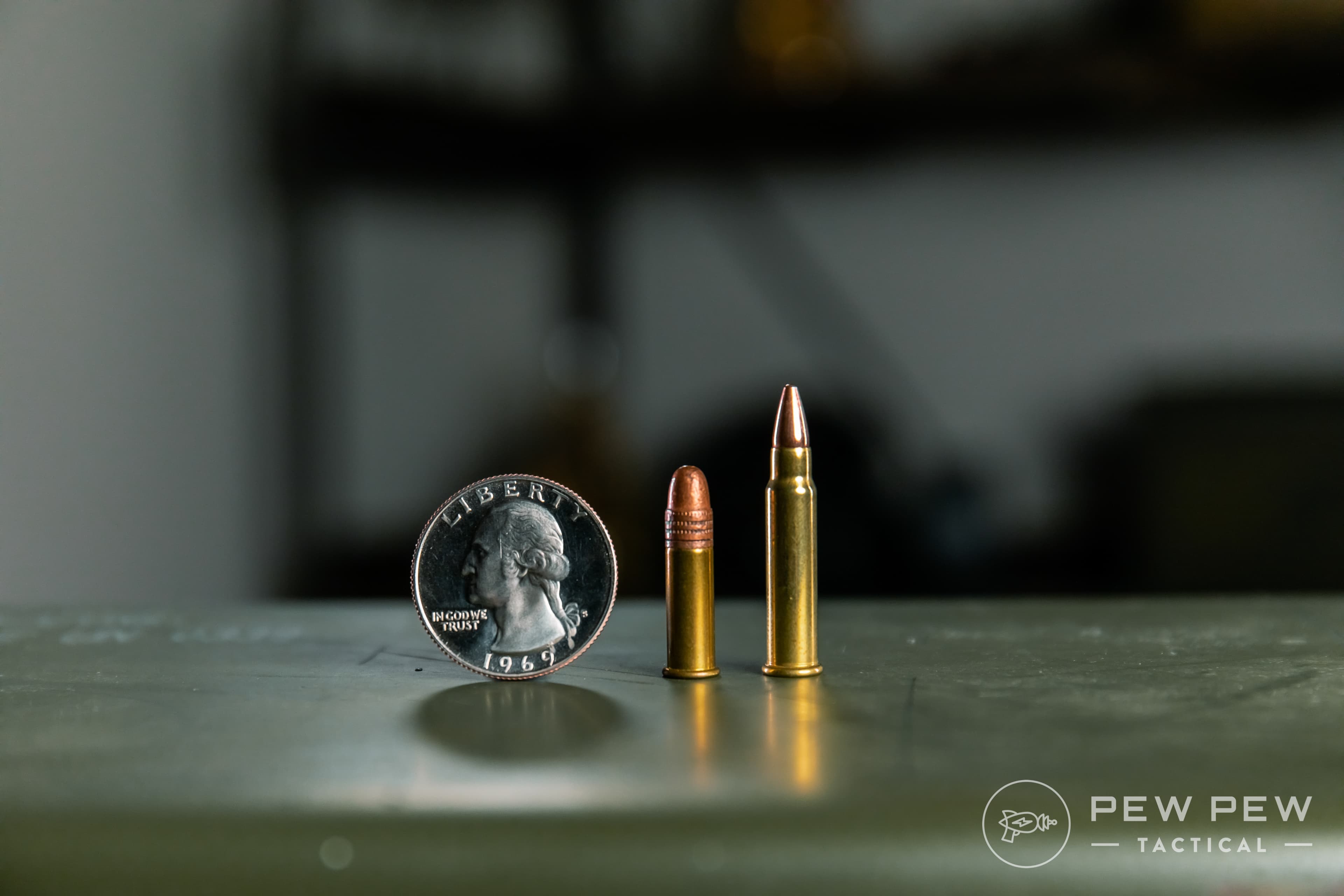
You can learn everything this caliber in our .17 HMR [Guide]: Best Ammo & Guns!
3. 5.7x28mm
Specs
- Bullet Weight: 23-40 gr
- Velocity: ~2,300-2,800 fps
- Energy: ~380-500 ft/lbs
- Price Per Round: ~$0.45
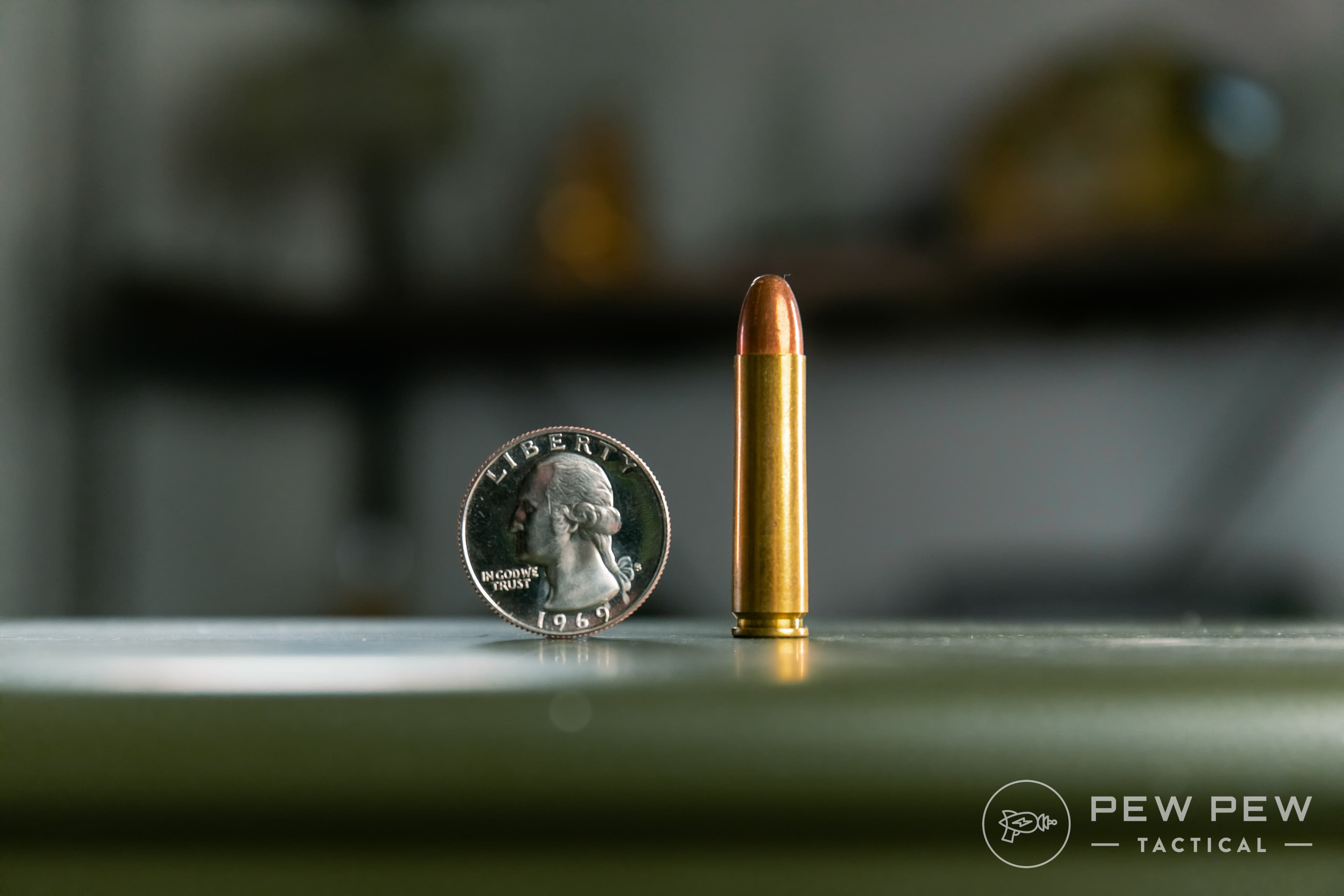
The 5.7x28mm, known colloquially as the 5.7, is an interesting little round that has seen a massive resurgence in popularity as of late.
Designed in the late 80s and early 90s by firearm manufacturer FN Herstal, the 5.7 was developed in response to a NATO request for a new combination SMG and pistol round that had better performance than the 9mm Luger.
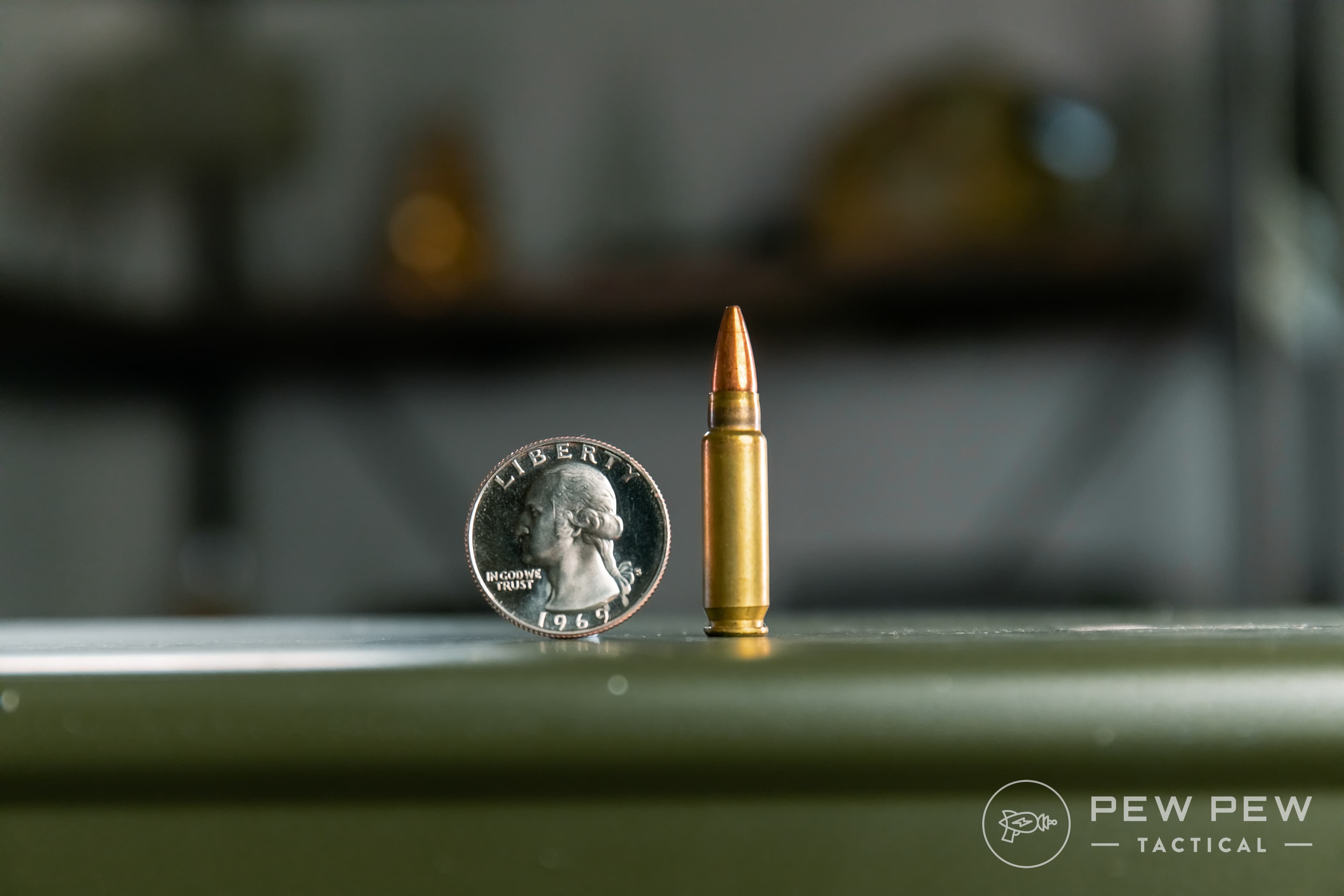
It was also partially designed to meet an additional request that the round should be able to penetrate soft body armor from that era.
FN set out to achieve all of this by using a small projectile going incredibly fast. It is essentially just a scaled-down version of the 5.56x45mm cartridge used in the ultra-popular AR-15.

The result is a very light round with very little recoil that shoots ultra-flat. These rounds do most of their damage by tumbling upon impact rather than expanding, and the results can be surprisingly devastating.
While 5.7x28mm is much more popular as a pistol cartridge, there are a few rifles available in it. The most popular by far is the FN PS90, followed by the Ruger LC Carbine.
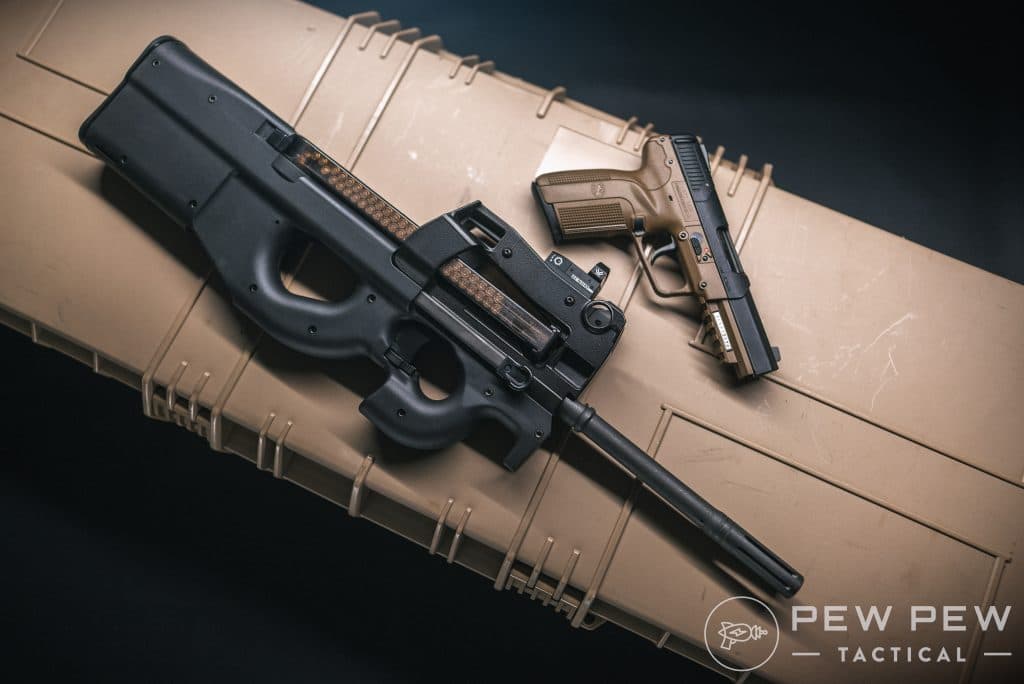
With the PS90, you get a whopping 50-round magazine that sits flush atop the firearm. Talk about capacity!
Check out our article on the Best 5.7x28mm Guns & Ammo!
4. .30 Carbine
Specs
- Bullet Weight: 110 gr
- Velocity: ~2,000 fps
- Energy: ~970 ft/lbs
- Price Per Round: ~$0.50
This one is a real blast to the past! While .30 Carbine is not super common nowadays, it saw plenty of military service from WWII through to the Vietnam War through its usage in the M1 Carbine.
The M1 Carbine was designed to bridge the gap between submachine guns like the Thompson and full-power service rifles like the M1 Garand.
Since it was meant to be an "intermediate gun," an intermediate cartridge was also designed for it. What came to be was the .30 Carbine.
It is a fairly low recoiling round, with ammo that doesn't weigh too much. Ballistically, it is pretty similar to stoutly loaded .357 Magnum.
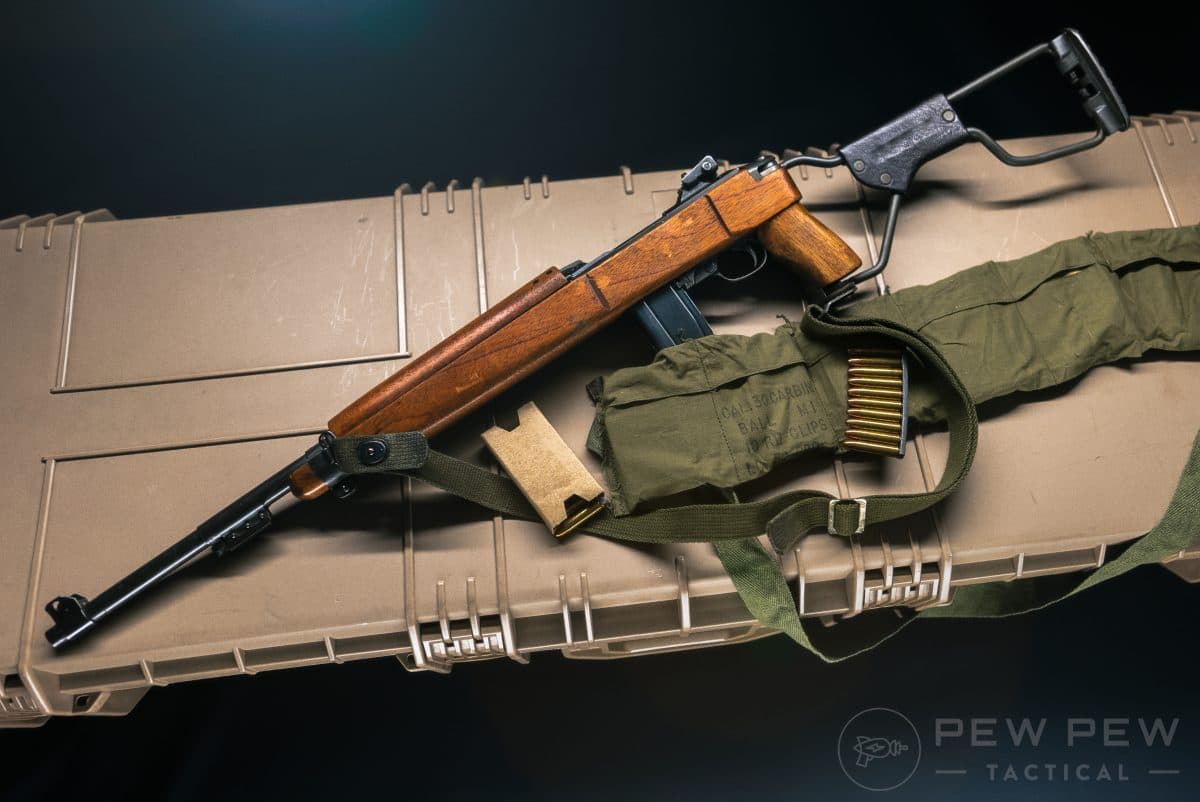
The vast majority of guns you will find in .30 Carbine are going to be M1 Carbines, whether original surplus or new production. These guns are insanely fun to shoot, and they just ooze historical significance and cool factor.
While the guns are limited, as is the ammo and loadings, there really isn't anything else that quite captures that same feeling.
5. .300 Blackout
Specs
- Bullet Weight: 90-220 gr
- Velocity: ~1,000-2,500 fps
- Energy: ~500-1350 ft/lbs
- Price Per Round: ~$0.60
The .300 Blackout (BLK) is a new-ish round that was designed to put a larger, heavier bullet in the AR-15 rifle with minimal modification needed.
You typically only need to swap barrels in most cases. It even fits in normal AR mags!
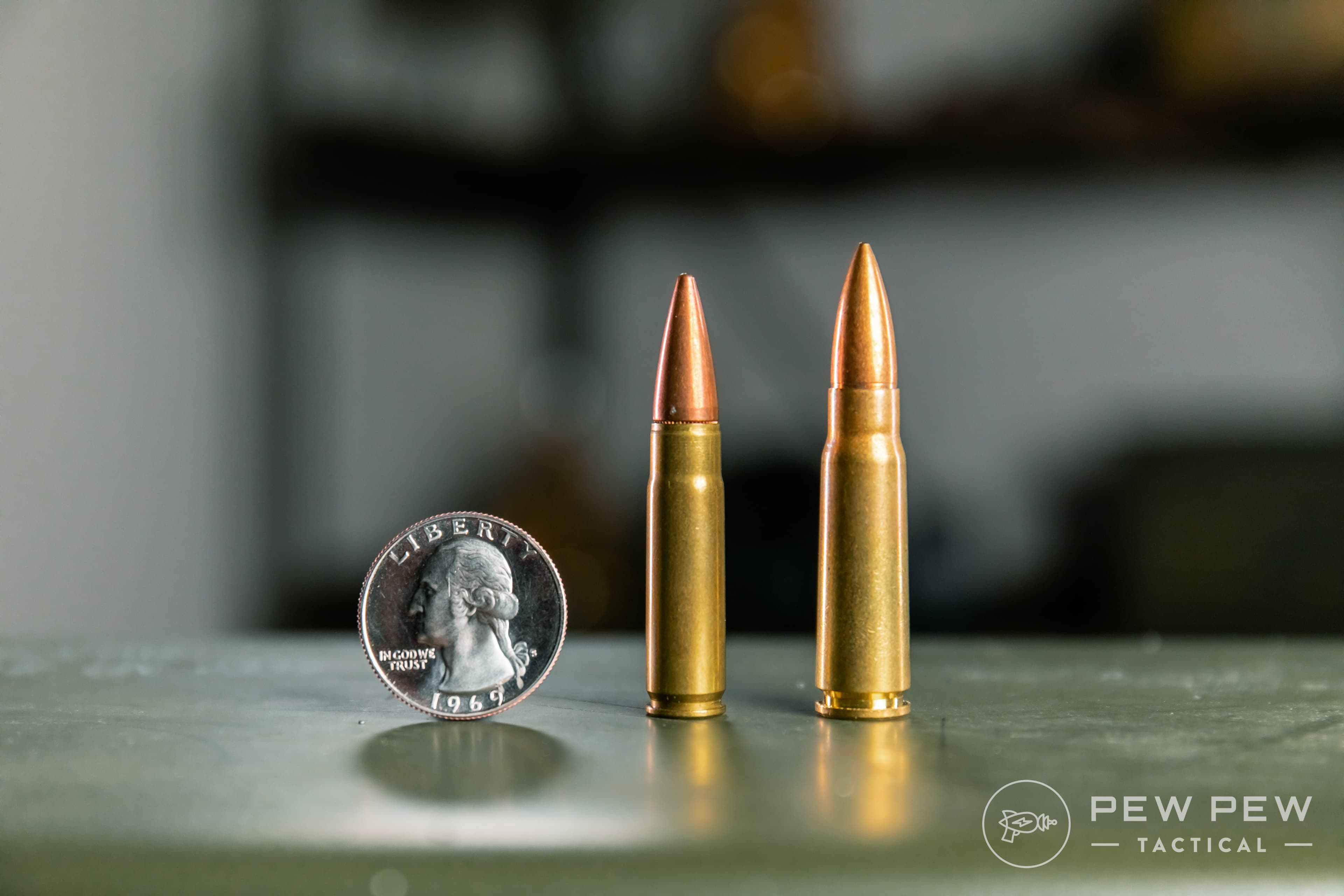
This cartridge accomplishes a few different things. Firstly, it is very efficient and can reach near peak energy out of barrels in the 9 to 11-inch range. This allows you to get more energy in a shorter and handier AR-15 than you would get if you used the standard 5.56 NATO round.
Additionally, .300 Blackout also offers great suppression abilities. The heavier rounds allow it to go subsonic to keep things extra-quiet, while still allowing semi-automatic guns to cycle properly.
Recoil is pretty similar to the regular soft-shooting 5.56 NATO. Ballistically, it carries a bit more energy as well, being very similar to the 7.62x39mm round found in the AK-47.
Check out the clip of .300 Blackout being run through a Maxim Defense PDW below!
This is one of the fastest-growing rounds in terms of usage and popularity. If you want to learn more, you can take a peek at our article on .300 Blackout vs. 5.56.
6. 7.62x39mm
Specs
- Bullet Weight: 123 gr
- Velocity: ~2,400 fps
- Energy: ~1,600 ft/lbs
- Price Per Round: ~$0.48
The 7.62x39mm cartridge is a Russian round designed for use in the venerable AK-47 and SKS rifles.
With the importation of these rifles to the US, the 7.62x39mm became a popular round over the last few decades.
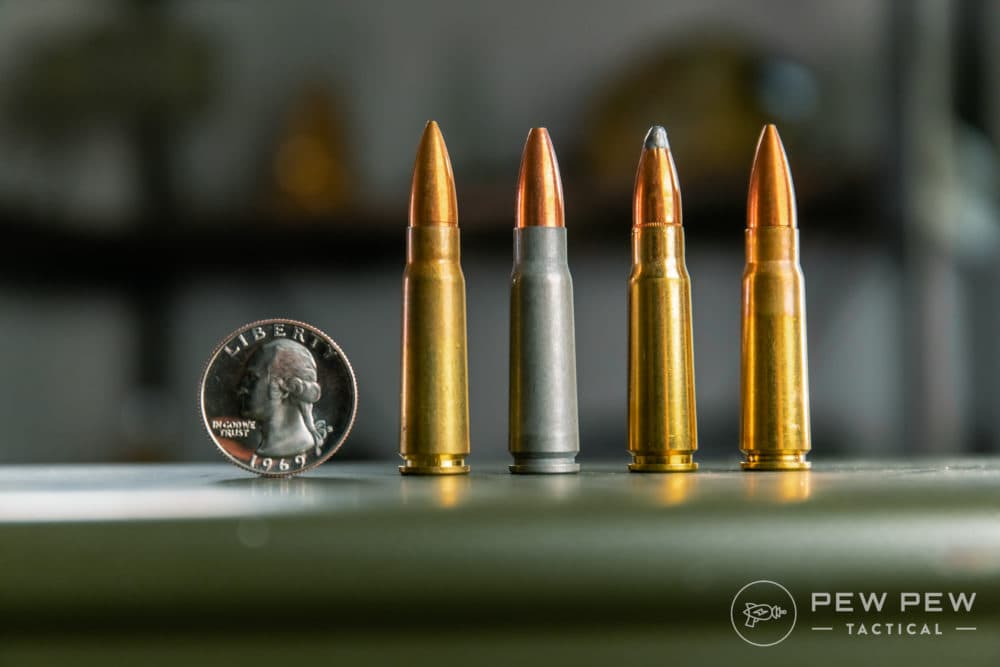
While the round is still synonymous with the AK, its popularity ensured that a number of other newer rifles were made with this round in mind. Everything from bolt-action rifles, to single-shots, to non-AK semi-automatic guns can be had in this caliber.
The recoil is moderate, and it has less range than some other intermediate cartridges, but it does put out decent energy for its size.
It hits hard enough to take medium-sized game such as deer, and is more than adequate for self-defense.
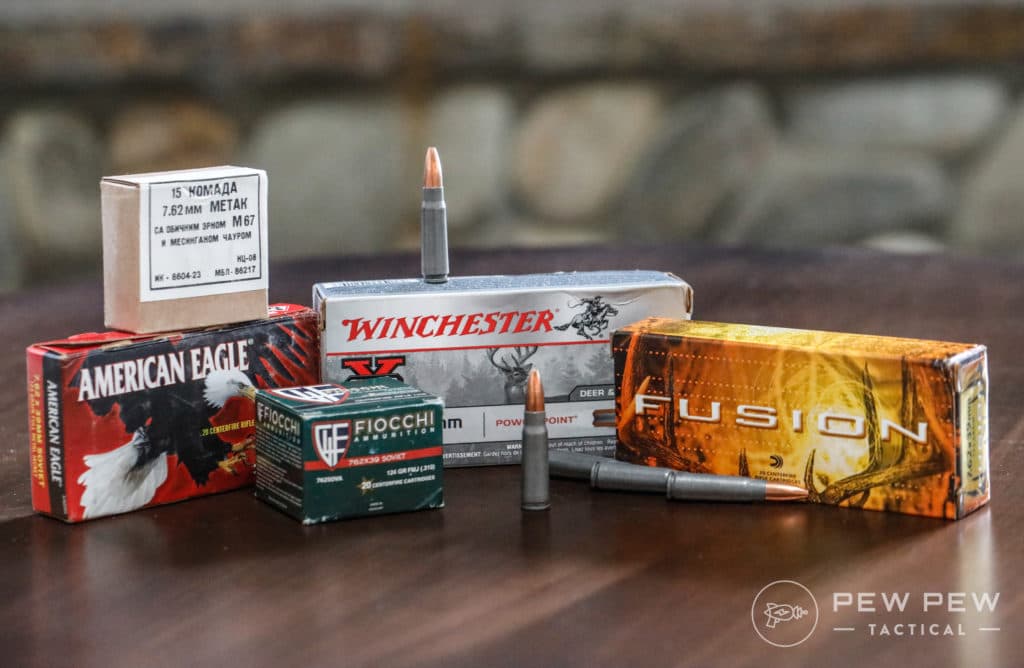
While there isn't a huge variety in ammo types for the 7.62x39mm, there is still a little something for everyone. We cover them all in our article on the Best 7.62x39 Ammo!
7. .224 Valkyrie
Specs
- Bullet Weight: 60-90 gr
- Velocity: ~2,600-3,500 fps
- Energy: ~1,500 ft/lbs
- Price Per Round: ~$0.80
Next up is another newer round that sprang onto the scene in 2017 --- the .224 Valkyrie.
This round was designed by the Federal Cartridge with the express purpose of creating a low-recoil round for the AR-15 platform that was capable of staying supersonic at 1000 yards and beyond.
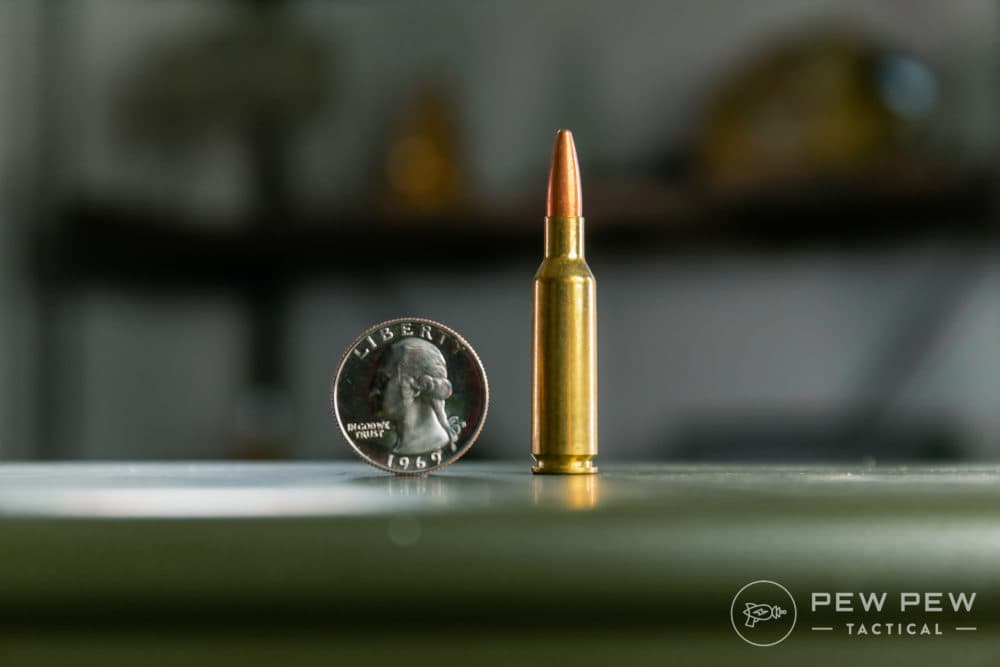
Despite its impressive ballistics, you can shoot it all day without bruising your shoulder.
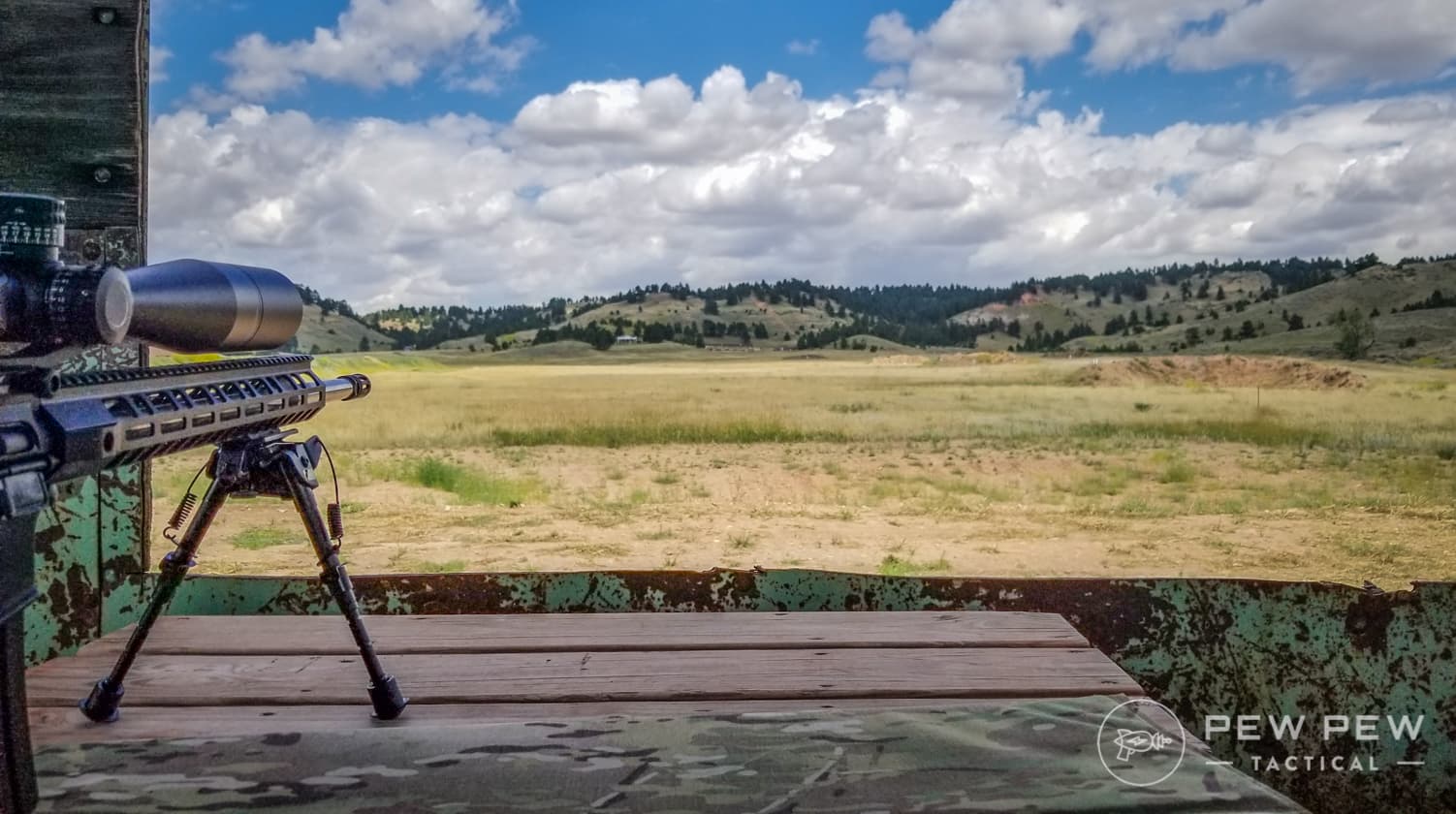
Last time I shot it, I was able to get 1000 yards semi-consistently. The better-skilled shooters were hitting pretty regularly out to 1,250 yards with the Valkyrie.
All you need to do to get into the .224 Valkyrie is buy a dedicated upper for your AR-15, pop it on, then grab a few 6.8 SPC magazines (slightly annoying), and you're ready to go.
Although the Valkyrie seemed poised to take off, its popularity has slowed in the last two to three years. It is still a fun and viable caliber for long-range shooting, but is likely to be unseated by the newer 6mm ARC.
Learn more in our Complete .224 Valkyrie Guide!
8. 5.56x45mm / .223 Remington
Specs
- Bullet Weight: 40-77 gr
- Velocity: ~2,600-3,200 ft/s
- Energy: ~1,300 ft/lbs
- Price Per Round: ~$0.45
Finally, the most popular intermediate cartridge in the world!
We are talking about the 5.56x45mm (also known as 5.56 NATO) and .223 Remington cartridges.
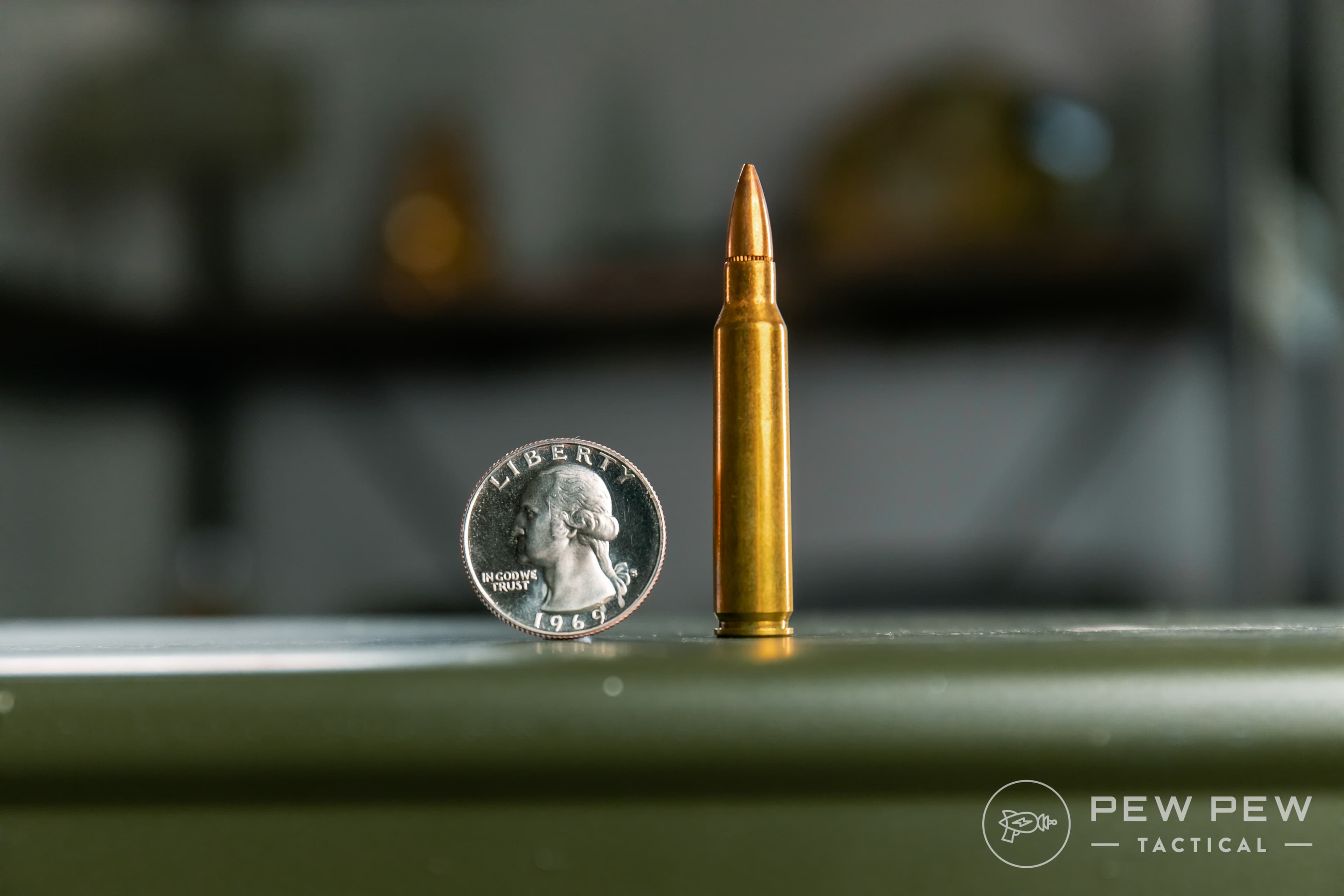
This is the standard caliber of the M16, M4, civilian AR-15, and numerous other civilian, military, and law-enforcement rifles worldwide.
Originally developed at the .223 Remington for the Armalite AR-15, the round found military success for being lightweight, soft-shooting, accurate, and having good wounding properties. It was eventually adopted as a NATO standard cartridge, where very slight changes were made, and it was labelled the 5.56x45mm.
Despite its military track record, some states don’t allow hunters to use .223/5.56 on medium game like deer because it’s considered inhumane due to the lower energy output and lack of expansion with some types of ammo.
Hunting-wise, it serves as a varmint and predator to take out things such as prairie dogs, coyotes, and such.
Outside of that role, it is one of the cheapest centerfire rifle rounds you can shoot, and is the preferred caliber of the most common rifle in the US --- the AR-15. Whether you are varminting, using it for self-defense, or just plinking, there is sure to be a 5.56 round suited to your exact needs.
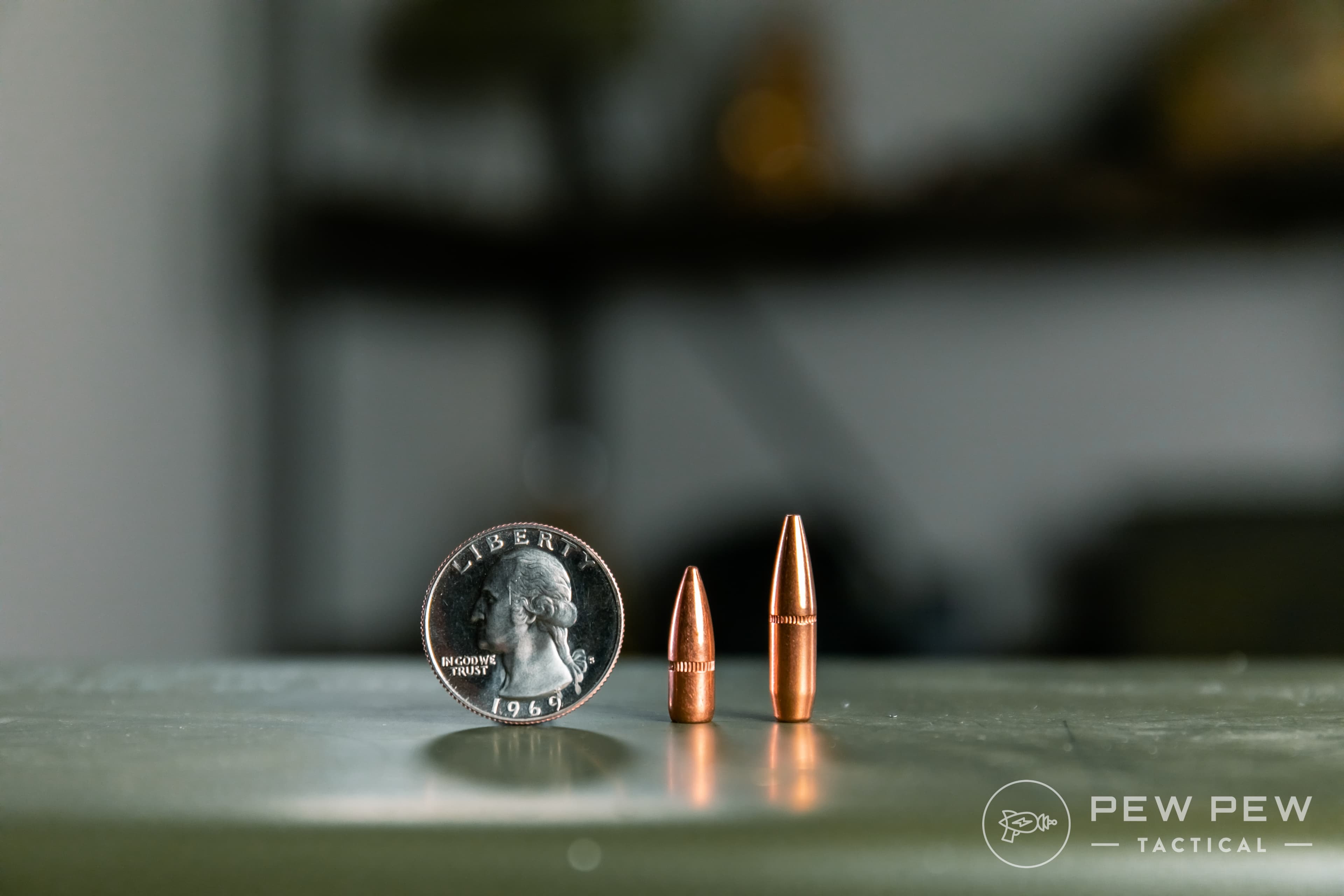
We have a whole article on Best AR-15 Ammo: Home Defense & Range, so take a look!
Readers’ Ratings
4.97/5 (2283 Votes)Your Rating
9. 6.8 SPC
Specs
- Bullet Weight: 85-120 gr
- Velocity: ~2,450-3,100 fps
- Energy: ~1,700 ft/lbs
- Price Per Round: ~$0.80
A name almost as long as the story that created the cartridge, the 6.8 Remington Special Purpose Cartridge was designed for the United States Military to be a middle ground between 5.56 NATO and 7.62 NATO.
We have a whole breakdown on the history behind this cartridge is totally worth reading if you are interested!
But the short version of the story is that while it performed well in field testing among Special Forces units in Iraq and Afghanistan, it never saw wide adoption in any form.
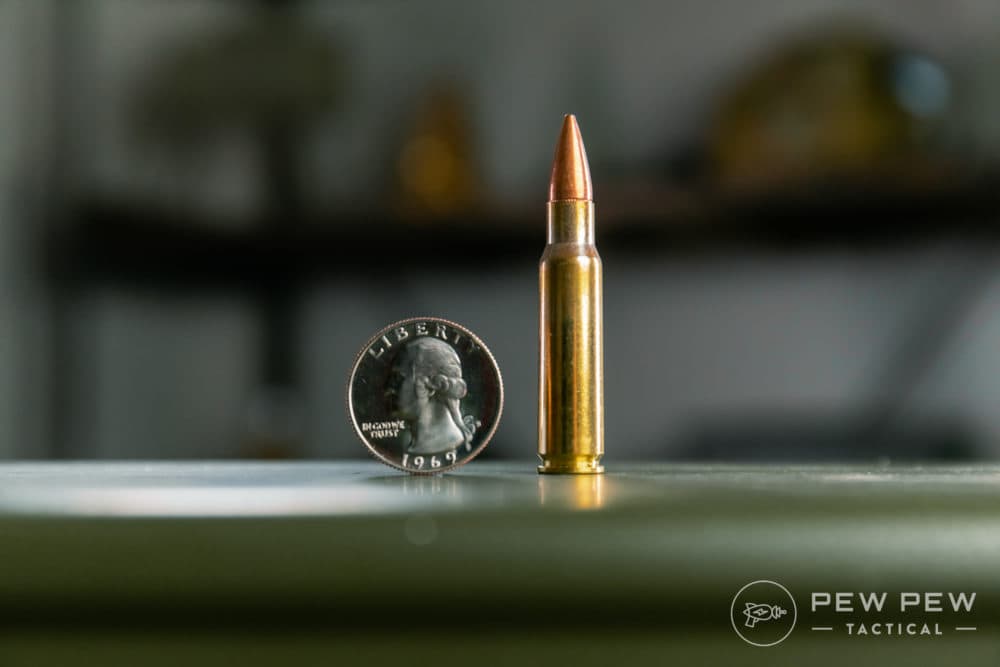
Yet, the 6.8 SPC lives on in the civilian world due to the power it can deliver at decent ranges in an AR-15 platform.
While it has lost the foot battle against the more popular 6.5 Grendel, 6.8 SPC is still a solid option that strikes a great balance between power, expansion, recoil, and capacity.
10. 6.5 Grendel
Specs
- Bullet Weight: 90-130 gr
- Velocity: ~2,500 - 2,900 fps
- Energy: ~1,800 ft/lbs
- Price Per Round: ~$0.70
Ever growing in popularity with long-range shooters looking to get the most out of their AR-15 rifles, the 6.5 Grendel delivers excellent ballistics and supersonic speeds well past 1,000 yards.
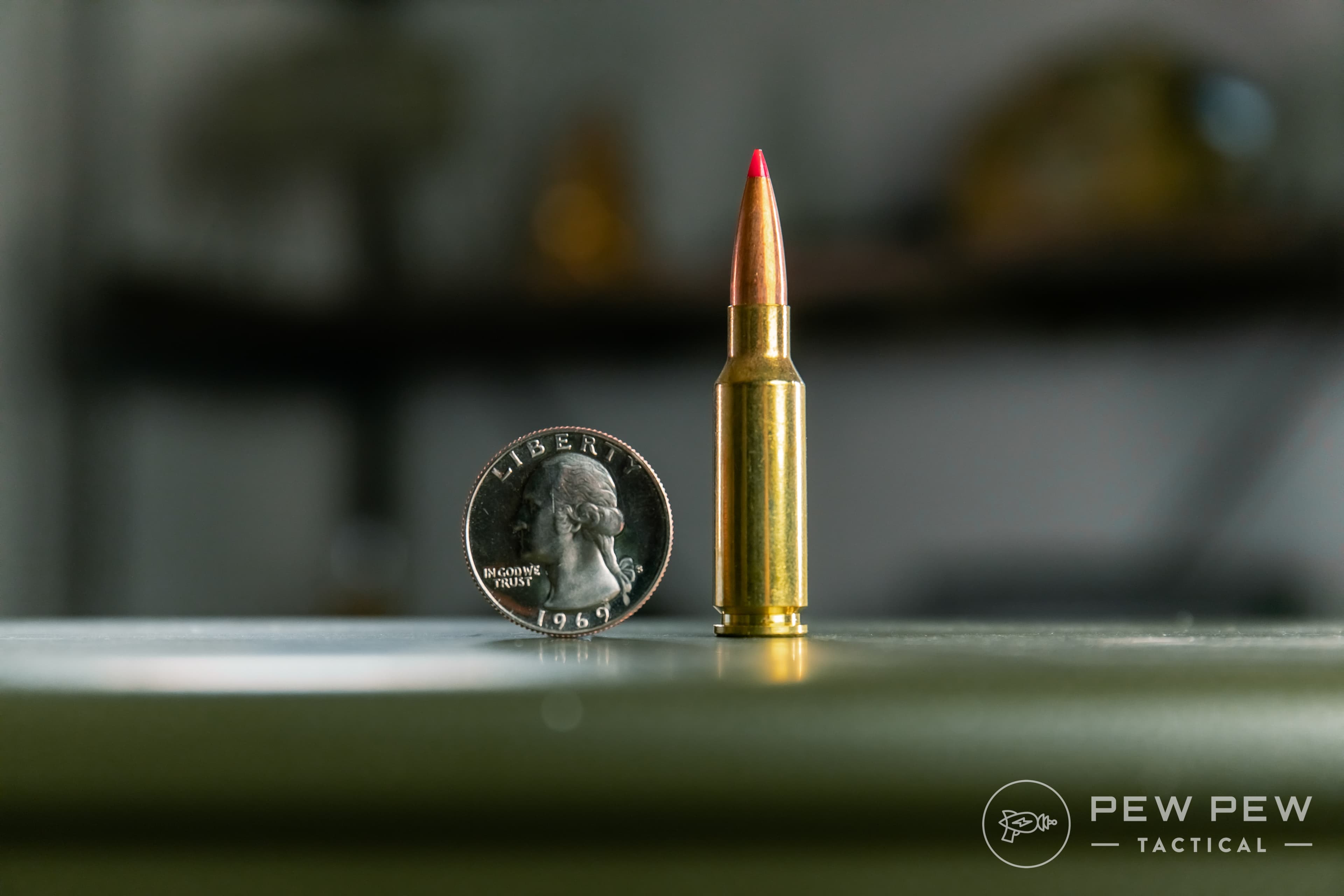
Inherent accuracy and a wide range of bullet options also make the Grendel a great option for hunters. It proves to be capable of dropping deer out to 300+ yards, even with barrels as short as 12.5 inches!
Even with the new 6mm ARC surging in popularity, 6.5 Grendel is still extremely popular and is the most affordable extended-range AR cartridge currently on the market.
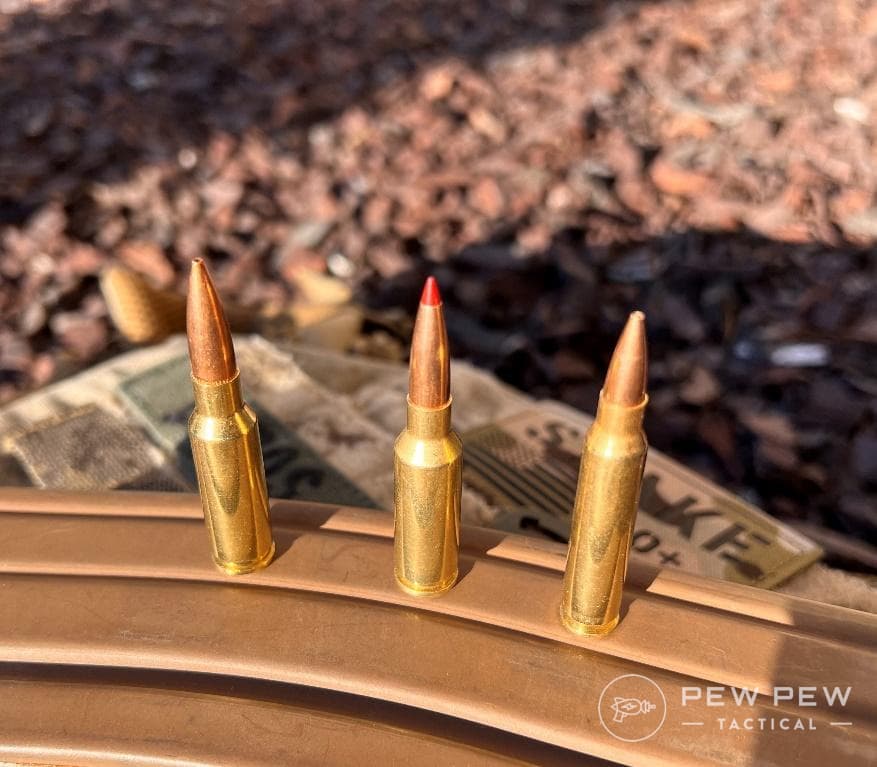
All you need to do is swap your upper and grab some 6.5 Grendel mags, and you are off to the races! Curious? Check out the Best 6.5 Grendel Uppers.
11. .458 SOCOM
Specs
- Bullet Weight: 250-600 gr
- Velocity: ~1000-2200 fps
- Energy: ~1,300-2500 ft/lbs
- Price Per Round: ~$2.00
The .458 SOCOM was designed after an informal discussion with some US military special forces members in the wake of Operation Gothic Serpent in the early 1990s.
At the time, the 5.56 NATO round was having difficulty putting down opposing forces in Mogadishu, often requiring multiple shots to incapacitate them.
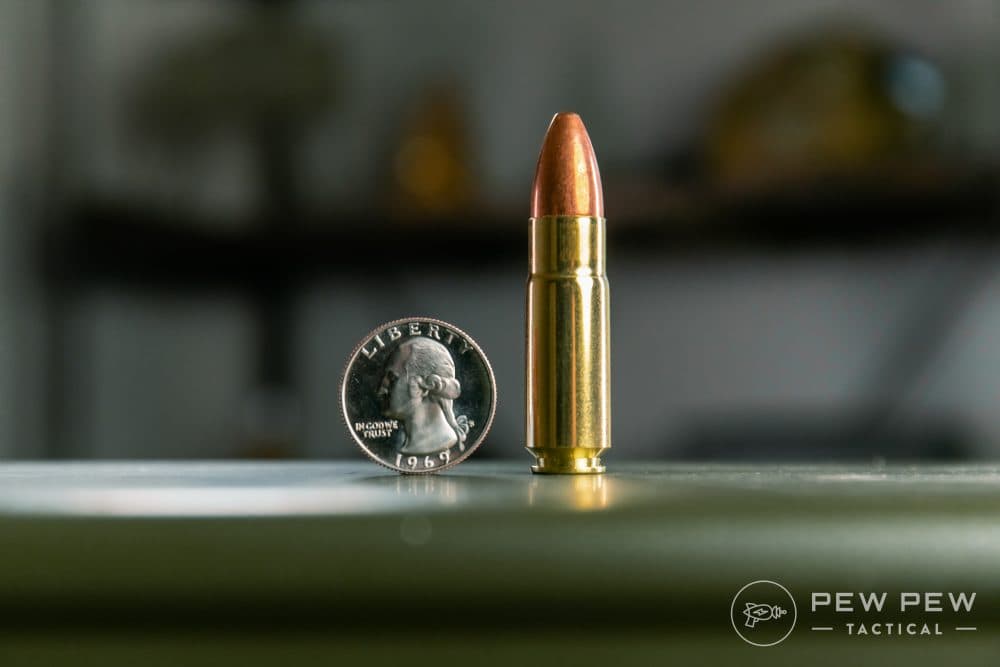
Born out of the lessons learned by the Rangers and Delta teams, .458 SOCOM is a heavy beast of a cartridge designed to deliver a huge amount of power on target, roughly equivalent to a lightly loaded .45-70!
Firing a bullet at least 5 times heavier than standard 55gr 5.56 NATO, .458 SOCOM was designed to be 100% compatible with standard M4/M16 rifles - including using standard magazines!
The only things required are a new barrel, bolt, and slightly enlarged ejection port.
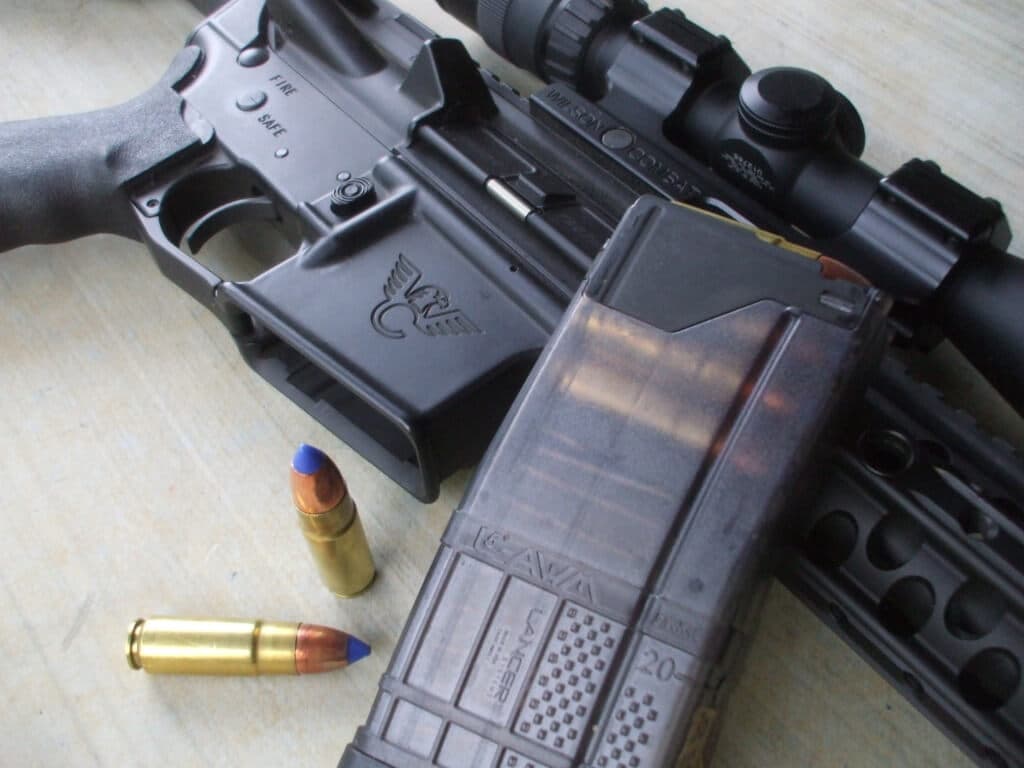
Although it never saw service with the US Armed Forces, the concept behind .458 SOCOM offers enough appeal that it has stuck around.
It offers civilian shooters a great option for big-bore shooting out of an AR-15 and is very easy to suppress with heavier loadings. However, it has largely fallen out of popularity in favor of the straight-walled .450 Bushmaster that is ballistically similar.
Be warned, if you plan on shooting .458 SOCOM, it will put a dent in your shoulder and your wallet.
Popular Rifle Calibers Part 2: Intermediate & Large
Whew...we're basically halfway there! Now on to the bigger cartridges.
12. .30-30 Winchester
Specs
- Bullet Weight: 110-170 gr
- Velocity: ~2,200-2,700 fps
- Energy: ~1,800 ft/lbs
- Price Per Round: ~$1.00
There is a popular saying that more deer have been killed by the .30-30 in North America than all other cartridges combined.
And really, we believe it!
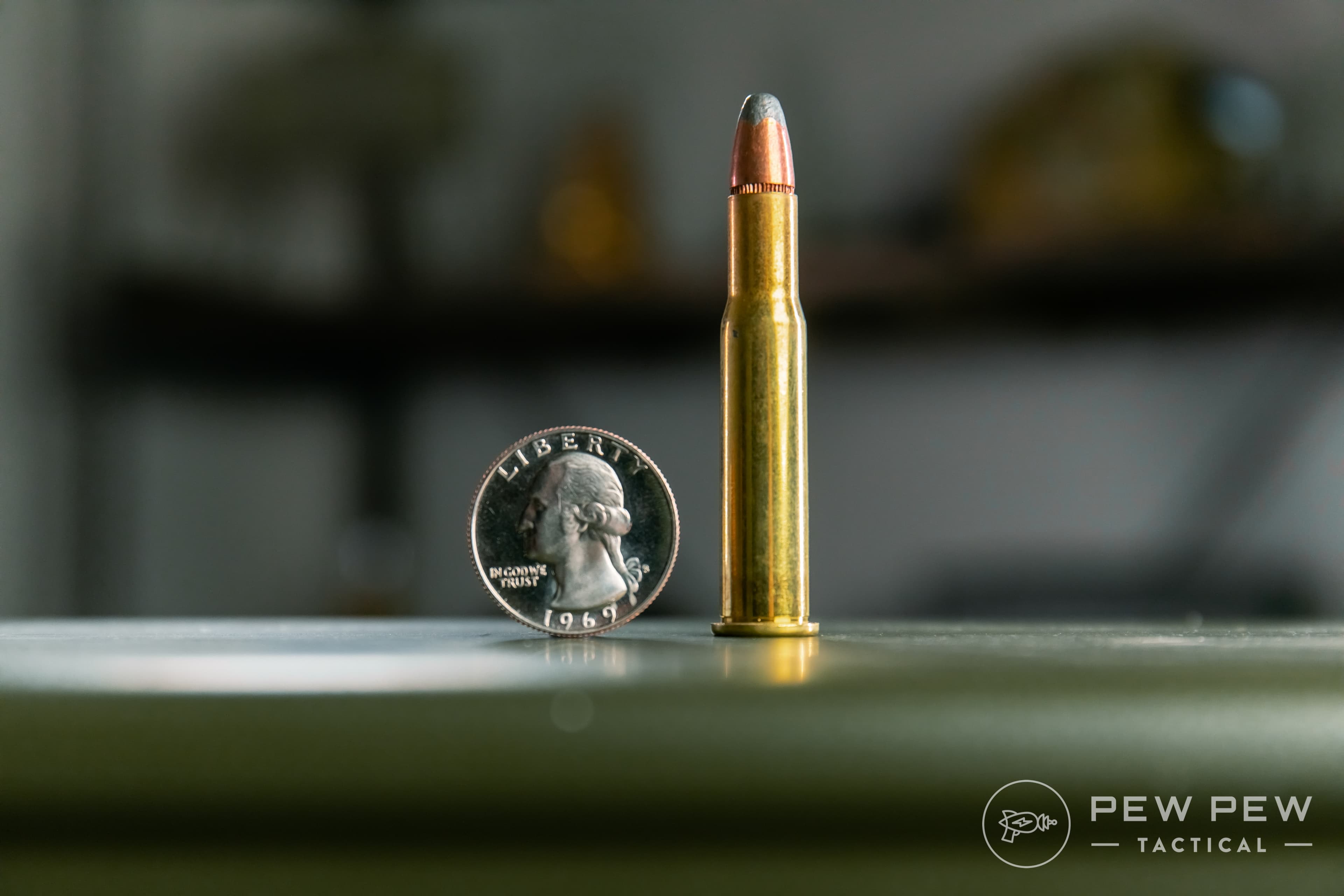
Introduced all the way back in 1895, the .30-30 is one of the oldest centerfire smokeless cartridges still in production today.
Normally found in lever-action rifles, this great-great-granddaddy of a round delivers a lot more knockdown power than most people give it credit for.
Check out the Best .30-30 Ammo and the Best Lever Action Rifles!

Bullet weights range from 110 up to 170 grains, with velocities averaging around 2,400-2,500ft/s. Perfect for stalking deer in the woods!
13. 6mm Creedmoor
Specs
- Bullet Weight: 70-115 gr
- Velocity: ~3,000-3,500 ft/s
- Energy: ~2000 ft/lbs
- Price Per Round: ~$1.35
The 6mm Creedmoor is simply 6.5 Creedmoor necked down to accept the smaller 6mm (.243 diameter) bullets.
What this offers shooters is a lighter recoiling, faster-moving round that is winning championship marksman competitions the world over!
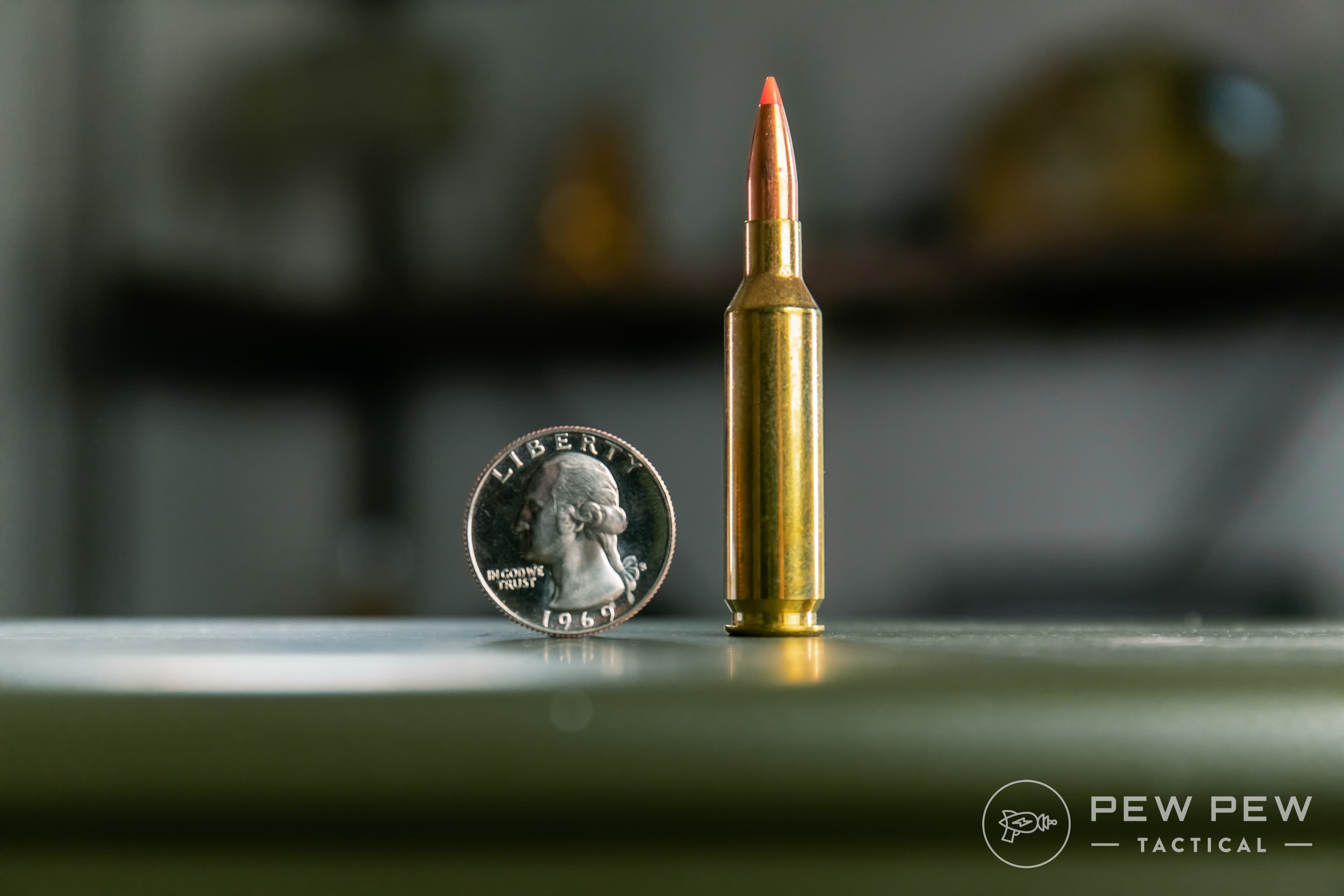
Many shooters and manufacturers are realizing that 6mm projectiles are in the perfect ballistic sweet spot when it comes to ballistic coefficient and velocities. As such, 6mm Creedmoor may be poised to eventually match 6.5 Creedmoor in terms of popularity.
14 .243 Winchester
Specs
- Bullet Weight: 58-105 gr
- Velocity: ~2,900-3,900 fps
- Energy: ~1,950 ft/lbs
- Price Per Round: ~$0.80
Introduced in 1955, the .243 Winchester is simply a .308 Winchester case necked down to accept 6mm (.243 diameter) bullets.
Like the 6mm Creedmoor we talked about above, the 6mm bullet takes advantage of high velocities and good ballistic coefficients, making it a very flat-shooting round.
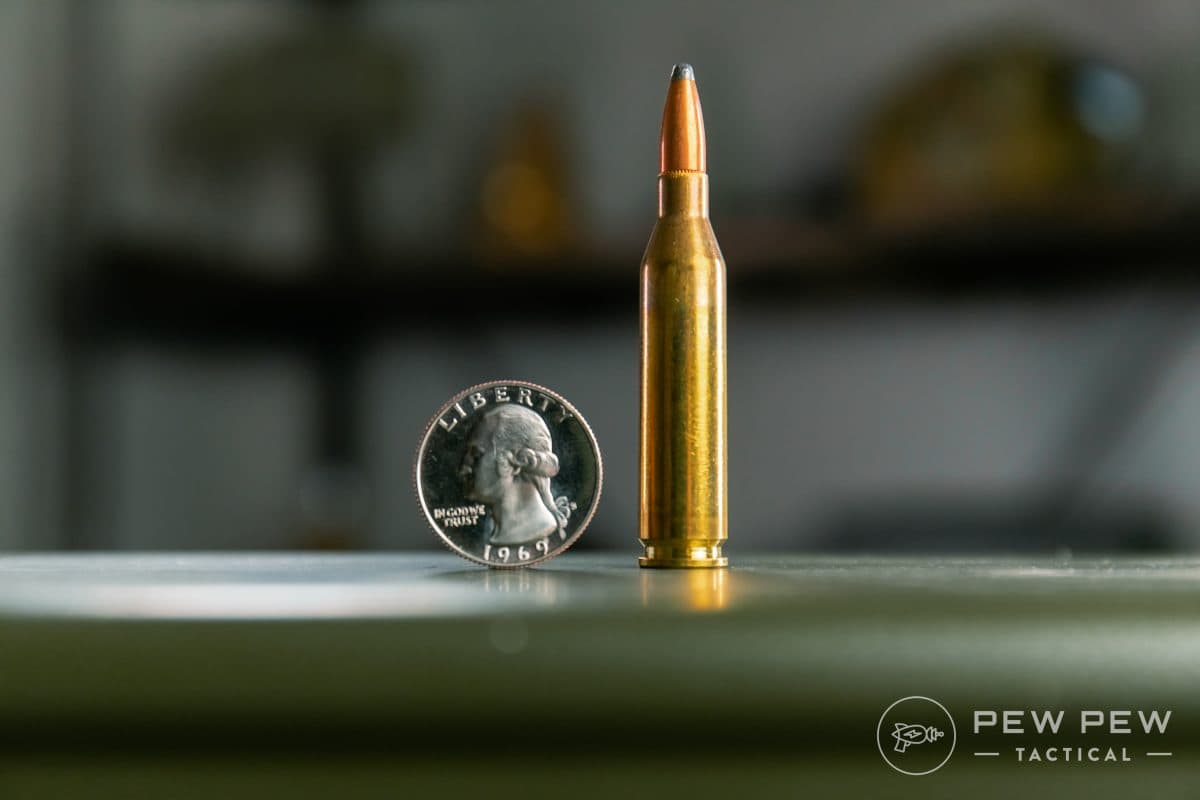
Designed for varmint hunting and target shooting, the .243 Win is popular due to its age and capability as a cartridge. Even though it is an older cartridge that is starting to show its age, it is still formidable when employed correctly.
While .243 Win will always have a special place for hunters looking to harvest game at medium ranges, for target shooters, the .243 Win has been almost completely replaced by more modern rounds like 6.5 Creedmoor.
15. .45-70 Government
- Bullet Weight: 250-500 gr
- Velocity: 1,250-2000 fps
- Energy: 1,200-3,500 ft/lbs
- Price Per Round: ~$1.60
Having the "Government" moniker because it was developed at the US Army's Springfield Armory in 1873, the .45-70 Govt. is an old-school, hard-hitting round that is steeped in history.
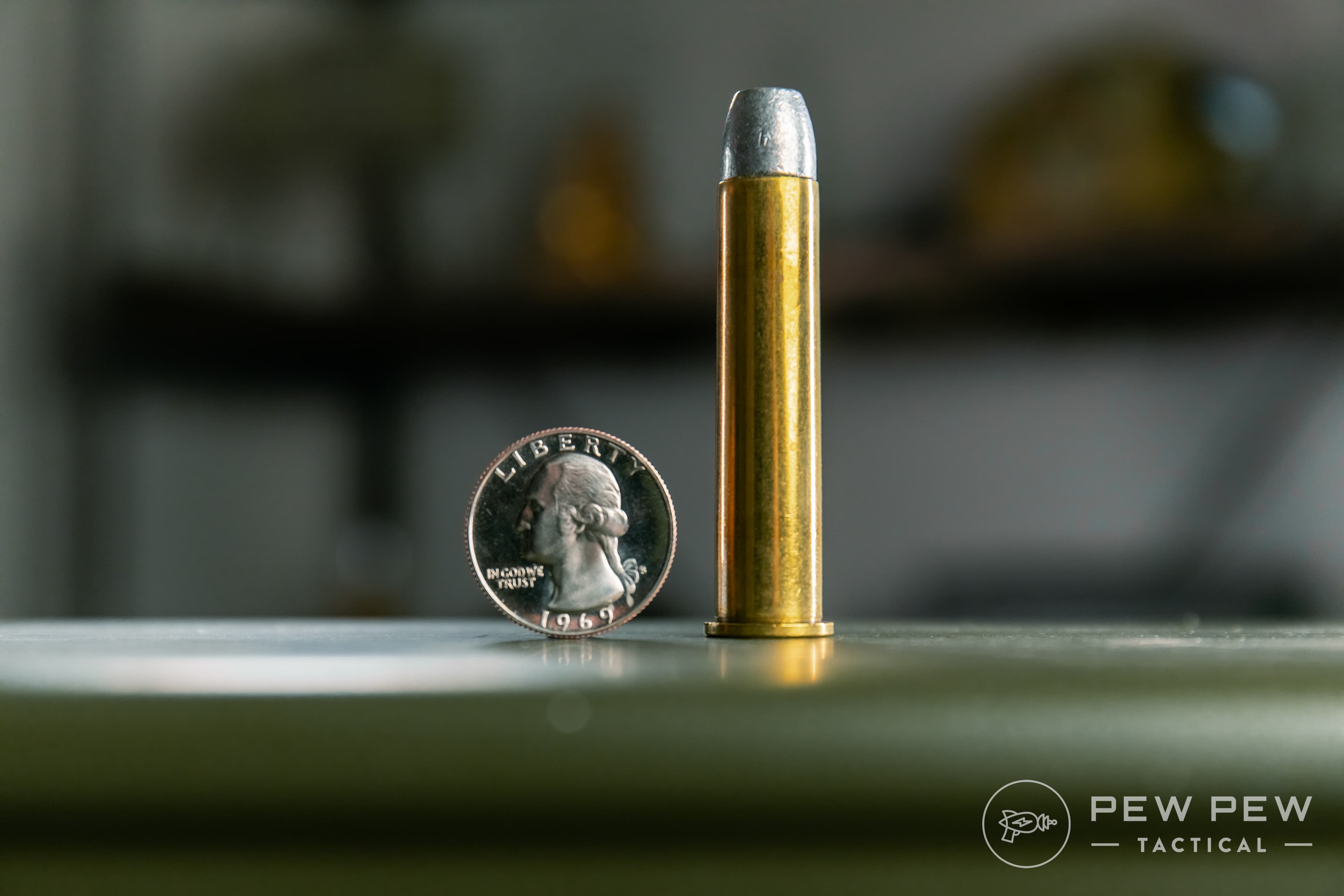
Known for its role in taking large game such as buffalo, the .45-70 has seen a resurgence in popularity.
Between Chris Pratt having one as a T-Rex gun in Jurassic World, the influx of modernized lever actions, and the general reignited love for manual-action guns, the .45-70 is what most people think of when it comes to big boy lever guns.
There are a myriad of loadings for the 45-70 as well. You can get everything from soft-shooting cowboy-action plinking loads to ultra-hot hunting rounds that can take some of the biggest game on the planet. There are even plenty of subsonic loads that make suppressing a 45-70 easy.
Whether you just want to be a badass cowboy or cowgirl, or you want a walloping hunting round, the .45-70 is one of the most common lever-action cartridges, and definitely the coolest!

We give the round a spin in our hands-on review of the Henry .45-70!
15. 7.62x51mm / .308 Winchester
Specs
- Bullet Weight: 110-220 gr
- Velocity: ~2,500-3,100 fps
- Energy: ~2,600 ft/lbs
- Price Per Round: ~$0.75
The 7.62x51mm NATO, or .308 Winchester as it is known in the civilian world, has been around since the 1950s and has seen constant military service around the world since its inception.
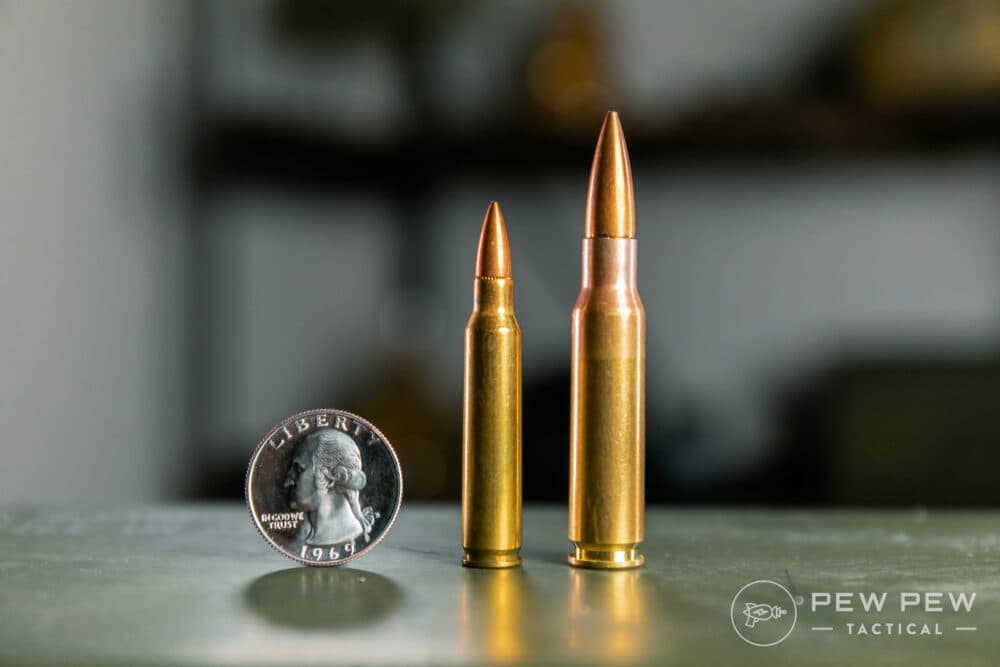
Some consider it the big brother of the 5.56 NATO due to their side-by-side military heritage. However, 7.62 NATO has much more range and energy, making it well-suited to marksman rifle, full-power battle rifle, and light machinegun roles.
One of the best things about .308 is that there are more options for .30 caliber bullets than any other diameter, period. You can get anything from screaming fast 110-grain varmint rounds all the way up to 220-grain subsonic rounds, and everything in between.
There are very few animals this round won’t take down, and it’s also the de facto sniper round the world over.
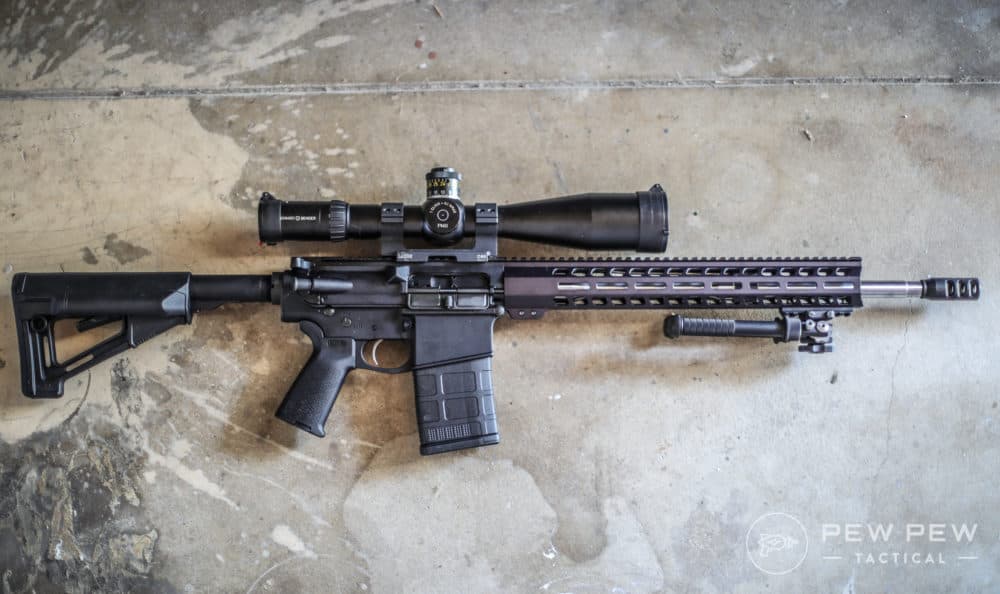
Check out the Best 7.62x51 Ammo and also Best AR-10s for the AR chambered in 7.62x51mm.
16. 6.5 Creedmoor
Specs
- Bullet Weight: 90-147 gr
- Velocity: ~2700-3300 fps
- Energy: ~2,300 ft/lbs
- Price Per Round: ~$0.85
Ah, the round that changed the entire trajectory of modern long-range competition as we know it --- the 6.5 Creedmoor (6.5 CM). And for good reason, it gives awesome performance at extended ranges without insane recoil.
And when does it go subsonic? 1300 yards.
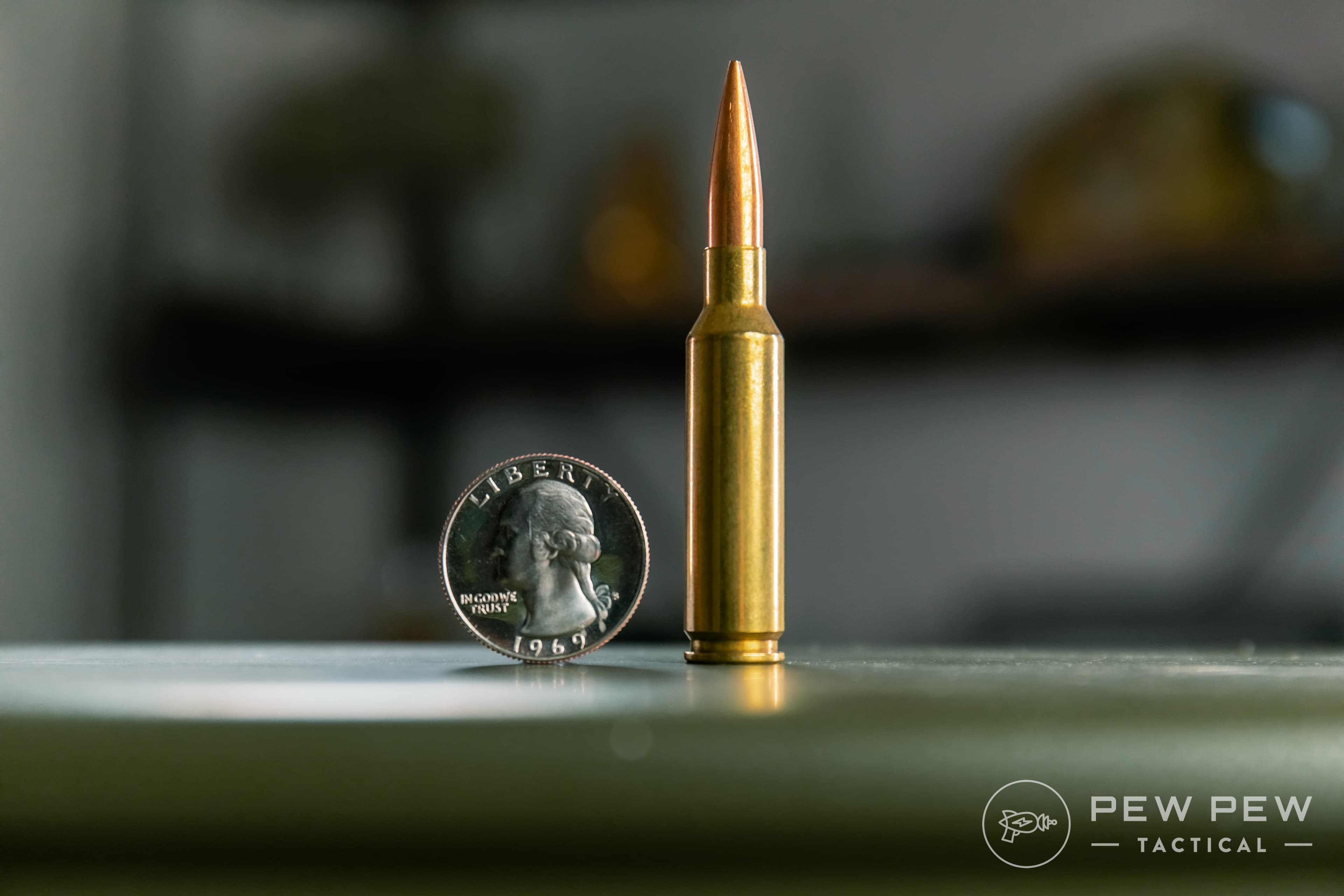
That's why both the military and competition shooters love the 6.5 CM. I've been able to hit 1000 yards easily with a 6.5 Creedmoor from PSA (full review), and I'm not an excellent shot.
It's arguably the third most popular intermediate cartridge behind 5.56 and 7.62 NATO, meaning there are plenty of loads for plinking, hunting, and extreme long-range shooting. There are also a ton of rifles offered in this caliber, meaning you can find just about anything you want.

Check out our full 6.5 Creedmoor Guide for the best ammo and guns.
16. 7.62x54mmR
Specs
- Bullet Weight: 150-181 gr
- Velocity: ~2500-2800 fps
- Energy: ~2,600 ft/lbs
- Price Per Round: ~$0.65
Next up is the 7.62x54mmR Russian cartridge design in the 1890s (yes, pre turn of the century) that is still in military use today. This cartridge is also known as 7.62 "Russian" (the R actually stands for rimmed and not Russian), or simply 54R for short.
It served as the main round for the Mosin-Nagant rifle until it was widely replaced by the 7.62x39mm in the AK platform.
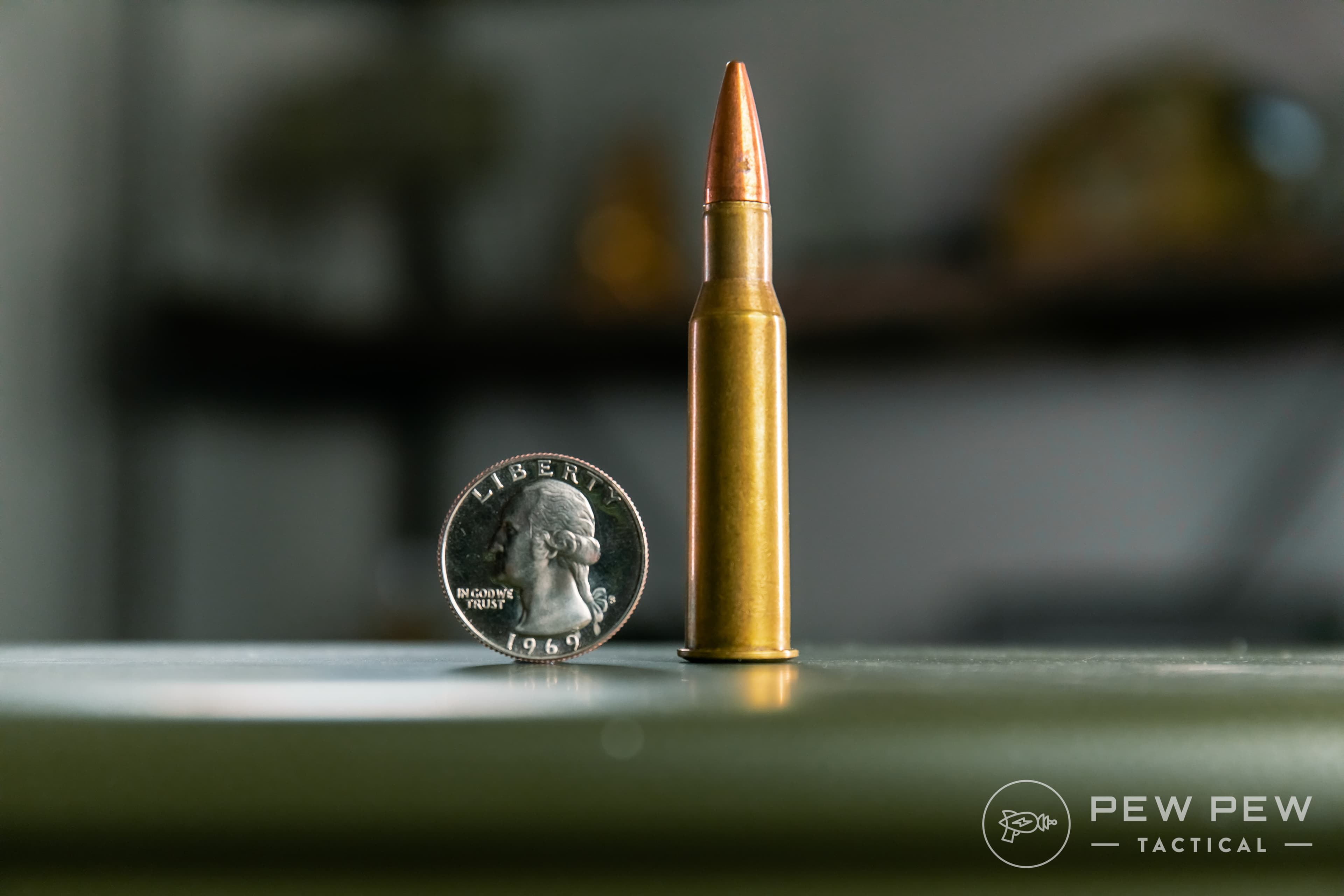
However, it still remains a popular round for Russian sniper rifles. This is because it is a hard-hitting round with a reasonably flat trajectory. Think of it in the same vein as the good ol' American 30-06, just with a little extra pep. That being said, it does have a decent amount of recoil, but it isn't a shoulder buster.
When you hear this round mentioned, there is one rifle that is always associated with it: the Mosin-Nagant. However, both surplus Mosins and surplus ammo have started to dry up, making this round less appealing than it was 10 years ago.
17. .270 Winchester
Specs
- Bullet Weight: 90-150 gr
- Velocity: ~2,850-3,600 fps
- Energy: ~2,700 ft/lbs
- Price Per Round: ~$1.00
Many have a special place in their hearts for .270 Winchester. It was the caliber of many people's first deer rifle, and has put an untold amount of food on the table for so many hunters.
Knocking down deer since the early 1920s, the .270 Win is basically .30-06 necked down from .30 caliber to .277 diameter.
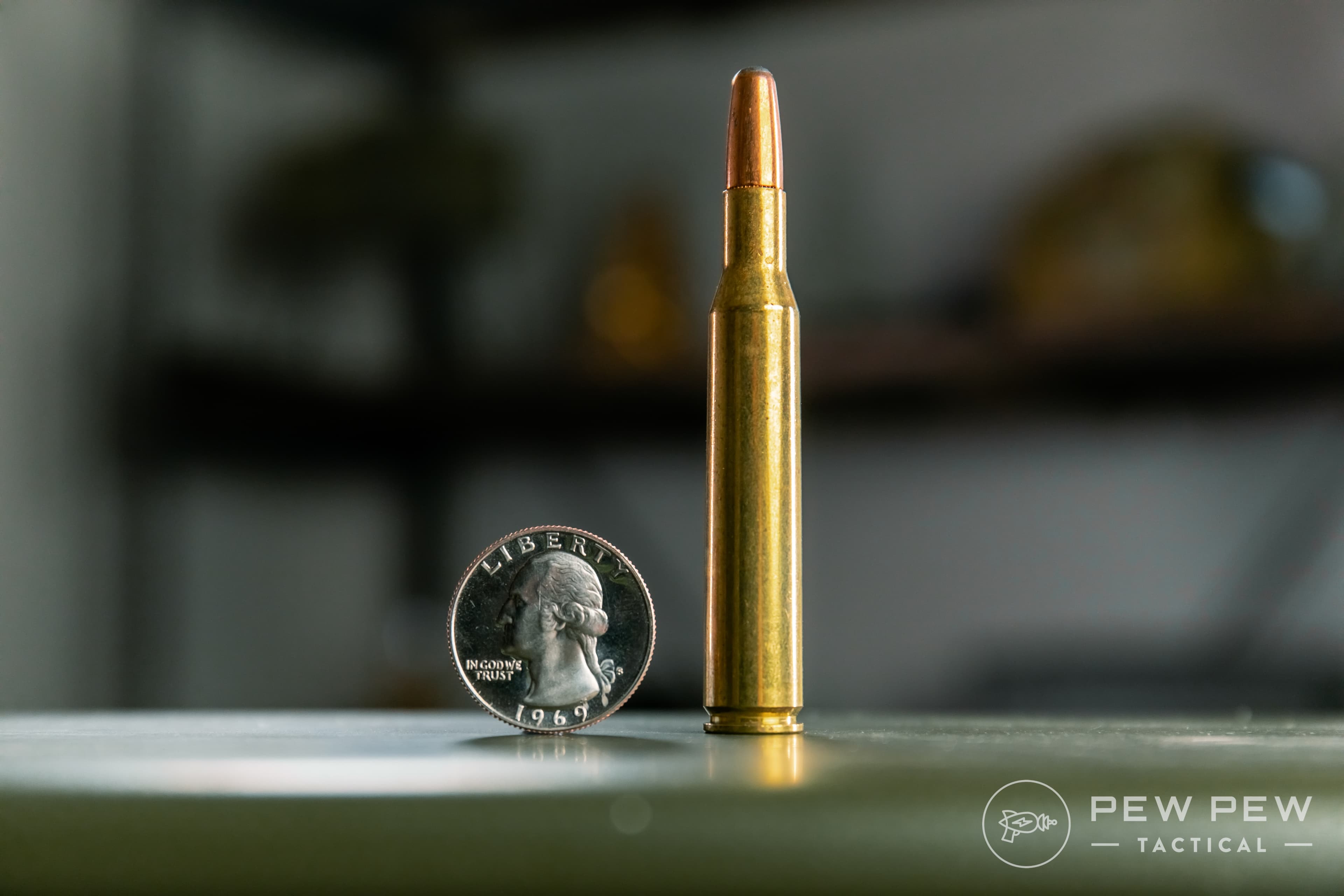
As we have seen with so many other cartridges on this list, pushing a smaller bullet faster by using the case of a larger cartridge ends up giving you a flat-shooter with good terminal ballistics.
The .30-30 might be the grim reaper of deer, but I suspect the .270 Win isn't too far behind second due to its shooting characteristics. The recoil isn't too bad, and the overall range and power delivery make it one of the best all-around medium game cartridges ever devised.
18. .30-06 Springfield
Specs
- Bullet Weight: 110-220 gr
- Velocity: 2,500-3,400 fps
- Energy: 2,800-3,000 ft/lbs
- Price Per Round: ~$0.85
The .30-06 (thirty-ought-six) began life as the .30 Government before being made the primary US military round in 1906 (hence the “06” in the name).
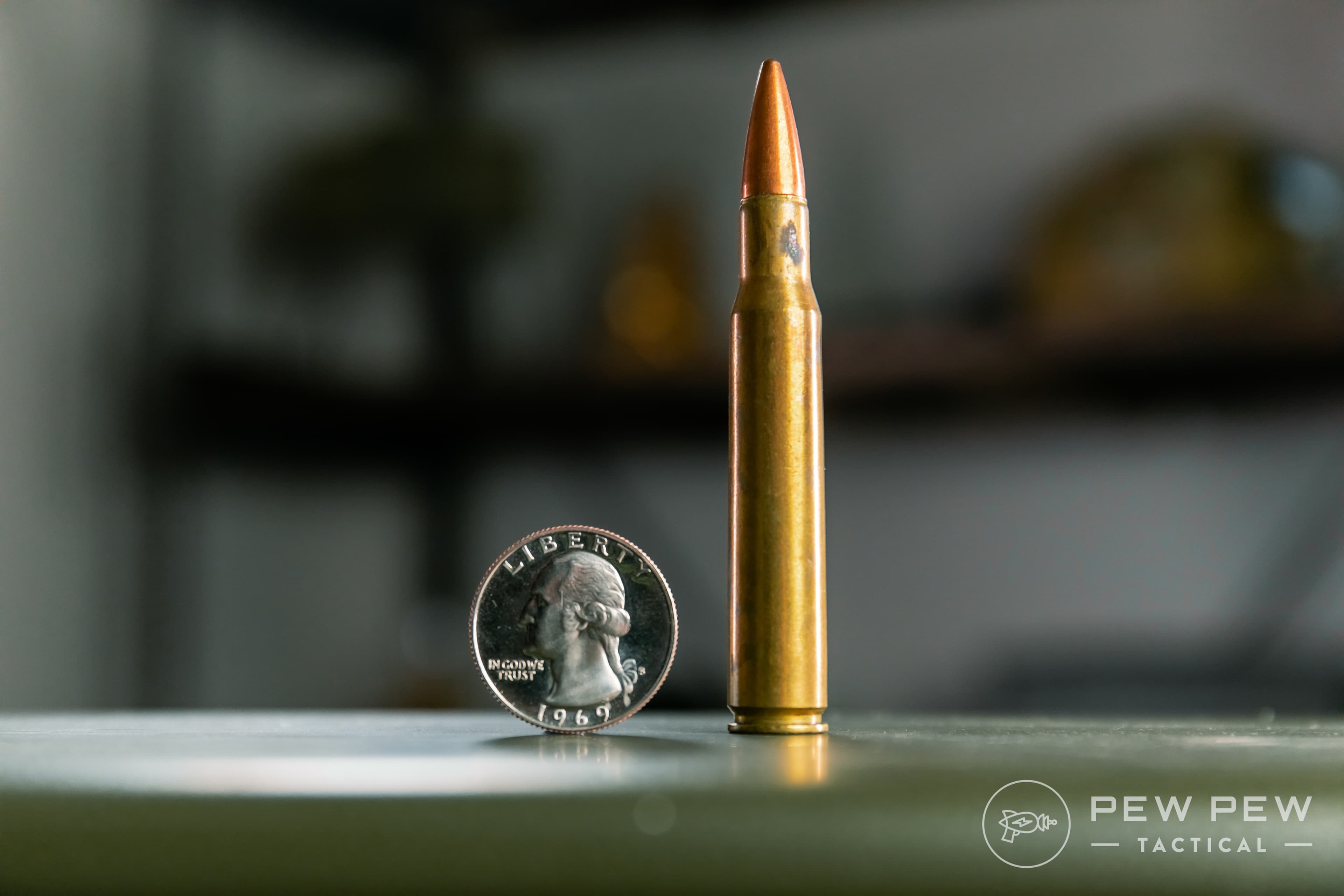
Though it was eventually replaced by the 7.62x51mm NATO in the military after 50+ years, .30-06 remains a popular bolt-action hunting round capable of killing any animal in North America given its tremendous knockdown power and range.
It is a bit faster than .308 Win, thus it generates a bit more power and more recoil. However, due to the length of the cartridge, it does require a long action (versus the .308's short-action), and ammo is a bit more expensive.
Despite being "outdated," so to speak, it is still an excellent choice for an all-around hunting cartridge and is extremely easy to find due to its long-tenured usage among the American population.
19 .338 Lapua Magnum
- Bullet Weight: 200-300 gr
- Velocity: ~2,800-3,400 fps
- Energy: ~5,100 ft/lbs
- Price Per Round: ~$3.00
People will argue whether the right way to say it is "LUH-poo-uh" instead of "lah-POO-uh," but everyone agrees that the .338 Lapua is a monster of a round that can reach insane distances while carrying a lethal amount of energy.
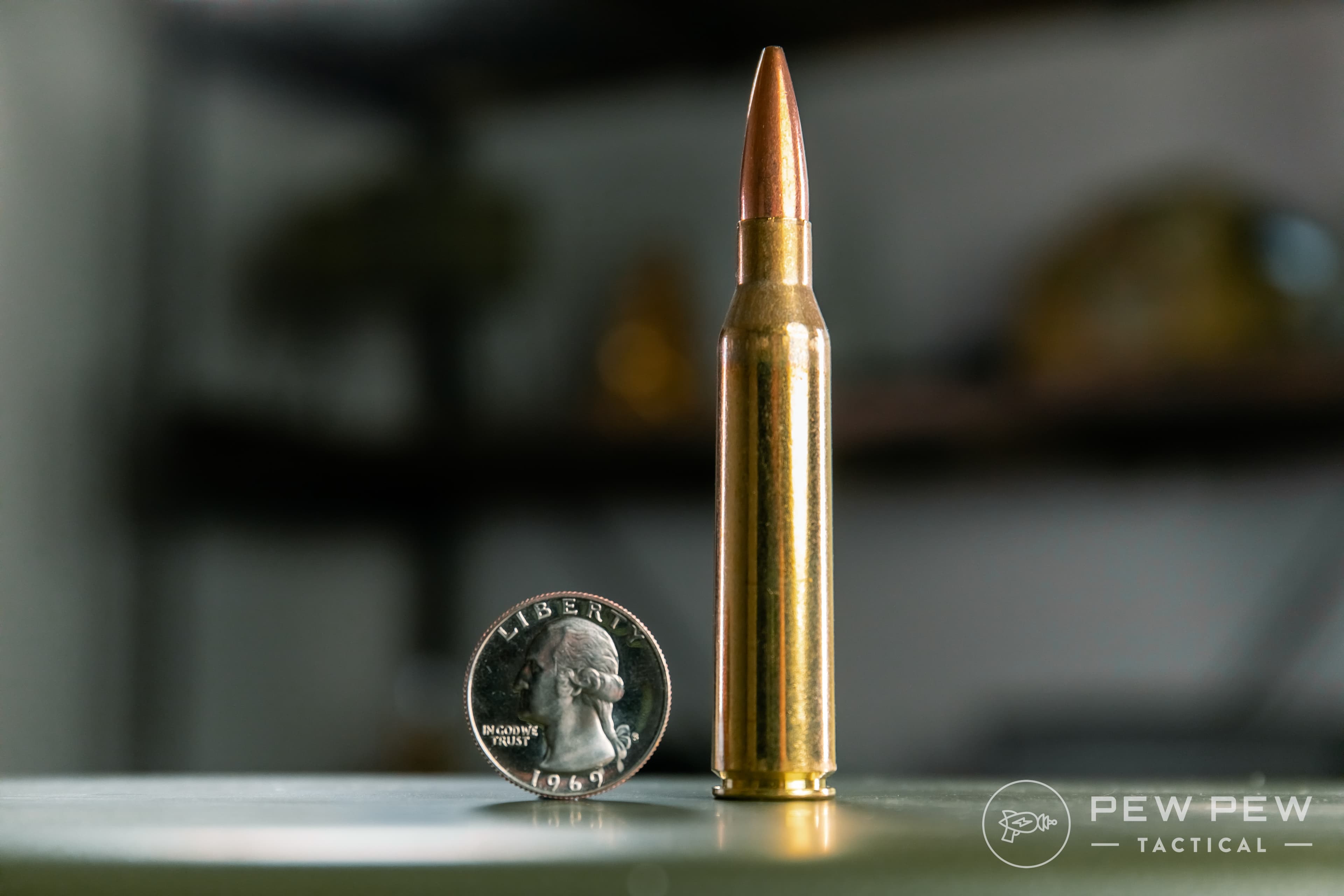
So monstrous that it held the then-new record for the longest confirmed sniper kill at 2707 yards in Afghanistan.
Like .243 diameter bullets (6mm), there is another ballistic "sweet spot" when you get to .338 diameter projectiles. The .338 Lapua takes advantage of this by using a very large case with a lot of power to push heavy .338 bullets that have ultra-high ballistic coefficients.
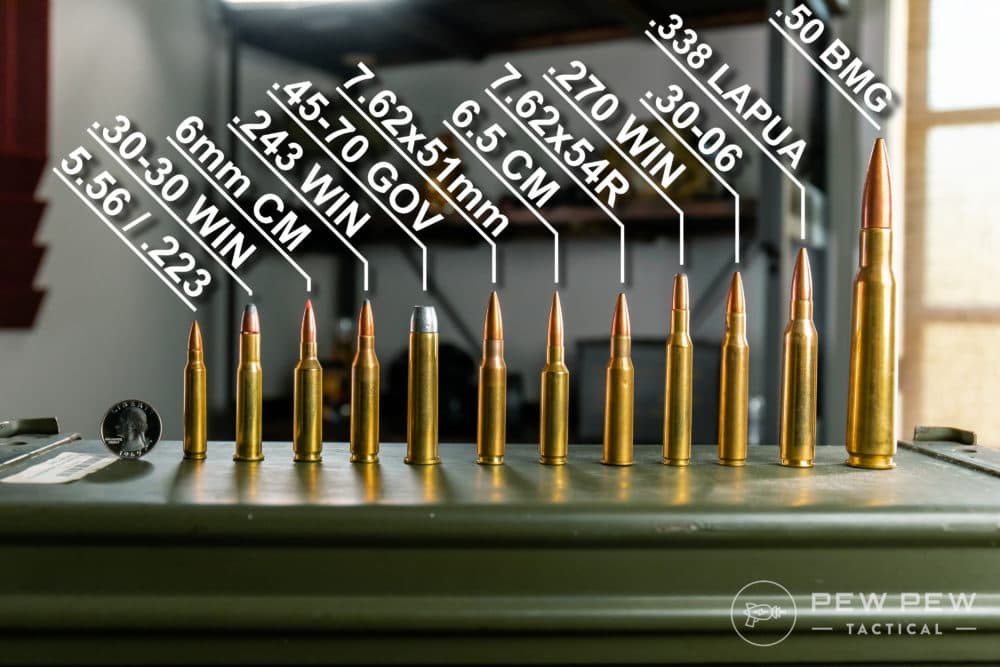
Just look at how big it is when compared to the already full-sized 30-06 Springfield!

While .338 Lapua is one of the best sniper rifle and long-range rounds ever developed, it does come with some downsides. It is relegated to use in mostly heavy bolt-action rifles, has a significant amount of recoil, and is anywhere from $3 to $5 a shot.
It may not be the most practical for everyone, but its long-range accuracy and terminal performance can't be understated.
20. .50 BMG
- Bullet Weight: 647-800 gr
- Velocity: 2,800-3,000 fps
- Energy: 13,000-15,000 ft/lbs
- Price Per Round: ~$3.00
No rifle caliber guide is complete without the true big boy. We are talking about the "fifty-cal" - the .50 BMG (Browning Machine Gun).
As the name implies, it was originally developed as a heavy machinegun round. It was made specifically for the Browning M2 Machinegun, which has been in constant service with the US military since 1933!
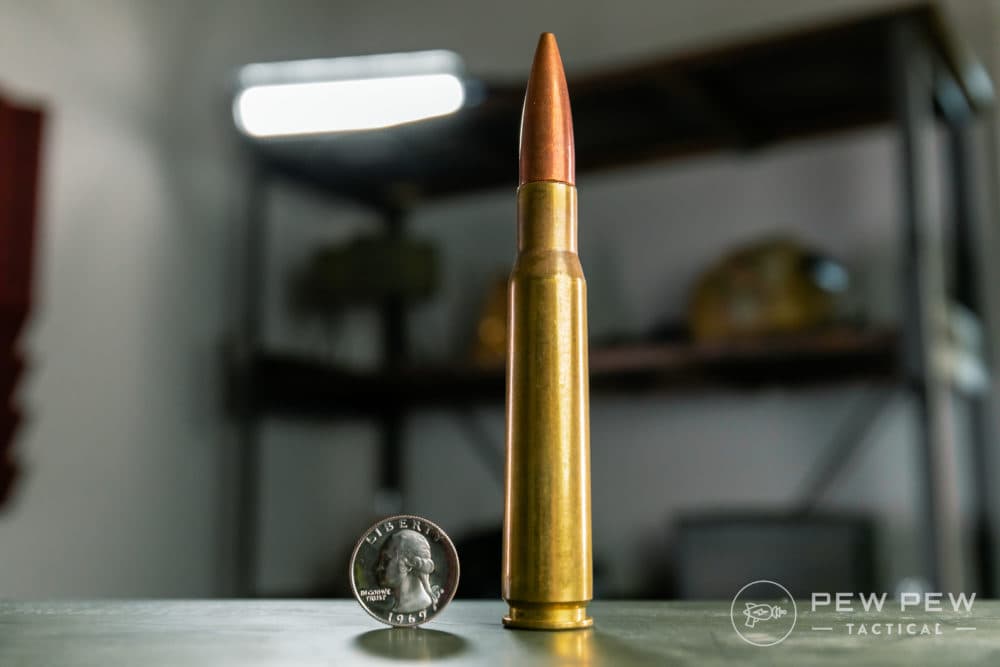
With .50 BMG, you are looking at about five times the muzzle of your average .30-06 round. Its ultra-heavy projectiles buck the wind like it is no one's business, making this one of the premier extreme-range cartridges in the world.
How premier are we talking? Well, it holds the world record for the longest confirmed kill shot in military history at a ridiculous 3,870 yards, which is 2.2 miles!
It has been used as an anti-tank round, anti-aircraft round, and just about anti-anything. The immense size difference it has over most cartridges is crazy. Let's zoom out to show proper perspective.

If you ever need to take down a T-Rex at 1,500 yards - this is the round you want.
The ammo is extremely expensive, as are the rifles chambered in it. The recoil is intense and is only offset by how heavy the guns are. Some ranges don't even allow it due to the damage it can inflict on backstops and targets. It is truly a hammer of a round.
But hey, it is still manageable to shoot (especially suppressed), and you are almost always going to be the coolest person if you show up with a .50 BMG.
Meet the Experts
This article was put together by Pew Pew Tactical CEO and Founder Eric Hung. In addition to founding Pew Pew Tactical as a place for shooters to learn, he’s also an NRA-certified pistol instructor and a USPSA/3-Gun/NRL22 competitor. Eric has also researched and written over 250 articles on firearms, training, gear, and just about everything else related to firearms.

Editor-in-Chief Jacki Billings runs our experienced team of reviewers. She is a member of the Society of Professional Journalists, ACES: Society for Editing, and the Professional Outdoor Media Association. Additionally, she is an NRA-certified Pistol Instructor and former Concealed Carry Instructor. Jacki has a bachelor’s degree in journalism and has worked as a media professional for close to 20 years, specializing in gun media for almost 10 years. She uses her professional journalism and editing experience to set testing protocols and editorial standards for Pew Pew Tactical.
Also editing this article is Wyatt Sloan, Editor. Wyatt is an NRA and USCCA-certified instructor with previous experience as a competitive shooter. Wyatt personally owns over 200 firearms in over 50 different calibers, and has 10 years of home-based FFL firearm sales. He has used his extensive experience with firearms at large to test guns for Pew Pew Tactical — evaluating them based on our standards and metrics.
Final Thoughts
So there you have it, our guide to a handful of common rifle calibers. Like we said, there are so many calibers that it is impossible to include them all, but this should give you a good base to build on.
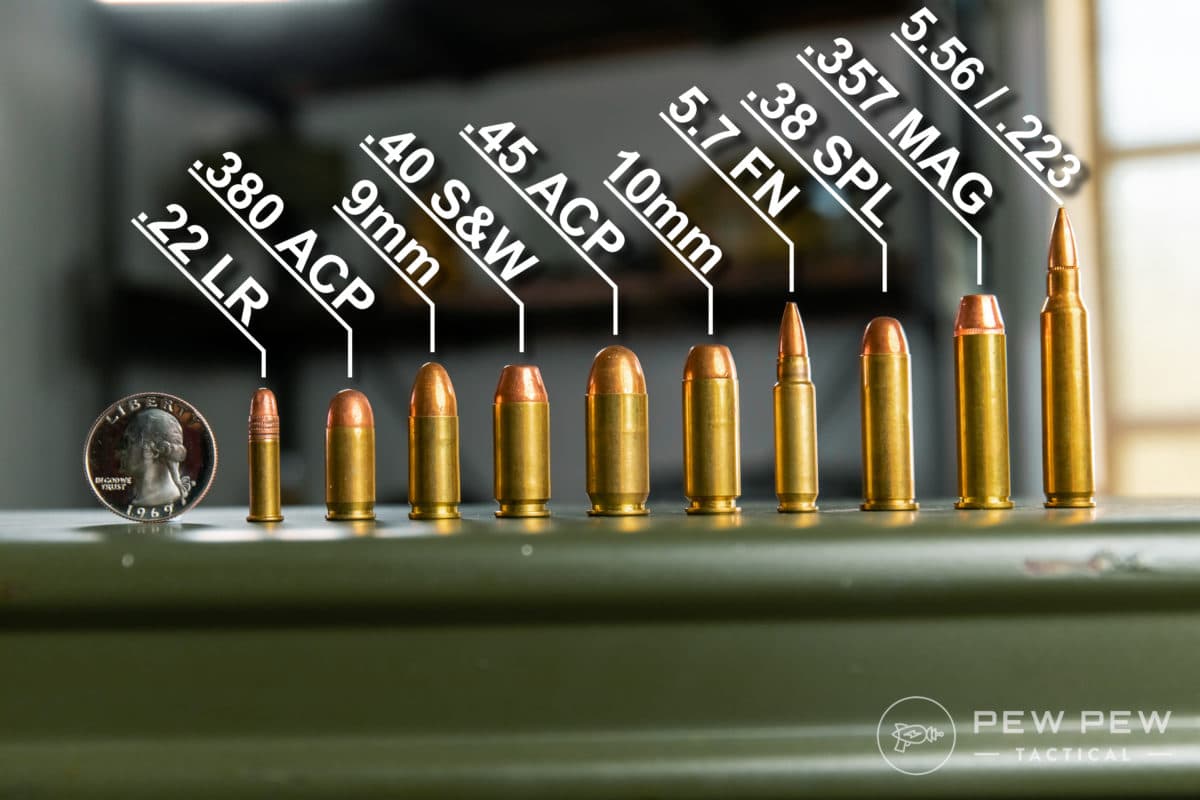
What are your favorite cartridges on this list? Let us know in the comments below! And be sure to check out our articles on the most Popular Handgun Calibers, as well as How Bullets Work!