Precision Rifle Competition is a great way to expand the skills in your shooting toolbox...plus it's just darn fun. Here's what you need to get started.
We review products independently. When you buy through links on our site, we may earn a commission to help support our testing. Learn more.
Like snipers…precision rifle competitors are all about hitting difficult targets at long distances. In precision rifle, you’ll engage targets out to 600 or 800 yards or further from a variety of positions and props. The targets are normally steel, but some matches will also have you shoot for score on paper.
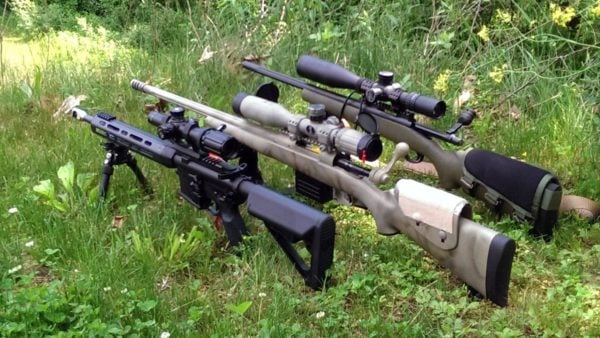
You might have to shoot them from cars, over and through fences, and after jumping in and out of giant tires… Basically, anything a creative match director can imagine. It’s a popular crossover sport for 3-gunners since the rifles that they use are often suitable for precision rifle with no more than a new optic. Precision rifle can end up feeling like just the rifle part of some 3-gun matches, especially the long range portions in big natural terrain stages. For 3-gunners who love that part of the game or who just want to get really good at it, precision rifle is a natural next step. An AR-15 and two bolt action rifles – all great precision rifle choices.You also see the occasional visitor from the pure accuracy sports. Shooting at a bullseye can get a little boring for even the most seasoned competitor and the skills carry over well to precision rifle. They just need a little more creativity when figuring out how to get into the positions that precision rifle often requires.
So, guns, long ranges, difficult targets…what’s not to love?
More importantly, does it sound like something you might want to try? Let’s get you set up for your first match!
Table of Contents
Loading...
Precision Rifle Rules to Get Started
Precision rifle is similar to 3-gun in that matches run all over the country under their own house rules – in other words as “outlaw” matches. In the last few years, there has been a movement to bring together a number of matches under the same rule set and award points and standings towards an overall national championship, much like 3-Gun Nation has done for 3-gun. The first and biggest group to do that is the Precision Rifle Series (PRS). PRS runs a Bolt Gun Series and a Gas Gun Series, each of which is divided into different divisions depending on the competitor’s choice of caliber and rifle. They are points races where a competitor’s finish at the matches in the series are used to determine rankings and whether he or she is invited to the overall championship match at the end of each season.
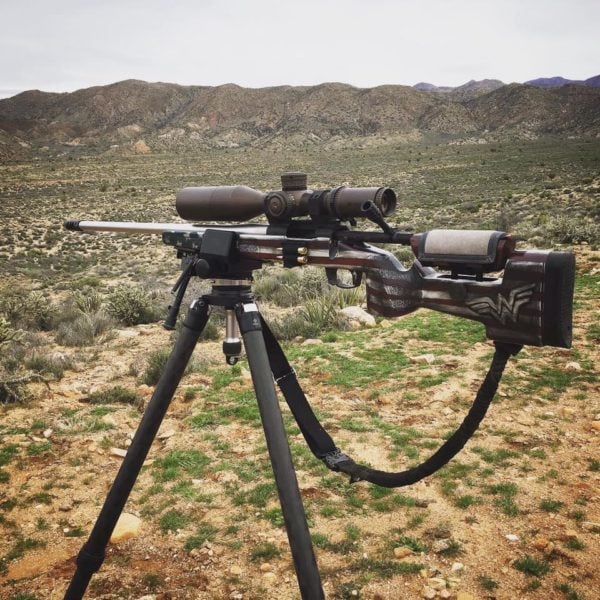
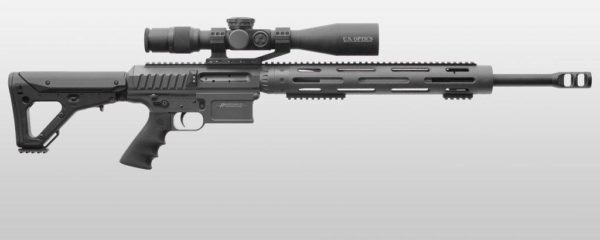
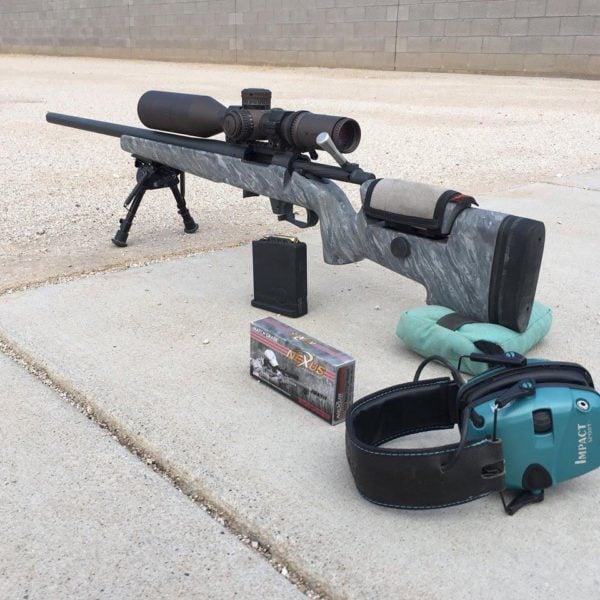
The Bolt Gun Series uses, unsurprisingly, bolt action rifles. Most people shoot in the Open division, where almost everything goes as long as the caliber isn’t larger than .30 and the rifle doesn’t throw bullets faster than 3,200 feet per second. These days, that generally means one of the 6mm or 6.5mm cartridges like 6×47 Lapua, 6XC, 6mm Creedmoor, 6.5×47 Lapua, or 6.5 Creedmoor. Regina Milkovich’s “Wonder Woman” bolt rifle.That’s not to say you can’t compete with less exotic calibers, though. The Tactical division only permits 7.62 NATO/.308 Remington and 5.56 NATO/.223 Remington rifles with further restrictions on bullet weight and velocity. Even more limited is the Production division, which only allows listed guns that cost less than $4,000 (half in the rifle and half in the optic) and that remain in factory configuration, so long as they are able to safely engage the targets in a match.If you’d like to shoot an AR variant or another semi-automatic rifle, then you’d compete in the Gas Gun Series. It has the same Open division but splits Tactical into Tactical Light (for 5.56 NATO/.223 Remington calibers) and Tactical Heavy (7.62 NATO/.308 Winchester calibers) while dropping the Production division entirely. The first PRS Gas Gun Series match was won with a JP Rifles LRP-07 similar to this one.Scoring for the Bolt Gun Series is a points system based on the number of targets you have successfully hit during the match, often under time or round limits for various stages. For the Gas Gun Series, your final score is determined by the amount of time it takes you to shoot at all of the targets, plus penalties for things like missing targets or not following the proper stage procedure. Not all PRS matches are part of the championship points series though. Local clubs can also shoot under PRS rules, and they’re probably a better place to start. They, and their schedules can be found under the Club Series page of the PRS website, where matches all over the country are listed.And really, that’s all you need to know and pick up before your first PRS match. Don’t believe me? I asked Regina Milkovitch, one of the top PRS shooters in the country, what she thinks you should know to jump into the world of precision rifle.
Expert Advice for the New PRS Shooter
First off, don’t wait. Your hunting rifle or your AR-15 is probably just fine for your first match. Still not sure? Contact the folks who run a match local to you and they can talk you through your equipment and maybe even lend you what you need to start. Like every other shooting sport, almost every seasoned competitor is friendly and loves to mentor new shooters who show a genuine interest in learning.In fact, it’s a good idea to not get too wrapped up in gear as you get into the sport. While there are all sorts of gizmos that you can buy, at the end of the day it’s about your ability to shoot and not your ability to spend money. You don’t need much to play in precision rifle – this .223 setup is plenty. PC: Regina MilkovichFinally, if you’re worried about calibers, you can definitely shoot PRS with .223 or .308. As you saw above, there are even divisions geared specifically for those calibers so you can be competitive. More importantly, high-quality commercial ammunition is readily available so you don’t have to reload, and the rifles you would use can be more affordable. The 6mm and 6.5mm calibers are popular and while off-the-shelf rifles and ammunition are becoming available, those rounds will still put a lot of wear and tear into your gun. Remember from our precision AR-15 round-up how the heart of the rifle is its barrel? Depending on several factors, a 6.5 Creedmoor you’ll need a new one after about 2,500 rounds with a 6mm or 6.5mm caliber. However, .223 can last into the 10,000 round range and .308 lasts about 7,000 rounds.
The Shopping List
If you don’t already have a rifle or want to go shopping anyway, here’s what Regina recommends:
A scope that goes to at least 10x magnification. While a 3-9x variable optic would work, a little more is better at the distances that PRS goes out to. It should also have turrets that can be turned to dial in elevation and windage, as well as a milling or holdover reticle that is not just a straight crosshair. A mil-dot reticle matched up to turrets that move in decimal points of milliradians is ideal, but an MOA reticle with turrets that click along in fractions of MOA works too. Just avoid mixing mil with MOA. Confused? Check out our guide to choosing a rifle scope.
A data book so that you can write down notes about what you did to make successful hits on target, information about the match, and anything else that comes to mind. There are specialized databooks you can buy, or you can just pick up a small, regular notebook.
A rear bag to help stabilize your rifle while shooting – something like the Wiebad Mini Tac Pad ($72) or Berry Bag($34), for instance, or the Rifles Only Rear Bag ($25).
A close-up of a Rifles Only Rear Bag in action. PC: Regina Milkovich
Some sort of ballistics app for your cell phone to help you calculate bullet trajectory for those long-distance targets. Regina likes GeoBallistics, followed by Shooter, and they’re both available for both iPhones and Android devices.
Want some words of wisdom from someone who really knows their stuff? Check out the Long Range Shooting Handbook.
Shooter Ready?
That’s it! You’ve got everything you need to try out the sport of precision rifle, so get out there and give it a shot. Do you still have questions about precision rifles? Do you have advice for beginners or want to share how your first competition went? And check out more of our favorite guns & gear in Editor’s Picks.