





A Picture From History: The Battle of Waterloo
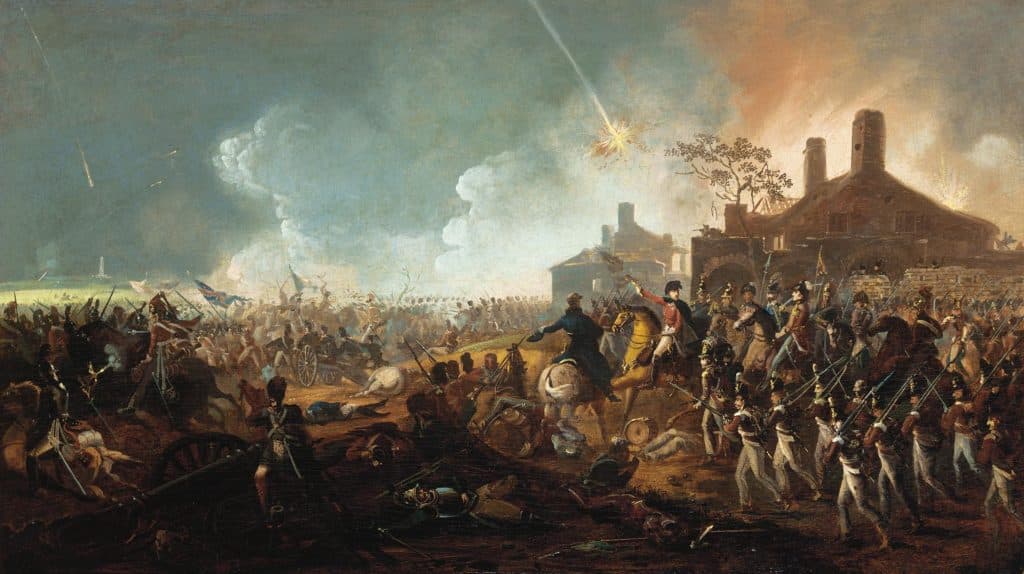
We take a look at Napoleon's famous last battle at Waterloo and the events that ultimately lead to his defeat.

Locksmith. Outdoorsman. Author of 3 books on survival & prepping
We review products independently. When you buy through links on our site, we may earn a commission to help support our testing. Learn more.
Napoleon Bonaparte had miraculously escaped from the island prison of Elba, somehow raised a new French army, and was awaiting the full weight of the allied hammer to fall upon his men.

The British, Austrians, Prussians, and Russians had all vowed to commit 150,000 men to face Napoleon, hoping to get rid of him forever.
A Series of Mistakes
At that moment, 794,000 allied forces were preparing to head his way. And Napoleon? His army stood at 160,000 men.

Napoleon knew the allied forces were coming but didn’t know where. He had to disperse almost half of his total army along the border.
He wasn’t just going to wait for the allies to come and smash him like a roach, however. No, he would take the fight to them, starting by destroying their communications lines at Mont St. Jean in Belgium.

However, some of his men set out to destroy these plans.
Deserters from Napoleon’s forces made their way to the allied forces to tell them where the French were heading, their battle plans, numbers – everything.
Preparing for Battle
With 72,000 men, Napoleon set off, making short work of the Prussian forces at Ligny. But then something happened.

Rumors began to circulate that there was an enemy force behind the French troops.
The left wing of the French began to maneuver to counter this new enemy, which allowed the Prussians under Gebhard von Blucher the time they needed to launch a heavy attack.

Just who were these enemies in the rear? Misidentified Frenchmen.
Two days later, Napoleon was preparing to advance further. But rain, unlike anything he had ever seen, was falling.

With his favorite strategy being entrapment, Napoleon knew that the mud would keep his artillery and cavalry from being able to flank anyone.
But he couldn’t control the weather, and so he waited. By midday, he had decided he would wait no longer, but this time has given the allies all the time they needed to regroup.
His enemy, the Duke of Wellington, placed his men in the natural undulations of the ground so that they could seemingly spring out of the earth.

He had also occupied two stone buildings in the area and had reinforcements en route; he was ready as he would ever be.
The Final Showdown
The ensuing battle in the muck was fierce.
Napoleon could not break through the Duke’s forces. French commanders repeatedly made blunders, expending men on tactically worthless positions, assaulting strong points, and underestimating their own strength.
This would spell his final defeat. For Napoleon, this was Waterloo.
Want to read more? Check out Bernard Cornwell’s Waterloo.
This is a new style of article for Pew Pew Tactical, if you liked it — let us know in the comments! If you didn’t enjoy it…well phooey. To catch up on previous Pictures from History, click on over to our History Category.